
Published on by Olivier Maupas-Sehikyan · Rings
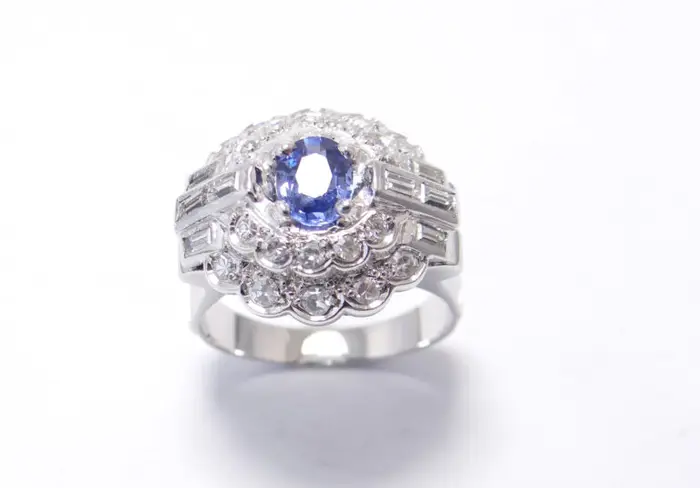
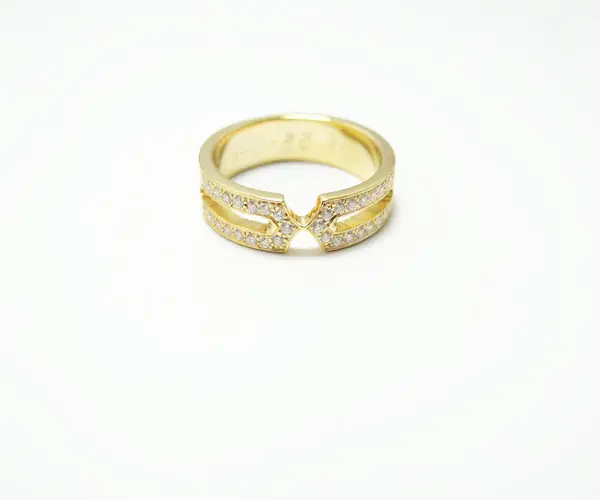
Some pieces of jewellery come into the workshop the way one walks into a doctor's surgery: a little reserved, a little shy, with the feeling of having waited too long. The one I am telling you about today was among them. A ring from the early twentieth century, in platinum, set with pavé diamonds, and above all robbed of its heart. Its centre stone had vanished over the years, leaving a gap that no one could fail to notice.
A client, a family ring and a gap to be filled
The client who entrusted it to me was not looking for a new piece of jewellery. She wanted to preserve a family heirloom, which is not at all the same request. She placed the box on my bench, opened it carefully, and simply told me that she could no longer bear to see this ring sleeping in a drawer with a hole in the middle.
I took up my loupe. The geometric lines, the rigour of the volumes, the pavé of diamonds running across the platinum: everything spoke of the elegance of Art Deco, an era in which designers drew as much with the set square as with the heart. A piece like this cannot simply be patched up. It must be restored, with respect, seeking to understand what its maker intended. I promised her that I would return this Art Deco ring to its original splendour, without betraying it.
Choosing a Ceylon sapphire to replace the missing stone
It all began with a long search. Replacing a centre stone is not a purchase: it is an investigation. I needed a colour able to stand up to the platinum and the diamonds, a presence that would not overwhelm the rest but would give it back its centre of gravity.
After looking at many stones, I settled on a Ceylon sapphire. It was no coincidence. These sapphires are renowned for the depth of their blue and for their clarity, and that is exactly what this ring called for. When I placed the stone on the empty bezel to judge the effect before deciding, I knew it was the right one. The blue answered the white of the diamonds as a low note answers a clear melody.
I showed it to my client. She did not hesitate for long. Sometimes the right stone is recognised by that very silence, just before one says yes.
Rebuilding the claws: precision in the service of security
Setting a sapphire was not enough. A successful restoration also lies in what one does not notice at first glance. The claws, for instance. These small metal supports that hold the stones in place wear down, grow thinner, tire. On a ring this old, they deserved better than simply being straightened.
So I set about rebuilding the claws, one by one. The work demands extreme precision, because they must fulfil two missions at once: guaranteeing the security of each precious stone, and blending into the original design. Too thick, and they would have weighed down the whole piece. Too fine, and they would not have done their job. One has to find the happy medium, the one the original jeweller had no doubt found too, a very long time ago.
A complete examination of the setting, diamond by diamond
There remained a step that might seem thankless, but which I consider the most important of all: checking the setting of the diamonds. In a pavé, every stone depends on its neighbours. Let a single one move, and the whole balance may eventually give way.
So I checked them one after another, the small and the large, under the loupe, with my tools. Some were perfectly secure. Others needed to be tightened. Nothing here is done in haste: each diamond demands an attention of its own. It is slow, almost meditative work, during which the workshop falls silent and one hears only the faint sound of the metal being worked.
Polishing brought the work to a close. The platinum recovered its white lustre, soft and deep, without ever losing that discreet patina which is also part of the charm of an antique ring. For the aim was not to make it new, but to make it alive.
A family ring that finds its place again
On the day I handed it back, I confess I was a little nervous. However certain one is that the work is right, one always awaits the gaze of the person for whom it was made. My client took the ring, tilted it towards the light from the window, and the Ceylon sapphire did what I had hoped: it caught the daylight, then gave it back, deep and luminous, in the midst of the diamonds.
That moment remains my finest reward. Seeing this piece from a bygone era recover its former glory, enriched by a stone that suited it as though it had always been there, moved me deeply. This Art Deco ring restoration also allowed me to delve into the history of the jewellery of those years, and to measure, once again, the finesse of those who came before me.
It strengthened a conviction in me: a piece of jewellery, whatever its history, deserves a second chance to shine. And when it belongs to a family, that second chance concerns not only the metal and the stones, but also all the memories they carry.
If you, too, have a damaged or incomplete ring waiting in a drawer, come and show it to me at the workshop in Saint-Sébastien-sur-Loire, near Nantes. We shall take the time to talk about it, to look at what it has to say and to see together what can be restored to it.