Published on by Olivier Maupas-Sehikyan · Wedding Bands
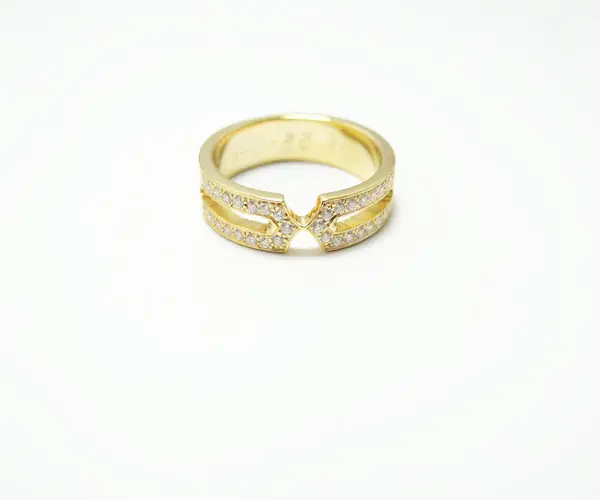
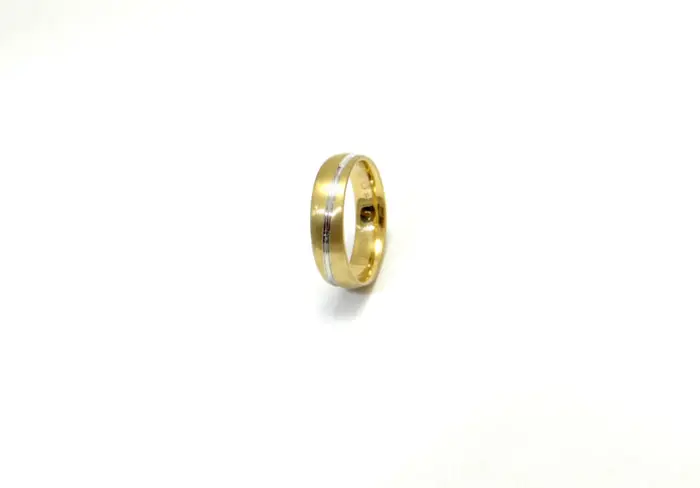
Some days in the workshop begin like any other, with the bench, the morning light and the sound of the file, then change pace the moment the door opens. That day, a couple walked into my workshop in Saint-Sébastien-sur-Loire, near Nantes. They had an idea that was still unformed and a very clear wish: an 18-carat gold wedding band for a woman, conceived as a unique piece and not as a catalogue model.
The meeting: entrusting me with their vision of a bespoke wedding band
With me, the story always begins the same way. I put down the sketchbook, pour a coffee and let them talk. I do not start by asking about budget or style. I ask what this wedding band should say, how it will be worn, what it should evoke when it is looked at in twenty years' time.
It is in this conversation, often hesitant at first, that the most intimate wishes take shape. There are the words people say, and those that surface between two sentences: a glance exchanged, a smile held back, a hand reaching for another. I listen to all of it. The first pencil strokes are born at this moment, sometimes before the conversation has even ended.
For this couple, one thing quickly became clear: the band had to have light, without ever becoming ostentatious. A fine, lively ring that accompanies everyday life and, with a simple movement of the wrist, catches a glint.
Why 18-carat gold for a wedding band
The choice of metal came naturally. 18-carat gold offers a very fine balance: rich enough to keep its warmth and brilliance, strong enough to withstand daily wear. A wedding band is worn without interruption; it works, it rubs, it ages with the person who wears it. It needs a metal that keeps its promise over time.
I set out several samples before them so that they could see the nuance of the gold under the workshop lighting, then in daylight by the window. A metal cannot be judged from a photograph. It must be looked at, touched, tried on the skin. That moment matters greatly: it is often there that the decision is made, in a silence full of certainty.
The drawing, then the wax
Once we had agreed the sketch together, I sculpted the model in wax. This stage is close to my heart, because it gives the piece its first volume. You can hold it, turn it, check the thickness of the band and the inner curve that will have to fit the finger. I correct, I refine, sometimes I start again. Wax forgives what metal will not.
Next comes casting: the model is transformed into gold, by heat, in an ancient gesture that I never tire of watching. When the ring comes out of its mould, it is still raw, dark, slightly matt. Everything remains to be revealed. I then take it up again with the file, at the bench, with the precision to the millimetre without which a wedding band could never be comfortable.
The diamond wedding band in grain setting: the most delicate step
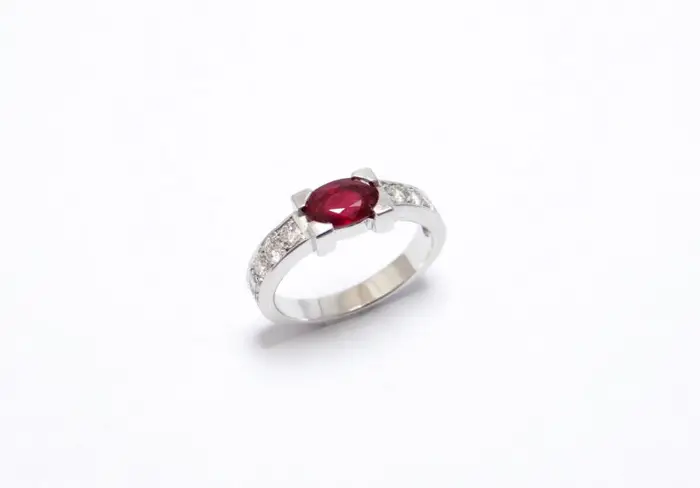
For this band, we had chosen diamonds placed in a grain setting. It is a technique that demands patience and a sure eye. Each stone is seated in a recess cut into the gold itself, then held by tiny beads of metal, raised one by one with the graver. Nothing is automatic; everything is a matter of the hand.
The result depends on very little: diamonds that seem to float in the gold, with no imposing claws, aligned with a regularity that cannot be seen but can be felt. To my mind, it is a small constellation. Each stone catches the light in turn, and the whole sparkles discreetly when the hand moves.
This work is done under the loupe, in calm, sometimes holding my breath. One badly seated stone, and the whole alignment loses its grace. So I proceed slowly, checking each bead before moving on to the next. A jeweller learns very early that haste has no place in setting.
Polishing, the last breath of light
Then comes the polishing. The ring is polished in stages, with ever finer abrasives, until the surface becomes a mirror. The inside is treated with the same care as the outside, because it is the inside that will touch the skin. Then I check every stone, every edge, every transition of light. Only when I am satisfied do I place the band in its case.
The handover of the wedding band: a moment I never forget
When the couple returned to the workshop, I made no speech. I placed the case on the bench, opened it and stepped back a little. That is my way of leaving room for emotion. There was a silence, then a breath, then that smile one recognises at once: the smile of someone who finds, in an object, what they had imagined without daring to say it.
The band slid onto the finger gently. It was in its place, as if it had always been there. Seeing this, after the sketches, the wax, the casting and the setting, is the finest reward of my craft. A piece of jewellery takes on its meaning at that precise instant, when it ceases to be my work and becomes their story.
I deeply believe that a bespoke wedding band is earned through listening as much as through craftsmanship. The metal and the diamonds are the materials, but the essential lies in the trust a couple places in the person who will translate their feelings into gold.
Let us talk about your wedding band, at the workshop
If you dream of an 18-carat gold wedding band for a woman, with or without diamonds, you are most welcome in my workshop in Saint-Sébastien-sur-Loire, near Nantes. Come with an idea, a wish, or simply a few words about what you feel. We will take the time to talk it over with a coffee, without obligation, and we will see together what your story wants to become.