
Published on by Olivier Maupas-Sehikyan · Rings
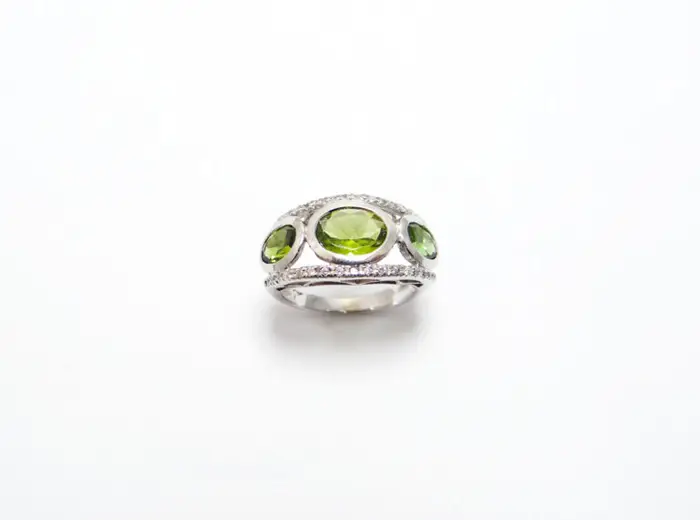
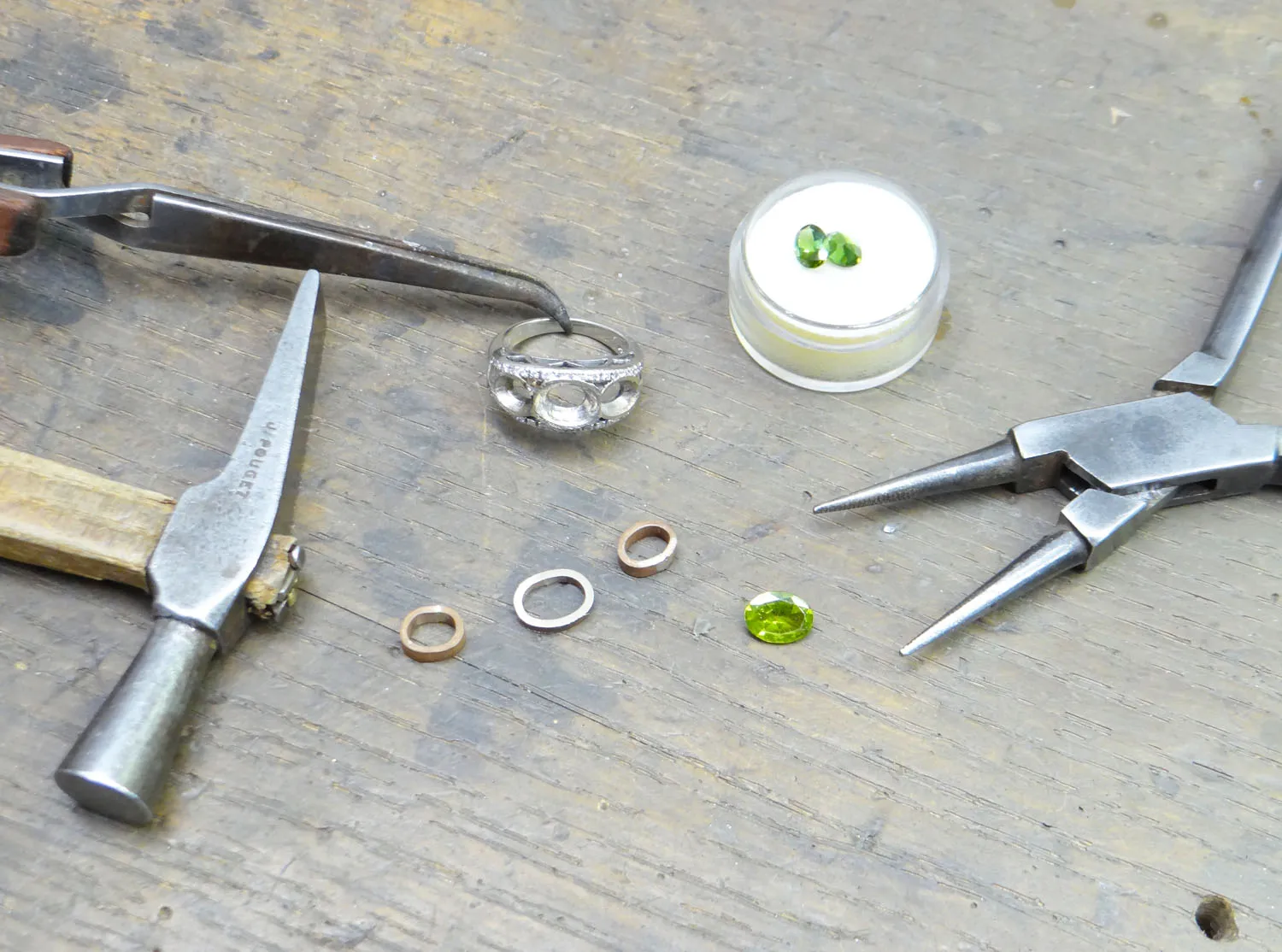
When I opened my jewellery workshop in Saint-Sébastien-sur-Loire, near Nantes, I made myself a promise: never to look at a piece of jewellery as a mere object. Each one carries a story, and some carry it right into their metal. Not long ago, a client walked in with an antique ring, three of whose stones were broken. She did not simply want it repaired. She wanted to give it a second life, and I accepted the challenge with genuine pleasure.
An antique ring with three broken stones
She placed the ring on my workbench and we took the time to talk, long before talking technique. What I understood at once was that this piece mattered to her. A simple restoration would not have been enough for what she hoped for: she was looking for a green tourmaline ring that would keep the spirit of the original piece while giving it a fresh lease of life.
Before making any decision, I examined the ring from every angle, under the loupe and then between my fingers. The metal showed signs of wear, the mount had lost its firmness, and the stones, quite plainly, had seen happier days. An antique ring restoration always begins this way: with patient observation, rushing nothing. A piece of jewellery that has lived deserves to be listened to before it is touched.
Added gold to restore strength to the mount
Gold is a noble metal, but it is not invincible. With wear, it thins in the places where it rubs, where the hand works, where the ring knocks against a table or a door handle. Setting new stones in tired metal would have been a mistake, and I would not have been proud of work that would not stand the test of time.
So I explained to my client what I wished to do: add gold to strengthen the structure. With her agreement, I reworked the gold mount in its weakest areas. This addition is discreet, almost invisible once the work is complete, but it is essential. It guarantees the longevity of the piece and prepares the ground for what follows. Each repair was adjusted by hand, then smoothed, so that the new metal blends into the old as though it had always been there.
Green tourmalines, a new light
Then came the question of the stones. My client had entrusted me with green tourmalines, of a vivid, luminous green, which she wished to see take the place of the broken stones. I studied them at length, under different lighting, to understand how they would converse with the gold of the ring.
Green tourmaline has soothing shades, ranging from soft green to a deeper tone, and it returns light in a quite singular way. Set against warm gold, it takes on a depth that few stones offer. I was certain they would elevate the ring, and that this choice would give the antique piece a more contemporary allure without betraying it.
Each seat then had to be adapted to the size and shape of the stone it was to receive. This is precision work, where a few tenths of a millimetre make all the difference between a stone that holds and one that wobbles.
The bezel setting to protect each stone
The bezel setting chose itself. This technique consists of surrounding the stone entirely with a fine rampart of metal, which holds and protects it on every side. Nothing protrudes, nothing catches. For a piece worn every day, this is real security: the knocks of daily life are absorbed by the gold rather than by the stone.
This setting is also a pleasure to look at. The metal draws a crisp edge around each tourmaline, which emphasises its colour as a frame sets off a painting. I closed it gently, stone after stone, checking at each stage that the tension was just right. Then came the polishing: a long finishing process, made of slow gestures, until the gold regained its lustre and the bezel setting seemed to flow around the stones.
This transformation took time, as each stage demanded meticulous attention. I never sought to hurry it. A piece of this kind cannot be rushed.
A transformed ring, returned with emotion
On the day of the handover, I placed the ring in front of my client and watched her face rather than the jewel. She lit up. That moment, I say it plainly, remains my greatest reward. She left with far more than a repaired piece of jewellery: a modernised ring, enhanced by its green tourmalines, strengthened by the gold and secured by its bezel setting.
For me, as a jeweller, giving a piece of jewellery a new life is always a privilege. It is the heart of jewellery transformation: respecting what has been, then writing what comes next with the person who will wear it.
If you have an antique ring at home, damaged or simply asleep in a drawer, you are most welcome at my workshop in Saint-Sébastien-sur-Loire, near Nantes. Bring it in, tell me what it means to you, and together we shall see what can be made of it.