
Published on by Olivier Maupas-Sehikyan · Rings
A young jeweller's dream, now a ring
When I began my career, I carried within me a rather stubborn image. That of a piece that would unite elegance and brilliance without either one taking precedence over the other. I did not yet know what it would look like. I only knew that it would exist one day, somewhere between my workbench and my imagination.
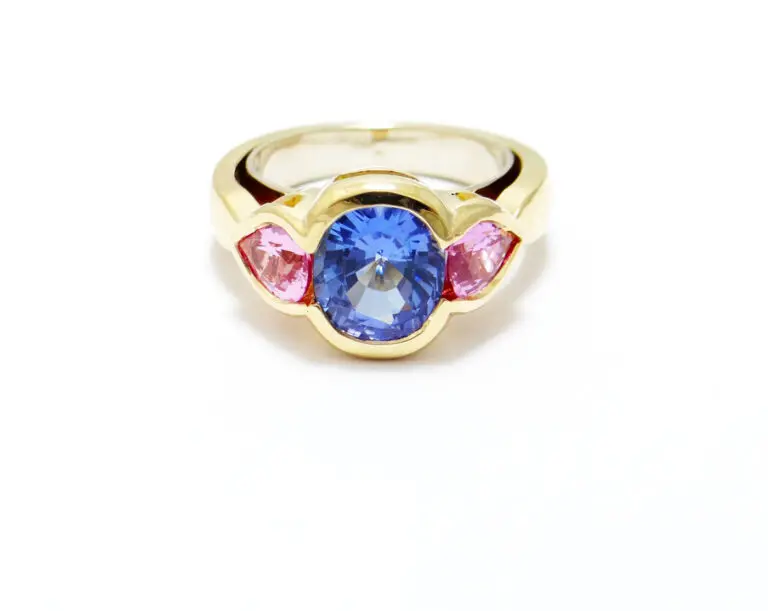
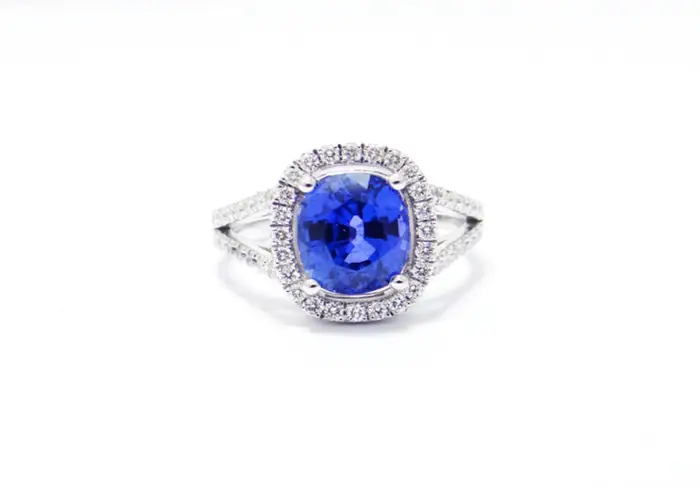
That day has come. In my workshop in Saint-Sébastien-sur-Loire, near Nantes, I have made a cushion-cut Ceylon sapphire ring surrounded by diamonds, mounted in 18-carat white gold. No commission drove me to it this time. I made the request to myself, and I took it very seriously. Let me put it simply: it is the ring I have long wanted to see exist.
I tell you its story here as I would that of any piece of jewellery to leave the workshop, with its choices, its hesitations and what it made me feel.
A cushion-cut Ceylon sapphire of deep blue
Everything began with the stone. A royal blue sapphire, cushion cut, of 3 carats. When I set it down on my work surface, under the light, I felt as though I were looking at a piece of night. The blue is dense, velvety, almost liquid. To me it evokes the great depths of the ocean and then, if you tilt the stone, a starry sky just before dawn.
The cushion cut is no accident. Its softened corners and generous facets give the stone a bearing that is both antique and alive. It does not seek the hardness of straight lines. It lets the colour spread and breathe, and it catches the light with a softness that I love endlessly.
I admit it openly: every time I look at this Ceylon sapphire, my mind drifts somewhere else. In a trade where one handles stones all day long, that does not happen with all of them. This one stopped me in my tracks, and that is often the best sign I can receive before beginning a piece of jewellery.
The diamond pavé, to make the blue sing
A large sapphire on its own is already beautiful. But I wanted it to be surrounded, supported, shown to its best advantage. So I imagined a diamond pavé that frames it and extends it, forming a sparkling band along the shank.
Choosing the diamonds took me some time. Each one was selected with care to answer the central stone: the same whiteness, the same liveliness, not a single discordant note. I compared them, set them aside, took them up again, until the whole formed a harmonious chorus. One dull diamond in the row and the entire play of light is blurred.
The contrast is what pleases me most. The bright white of the diamonds brings out the depth of the blue, and the blue, in turn, gives the diamonds greater intensity. They light one another. One can no longer quite tell which enhances the other, and that is exactly the effect I was after.
Why 18-carat white gold
For the mount, I chose 18-carat white gold. Its pale, luminous tone takes nothing from the sapphire or the diamonds; it recedes behind them while holding them securely. 18-carat gold also offers the strength needed to set a stone of this importance and to wear the ring every day without worry.
From drawing to polishing: creating it in the workshop
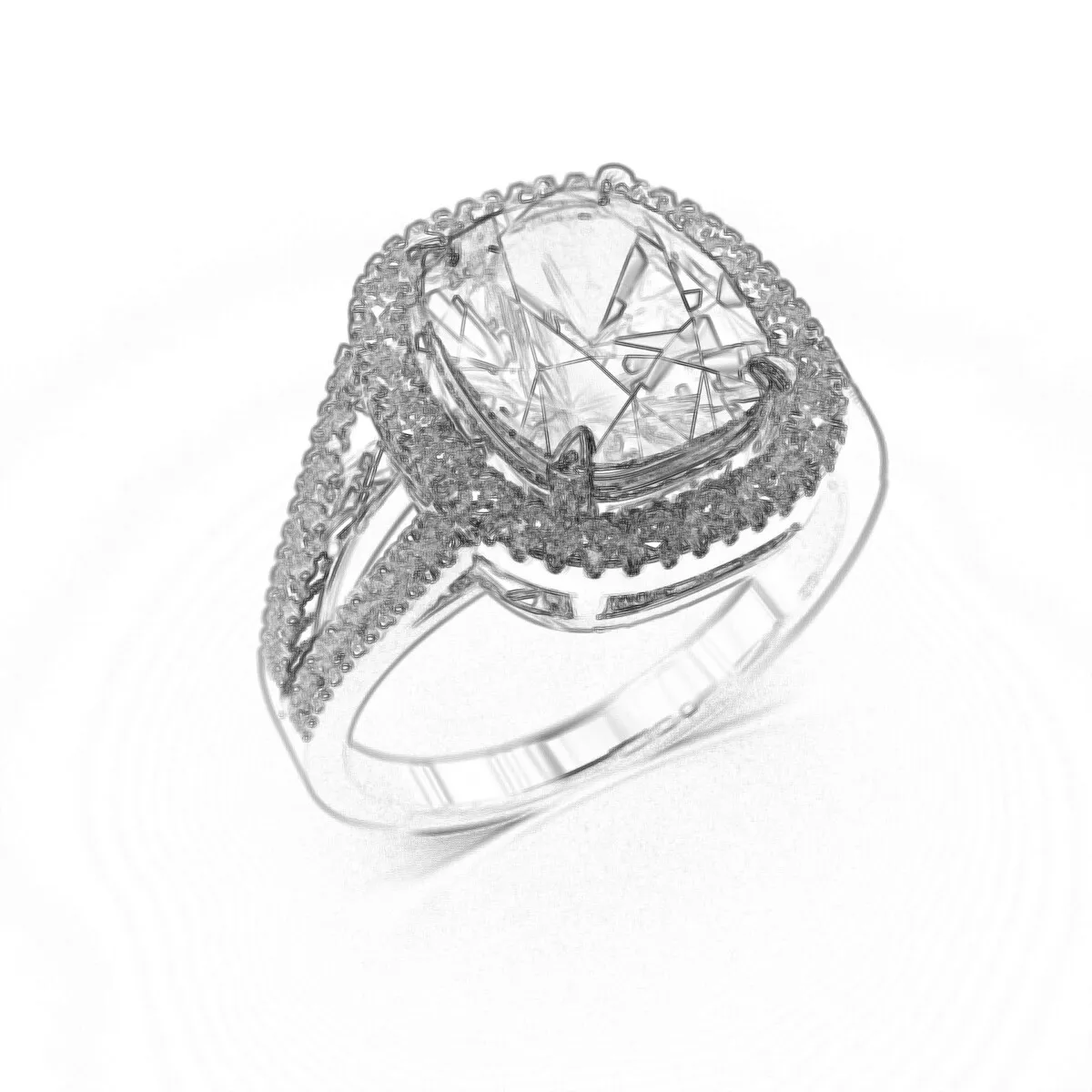
As with every bespoke ring in Nantes that leaves my hands, everything begins with the pencil. I drew the ring several times, seeking the right proportion between the central stone, its surround and the slenderness of the band. A line too heavy and the sapphire is smothered. A line too fine and it lacks a foundation.
Next comes the wax. I work it by hand to sculpt the exact volume of the mount, the claws, the seatings for the diamonds. It is a stage I enjoy because it still allows me to correct, to rework, to adjust with a stroke of the blade. Once the form is approved, the wax is turned into metal by casting, and the white gold then takes on its final existence.
Then comes the most delicate moment: the setting. Each stone is placed in its seating, held by tiny claws that are closed with great care. The sapphire first, with all the slowness that a fine stone demands. Then the diamonds, one by one, aligned with patience. Here, one does not hurry. A gesture made wrongly cannot be undone.
Finally, the polishing. The metal is refined, smoothed and brought to life until the ring has not a single rough edge and the light glides everywhere without meeting an obstacle. I set the ring down, looked at it for a long time, and knew that I held at last the piece I had dreamed of since my beginnings.
A ring waiting for its finger
I am proud of this creation, and I will not hide it. For me it marks a milestone: the point at which one feels that the hand has caught up with the idea. From the sapphire to the band of diamonds, every element carries my passion for jewellery and the exacting standards I set myself at the bench.
And yet a piece of jewellery only truly lives when it is worn. I am convinced that this ring will one day find its place on the finger of someone who loves fine jewellery, who will know how to read the blue of the sapphire and feel what lies behind it. For me, it is far more than a ring. It sums up what it means to be a jeweller.
A successful piece of jewellery is a stone that speaks and a setting that knows how to stay silent.
If you too carry the idea of a ring with a sapphire, diamonds and a carefully chosen metal, come and talk to me about it at the workshop in Saint-Sébastien-sur-Loire, near Nantes. We will take the time to look at stones, to draw together and to see what your story can become in the hands of a jeweller.