
Published on by Olivier Maupas-Sehikyan · Signet rings
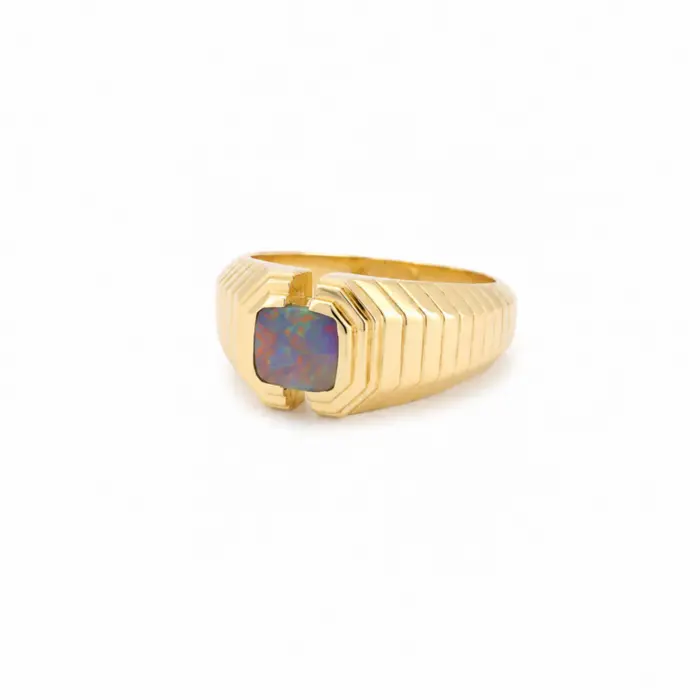
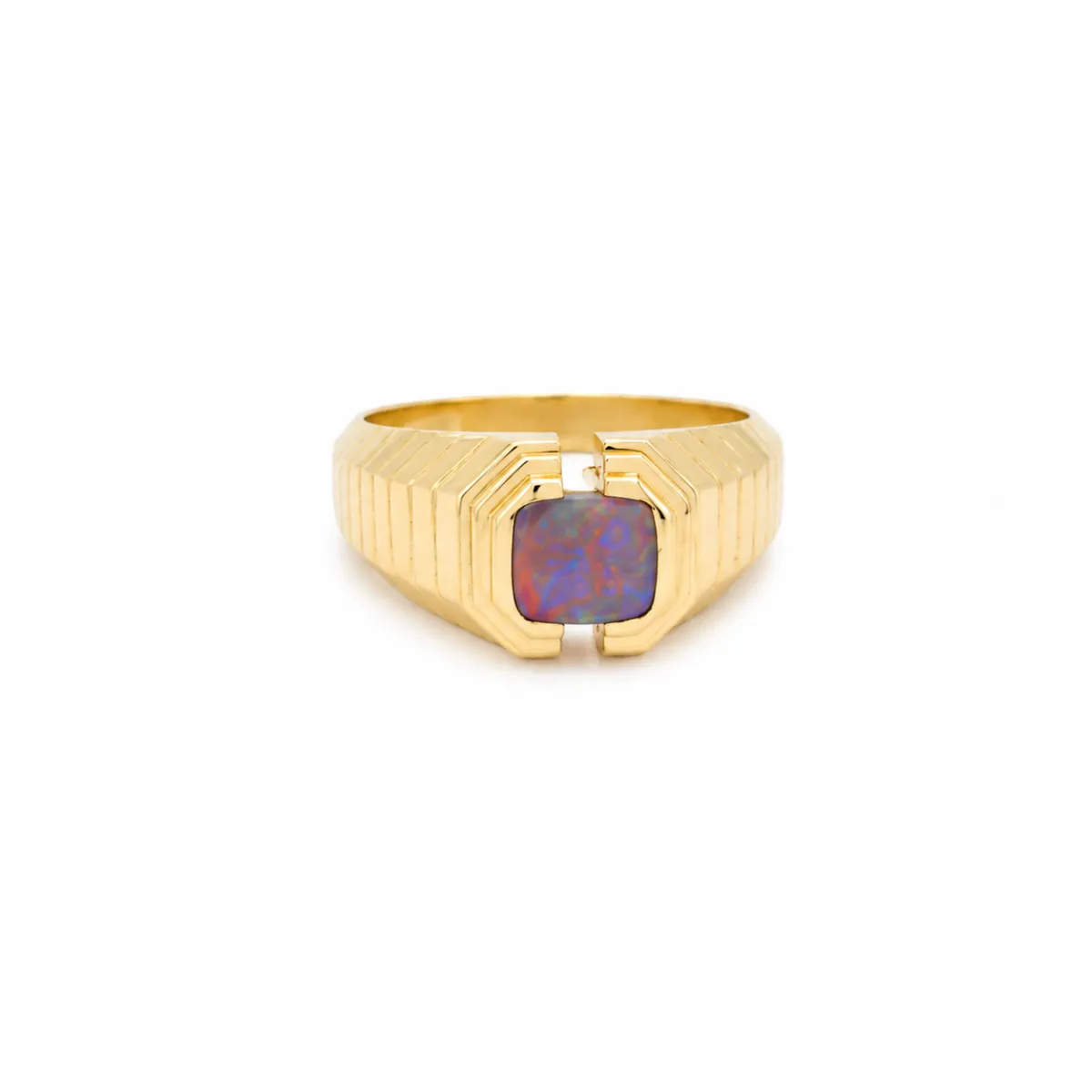
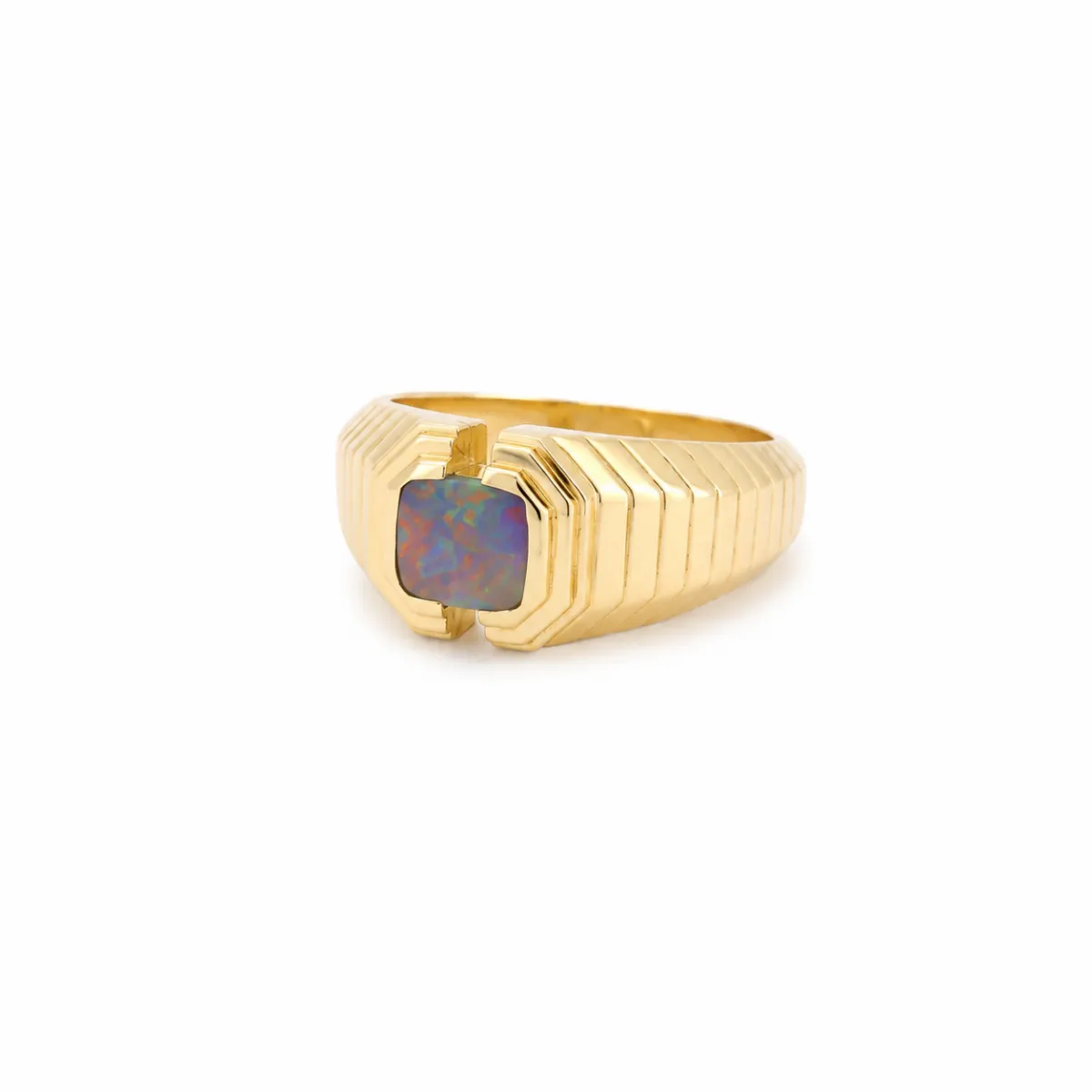
Some pieces leave the workshop carrying a story far heavier than their weight in gold. This men's yellow gold signet ring, set with an Australian opal in a closed setting, is one of them. I made it entirely by hand in Saint-Sébastien-sur-Loire, just south of Nantes, for a client who wanted to wear his journey on his finger. Here is how it came to life.
A bespoke men's signet ring, born of a journey to Australia
It all began the day a client pushed open the door of my workshop, a small velvet pouch in his hand. He had just returned from a long journey through Australia, where he had crossed the red desert at the heart of the country. He opened the pouch in front of me. Inside lay an opal with striking play of colour, which he had chosen himself from a miner in Coober Pedy.
His idea was clear. He wanted to set this stone in a signet ring that he would wear every day, a piece of jewellery that would hold together the memory of the journey, the encounter with the miner and his fascination with Australian geology. I sensed it within the first few minutes: he was not looking for a mere object, he was looking for a witness.
We talked at length. Overly smooth designs left him cold. He wanted character, a strong graphic quality, a confident presence without ostentation. When I suggested a stepped motif on the shoulders, a series of parallel grooves arranged in tiers, his eyes lit up. This design recalls the codes of Art Deco, but also, for him, the terraces dug into the hillside in the opal mines.
I took out my notebook and drew several sketches. Only one eventually won out: the opal nestled at the centre of a raised rectangular plateau, framed by two shoulders each bearing five parallel grooves. The body of the ring would remain thick and sculptural, so that this bespoke signet ring would keep an unmistakably masculine presence. The project was approved.
The Australian opal and the stepped motif: two memories in a single piece
A living stone, beautiful and fragile
Before touching the metal, I always take the time to get to know the stone properly. The Australian opal is made of hydrated silica, and its name comes from the Sanskrit upala, "precious stone". It can contain up to 21% water in its structure. This singularity gives it its brilliance, but also its sensitivity.
Its play of colour, known as opalescence, arises from tiny spheres of silica that diffract the light. They bring forth flashes of blue, green, red and orange that seem to dance with every movement of the wrist. The more regular these spheres, the richer the spectrum.
Australia supplies around 75% of the world's gemstones. Lightning Ridge is known for its black opals, the rarest of all, and Coober Pedy for its white opals with vivid colours. It was in Coober Pedy that my client found his, in a mining town born around the deposits, where the successive terraces resemble vast staircases cut into the rock.
With a hardness of 5.5 to 6.5 on the Mohs scale, opal is wary of knocks, sudden changes in temperature and chemicals. For a piece worn every day, a closed setting was the obvious choice: a fine band of gold surrounds the entire stone and protects it on every side.
A motif that travels between two worlds
The stepped motif, for its part, belongs to the history of jewellery. It is one of the signatures of the Art Deco of the 1920s and 1930s, when it evoked the silhouettes of New York's skyscrapers. On this signet ring, it carries two references at once: modernist architecture and the Australian mining landscapes.
As for the 18-carat yellow gold, an alloy of 75% pure gold, copper and silver, it offers an almost solar warmth. It brings out the orange and red flashes of the opal, and recalls the overwhelming light of the desert.
Making the yellow gold signet ring in my workshop in Saint-Sébastien-sur-Loire
Then came the work at the bench. Everything was made here, by hand, in my jewellery workshop in Saint-Sébastien-sur-Loire, near Nantes.
I began by melting the 18-carat yellow gold. The metal was heated to around 1,064 °C, its melting point, purified with borax and then poured into an ingot. I then rolled it into a thick sheet and drew it through the draw bench to obtain the sections required.
The rectangular plateau was cut with a piercing saw, to the dimensions agreed with my client. The shank, shaped separately from thick gold wire, was bent on a ring mandrel to fit his finger size exactly. I then soldered the plateau to the shank with a flame, using a compatible 18-carat gold solder.
Next came the stage I love most: the stepped motif. With a chisel and hammer, I traced each groove of the shoulders by hand. Every line was incised with millimetre precision, in a steady rhythm. This work demands total concentration, because a deviation of a tenth of a millimetre would be enough to break the harmony. The five grooves on each shoulder were made as mirror images, and depending on the angle of the light, they create shadows and reflections that give the ring depth.
I then built the opal's mount from a fine band of gold, bent to fit the perimeter of the stone exactly. During the setting, I lowered the opal into its seat with the utmost care, then pressed the gold band down around its edge with a pusher, using gentle, gradual pressure. A sudden movement could have caused an invisible crack: here, there is no hurrying.
Finally, I sanded the signet ring and ran a needle file along every edge of the motif. Polishing with felt and cotton did the rest. The mirror finish revealed all the warmth of the gold and the magic of the stone's colours.
When the journey became a piece of jewellery
On the day of delivery, my client slipped the signet ring onto his finger. He said almost nothing. He turned his hand towards the light, watched the opal ignite, and his smile told the whole story. He was no longer simply bringing back a stone: he now wore his journey, the red desert and the miner's handshake.
It is for moments like these that I do this work. If you too are keeping a stone brought back from a journey, or the memory of a place that left its mark on you, come and talk to me at my workshop in Saint-Sébastien-sur-Loire, near Nantes. We will take the time to look at the stone, leaf through a sketchbook, and imagine together the piece that will be truly yours.