
Published on by Olivier Maupas-Sehikyan · Signet rings
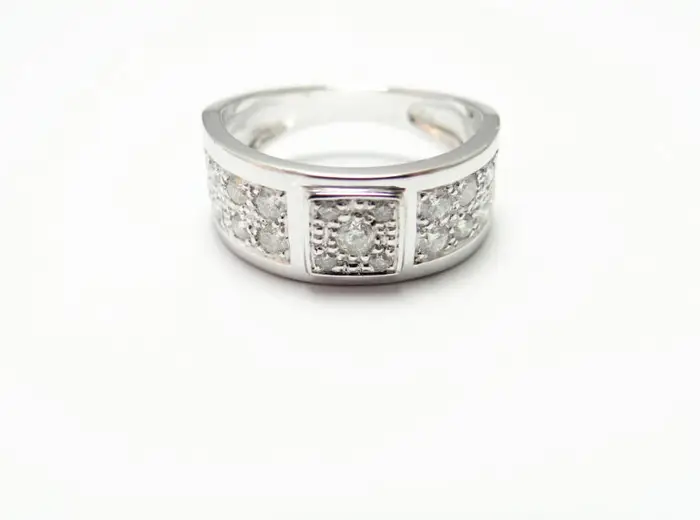
Some commissions arrive with a sketch, others with a single sentence. This one came down to very few words: a client wanted a bespoke white gold and diamond signet ring, a piece that would belong to him alone. I remember putting down my pencil and replying: "Then let us begin by listening to you." What I am about to tell you here is the birth of this ring, from the first sketch to the moment it left the workshop.
An 18-carat white gold signet ring: a client's request
In my workshop in Saint-Sébastien-sur-Loire, near Nantes, conversation always comes before drawing. My client was not looking for a shop-window piece. He wanted an 18-carat white gold signet ring, present enough to be noticed, and exact enough to become, over time, a second skin. We talked about the width of his finger, the shape of the face, the way the ring was to be worn day to day.
A signet ring has a particular history. Long engraved with coats of arms, it has opened up to other uses: it is worn to mark a milestone, to express a taste, or quite simply for pleasure. Here, the idea was clear: white gold for its luminous restraint, and diamonds to bring life to the surface without ever weighing it down. From that very first meeting, I sensed that the project would call for precision, but also a touch of boldness.
The wax model: giving shape to the idea
Before I touch any precious metal, I work in wax. It is a stage I love deeply, because it still allows for mistakes. In a block of wax, I carved, filed and hollowed out the volume of the signet ring, seeking the right proportions between the face and the shoulders of the ring.
The model is there to be seen. You hold it between your fingers, turn it in the light, imagine the stones in place. It was tried on, adjusted, reworked. I never regard this phase as a formality: it lays the foundations of the finished piece, and every millimetre gained here spares a great deal of rework later. When the form felt right to me, and my client had approved it, the time had come to move on to the metal itself.
Lost-wax casting: when wax becomes white gold
The lost-wax casting process is a very ancient one, and yet I never tire of it. The model is encased in a refractory mould. As it is heated, the wax disappears (hence the name) and leaves behind a hollow that is a perfectly faithful copy. All that remains is to pour in the molten white gold.
There is always a moment of suspense when the mould is broken open. What will we find? This time, the piece was there, raw and a little dull, but already recognisable: the signet ring drawn a few days earlier had taken shape in 18-carat white gold. This transformation of matter still feels almost magical to me, even after years of practice.
Finishing the casting, or the art of refinement
A piece fresh from casting is never finished. The finishing work involves going over every surface, removing the marks left by the mould, refining the details and checking that the ring matches the original design exactly. It is patient work, done with file, gouge and abrasive paper. The gestures are discreet, but they decide the final quality. A signet ring with clean lines is recognised at once, and it is at this stage that it acquires them.
The setting: a pavé of diamonds across the face and the shank
Then came the most delicate stage: the setting. My client wanted a diamond pavé, set both on the face and along the body of the ring. In pavé, the stones are placed so close together that the metal almost disappears, and the surface seems to be made of light.
Each diamond has its own seat, cut to its exact measure. I adjust the height, raise the beads of metal, then fold them down one by one to hold the stone securely without forcing it. Nothing is done in haste: a single poorly seated stone would be spotted at once. During these hours of setting, the outside world fades away. All that remains is the loupe, the tool and the breathing one learns to control.
Little by little, the signet ring changed its face. The diamonds, carefully distributed, gave relief to every curve. They caught the light of the workshop, then returned it in fine flashes, without dazzling. It is exactly the effect I was after: a brilliance that follows the form rather than masking it.
Rhodium plating and polishing: the finishing touch
To finish, I applied a rhodium plating. This very fine layer of rhodium gives white gold its clear, cool lustre, and strengthens its resistance to everyday wear. Before that, a meticulous polish removed the last of the micro-scratches. Passed from hand to hand under the light, the ring then revealed its true character: bold, crisp, luminous.
I always look at a finished piece in silence for a few moments. I run back through the stages in my mind: the wax, the casting, the file, the beads that hold the stones. It is all there, in an object that fits in the palm of a hand. A technical piece of work, certainly, but for me also a true act of devotion to my craft.
The handover: a signet ring made to be worn
On the day of the handover, my client took the ring, studied it for a long while, then slipped it onto his finger. Some silences are worth more than any speech, and that was one of them. The signet ring sat exactly where it belonged, as if it had always been there. That is what I strive for every time: that a bespoke piece of jewellery should feel not like a purchase, but like a certainty.
Today, this white gold and diamond signet ring lives its own life far from the workshop, and that is just as it should be. A piece of jewellery only truly exists once it is worn, gently marked by the passing days, filled with gestures and memories.
If you dream of a signet ring, a ring or any other unique piece, I invite you to step through the door of my workshop in Saint-Sébastien-sur-Loire, near Nantes. We will take the time to talk through your idea over a coffee, and see together what it might become.