Published on by Olivier Maupas-Sehikyan · Rings
Creating a birth ring is unlike any other commission. In my workshop in Saint-Sébastien-sur-Loire, near Nantes, I work all year round on wedding bands, signet rings and repairs. But when a client walks through the door to celebrate the arrival of a child, something changes. The pace slows, and my movements become more attentive. This is a story I wanted to tell here.
A request for a bespoke birth ring
This client came to see me with a clear intention, even if the words to express it did not come to him straight away: to mark the birth of a child with a jewel that would be more than a simple gift. He wanted a piece that would keep the trace of that moment, and that could one day pass from one hand to another.
We took the time to talk. In these appointments, I ask a great many questions and draw very little, at first. What should this bespoke birth ring say? What light, what colour, what presence? Little by little, three ideas emerged: the sparkle of a life just beginning, a discreet protection around the child, and the child's first name, slipped into a place that only those closest would think to look.
By the end of the meeting, my notebook was full of sketches, and I knew this commission would stay with me for several weeks.
18-carat white gold, cubic zirconia and rubies: choosing the materials
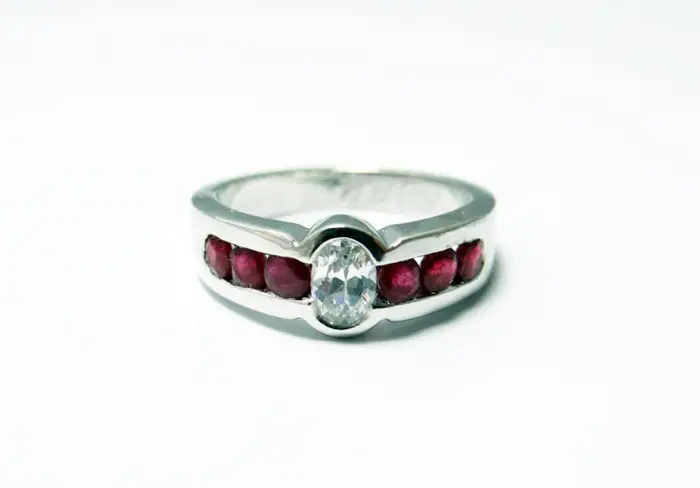
The metal is the first decision, and the most defining. I suggested 18-carat white gold, a noble metal whose brilliance remains measured. It does not seek to dominate. It acts as a setting in the truest sense, letting the stones speak, and it suits a jewel meant to last. Its luminous, almost silvery white would also sit well with what we wanted to place at the centre.
At the heart of the ring, I placed a cubic zirconia. I chose it for its brilliance and its durability: it catches every glimmer of light in the room and returns it as tiny sparks. In our project, it stood for the new clarity a child brings into a home. Its place was therefore obvious, right at the centre, facing the eye.
Around it, I planned a circle of rubies. The deep red of this stone, long associated with love and protection, brought the vivid colour the design was missing. The image is simple, which is why it moves us: the rubies surround the zirconia like watchers around a cradle.
From wax to setting: making the ring in the workshop
The design and the wax model
Once the materials were settled, I returned to my sketches to refine the proportions. The circle of rubies had to frame the zirconia without overwhelming it, the ring had to remain comfortable on the finger, and the lines had to be clean. I then carved the wax model, a stage I particularly enjoy: the material is docile, a volume can be corrected with one stroke of the blade, a balance tested, then I step back and begin again. It is here that the ring takes on its true silhouette.
Casting and setting
Once the model was approved, the wax was transformed into white gold by casting. The rough piece that emerges still requires a great deal of work: it is filed, reworked, and the seats for the stones are prepared. Then comes the most delicate moment, the setting. Each ruby must be placed at the right height, held firmly and yet without any excessive strain. A heavy-handed gesture can damage a stone or distort a circle, so I work slowly, checking each grain under the loupe. The central zirconia was set last, once the whole piece had stabilised.
Polishing brought this stage to a close. It restores the brilliance of the white gold, erases the tool marks and brings out the dialogue between the metal, the white of the zirconia and the red of the rubies. A well-polished ring is recognised by the way light glides across it without a snag.
Engraving the first name, the jewel's intimate signature
What makes this ring truly singular is what one does not see at first glance. Inside the band, I had the child's first name engraved. It is not there to be shown. It is there to exist, against the skin, like a secret shared between the jewel and the person who will wear it.
This personalised engraving changes the nature of the object. Without it, the ring would be beautiful. With it, it becomes a family jewel: a piece that belongs to one particular person, on one particular date, and that can be handed down with its story. Engraved words do not wear away; they age with the gold and gain depth over the years.
I always engrave with great care. The letters are tiny, the space is narrow, and a mistake cannot be undone. Each time, I read the name over several times before setting the tool in motion.
Handing over a birth jewel: what stays with me
In my trade, some handovers are more solemn than others. That of a birth ring has something special about it: one is not closing a chapter, but opening one. I know the piece will leave the workshop to enter a life that has barely begun, and that its meaning will grow with it.
This project reminded me why I chose to be a jeweller. For me, this craft is not just about making precious objects. It is about keeping, in gold and stones, moments one would never want to see fade. This 18-carat white gold ring, with its luminous zirconia, its protective rubies and the name hidden inside, is the finest illustration of that I know.
A birth jewel does not need to be large. It simply needs to be right, and to carry what words cannot always say.
Come and talk it over at the workshop
If you are expecting a child, have just welcomed one, or wish to mark a birth in your family, you are welcome to visit the workshop in Saint-Sébastien-sur-Loire, near Nantes. We will take the time to talk, to look at stones, to leaf through my sketches. There is no hurry and no obligation: I simply like an idea to take shape quietly, over a coffee, before it becomes a jewel.