
Published on by Olivier Maupas-Sehikyan · Rings
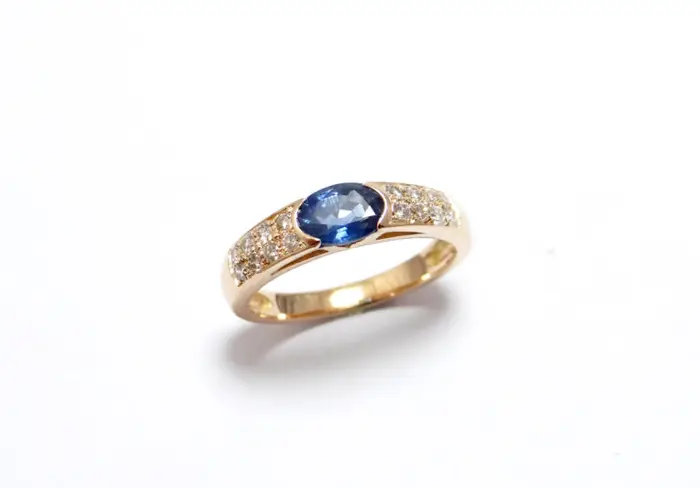
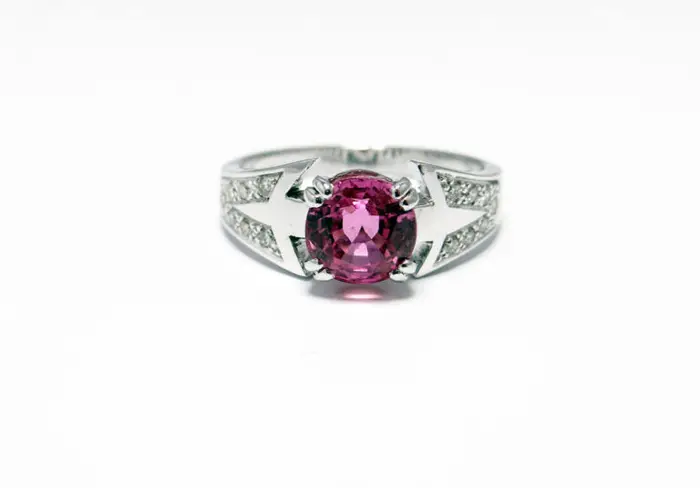
Every commission that comes through the door of my workshop in Saint-Sébastien-sur-Loire, near Nantes, is a small adventure of its own. The one I want to tell you about today began with an act of trust: a client arrived with gold that belonged to her, and asked me to turn it into something else. Something new and alive, that she would truly want to wear. A Ceylon sapphire ring in rose gold, to be precise.
A client, her gold, and the wish for a bespoke ring
When I am handed gold, I never see it as mere material. This metal has already lived a life, and it carries a history that I do not always know in full, but which I can feel. My client knew exactly what she wanted: an 18-carat rose gold ring, a Ceylon sapphire at the centre, and two bands of pavé diamonds along the shank.
We spoke at length about the colour, the shape, the way the piece would be worn. Then I made my first sketches. At this stage a drawing is never final: we revisit it, adjust it, let it evolve until the client recognises her ring before it even exists. That, I believe, is the true beginning of any bespoke jewellery commission in Nantes: the moment the idea becomes visible.
From entrusted gold to 18-carat rose gold
The moment I held this gold in my hands, I knew its transformation would be beautiful. The first stage is spectacular, even after years in the trade. The metal is melted down and brought back to a raw state, as if reset to zero. It loses its former face so that it can take on another.
Then comes the quiet alchemy of the alloy. To achieve the desired shade, the gold is blended with other metals, carefully measured. This is how rose gold is born, a hue that is at once soft and daring, romantic without being demure, resolutely contemporary. It flatters the skin, and it pairs as beautifully with the blue of a sapphire as with the white sparkle of diamonds.
The metal is then worked, calibrated and shaped. The ring takes form from the design we drew together, and the shank emerges, ready to receive its stones. I will not hide a certain emotion at this point: watching old gold become the foundation of a new piece of jewellery remains, for me, one of the finest moments in the transformation of a gold jewel.
The Ceylon sapphire, a blue from far away
The centrepiece of this creation is, without question, the Ceylon sapphire. Its deep, vivid colour recalls distant oceans and nights when the sky fills with stars. One could gaze at it for hours without exhausting its nuances.
Choosing such a stone takes time. I wanted a cut and shape that would show off the rose gold without ever competing with it. It also had to converse with the two bands of diamonds, remaining the anchor for the eye while letting the rest of the ring breathe. So I compared, set aside, and began again, until I found the balance. Sapphire blue against rose gold is a contrast I love dearly: one is calm and deep, the other warm and luminous.
Why this pairing works
The pink of the gold warms the blue, which then appears even more vibrant. The diamonds, for their part, act as small touches of light around that depth. Nothing is there by chance.
Two bands of pavé diamonds, set one by one
Along the shank of the ring, I designed two bands of pavé diamonds. Set delicately into the metal, these stones twinkle like stars and give the whole piece its brilliance and luminosity. Each one was chosen with care, then cut and set with a goldsmith's precision.
The stone setting is an exercise in patience. Each diamond sits in a seat cut to its exact size, then is held by tiny beads of metal pushed over by hand, one at a time. Press too hard and the stone is weakened; too timidly and it will not hold. One works slowly, under the loupe, sometimes holding one's breath.
Finally comes the polishing. It is this that makes the metal sing: the rose gold takes on its shine, the surfaces soften, the claws melt into the light. These pavé bands do more than reflect the rays that strike them. They also speak of the commitment I put into every piece, that desire to do things well even in the details no one will ever see up close.
What this jewel means to me
Throughout this work, I felt a strong bond with my client. She had entrusted me with her gold, a precious possession, so that it might become a work to be worn. It is a great responsibility, but also an honour that I never take lightly. One does not simply hand back a piece of jewellery: one returns a material charged with meaning, now turned towards the future.
Today, as I look at this finished ring resting on my bench, I think of the joy it will bring to the person who wears it. I also think of that little bit of magic that still amazes me after all these years: simple materials, a little fire, a great deal of patience, and a treasure appears.
If you too have a forgotten jewel at home, a wedding band that is no longer worn, or family gold sleeping in a drawer, come and talk to me at the workshop in Saint-Sébastien-sur-Loire. We will look together at what it might become, with no obligation and no rush. Sometimes a simple conversation over a coffee is all it takes for a lovely idea to be born.