
Published on by Olivier Maupas-Sehikyan · Rings
Some requests arrive at the workshop with a quiet certainty. This client's was one of them. She came to see me in Saint-Sébastien-sur-Loire, near Nantes, with a clear idea and some gold of her own, to celebrate her wedding anniversary. I remember the sense of responsibility I felt in that moment: I was not simply being given a commission, I was being entrusted with a date, a bond, a story to be held in the hollow of a finger.
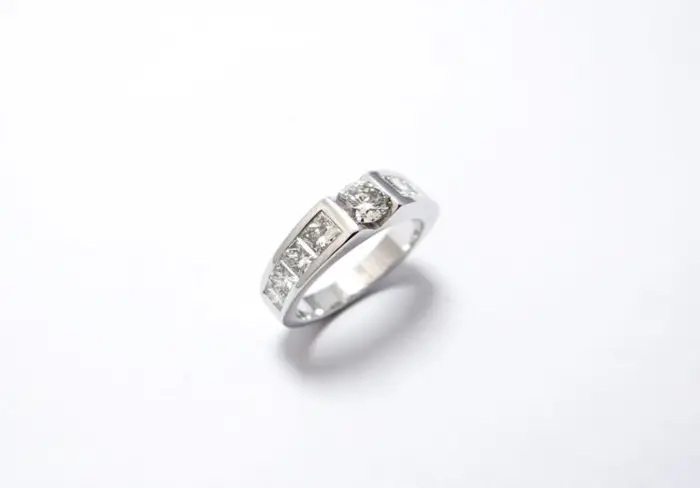
She imagined a palladium white gold ring, crowned with a 0.50-carat round diamond, with a line of baguette diamonds channel-set on either side. A restrained, almost architectural design, in which every element finds its rightful place. We talked about proportions, the height of the central diamond, and the space to leave for the baguettes so that they would accompany the stone without ever stealing its thunder. For a wedding anniversary ring, these details matter more than one might think.
The wax model: seeing the ring before it is cast
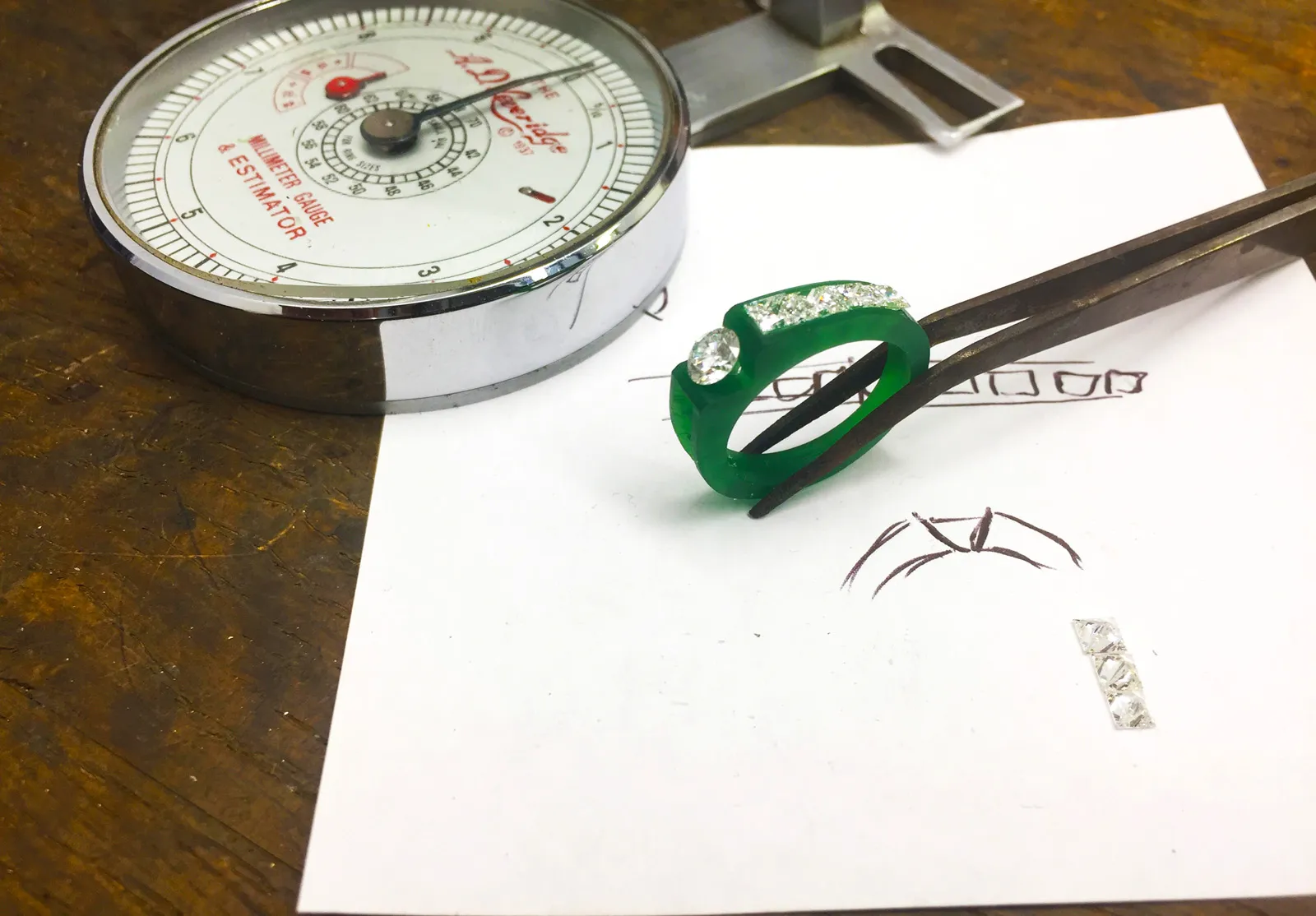
I always begin with the drawing, then move on to the wax. For me, the wax model is the stage at which a project stops being an idea. In my hands, the block is hollowed out, smoothed, given volume. I carve, I remove, I begin again. With each movement, the wax captures a little more of my client's dream and makes it tangible.
This stage is decisive, because it offers a three-dimensional vision of the finished piece. It is where we judge the harmony of the forms, the balance of the proportions, the way the ring will sit on the hand. A line that is too thick, a gallery that is too high: everything can be corrected at this point, without wasting any metal. For a bespoke ring, the wax model also serves as a shared language. It allows us to understand one another without words, simply by holding it and turning it in the light. Once it had been approved, we were both certain of the direction to follow.
From the gold entrusted to me to palladium white gold
Then comes the moment I always approach with gravity: the transformation of the metal. The gold my client brought was more than raw material. It was a part of her history and her memories, and I knew it as I handled it. Melting it down to give it a second life demanded as much care as technique.
I chose palladium white gold for its pure, crisp whiteness, which sets the diamonds off without casting a shadow over them. The wax was taken in a mould, then replaced by molten metal during casting. What emerges from the mould is not yet a piece of jewellery: it has to be roughed out, filed, each surface adjusted, and the seats that will receive the stones prepared. I love this patient work, where the traditions of the workshop meet today's tools. Shaping palladium white gold calls for both gentleness and rigour, and it is precisely this blend that I love about my craft.
The setting: a round diamond and two channels of baguettes
Mounting the stones is a moment when one holds one's breath. The 0.50-carat round diamond is the heart of this ring. I set it under the loupe, taking care that it sat perfectly straight and was securely held, without the metal smothering it. Brilliant, imposing without excess, it catches the light at the slightest movement of the hand.
On either side, the channel-set baguette diamonds draw two crisp lines. Their rectangular cut, held between two fine walls of metal, demands great precision: each stone must touch its neighbour without being constrained by it, and the whole must remain perfectly aligned. This channel setting brings the ring a structured elegance. The baguettes play with the light differently from the round diamond, with straighter, longer reflections, like flashes ruled with a straight edge.
Then came the polishing. It smooths every surface, brings out the whiteness of the metal and reveals the full clarity of the stones. I check with the loupe, I go over it again, until nothing catches either the eye or the fabric of a sleeve.
Why this choice of stones works
The contrast between the roundness of the central diamond and the rigour of the baguettes gives the ring its character. The one softens, the others structure. This is the balance my client was looking for, and the one I pursued at every stage.
A ring that tells of love
A finished ring is never just a piece of jewellery. This one reflects a love celebrated, and a craft that I received and try to pass on in my turn. It carries my client's gold, her memories, one more year together. My most sincere wish is that every time she wears it, the ring will be the silent witness of those moments, and will keep their light.
If you too have family gold, a memory to honour or an anniversary to celebrate, you are welcome to come and talk to me at the workshop in Saint-Sébastien-sur-Loire, near Nantes. We shall take the time to look at what you have, to draw together and to imagine a bespoke white gold diamond ring in Nantes that is truly yours. With no obligation: simply a conversation, around a workbench.