
Published on by Olivier Maupas-Sehikyan · Rings
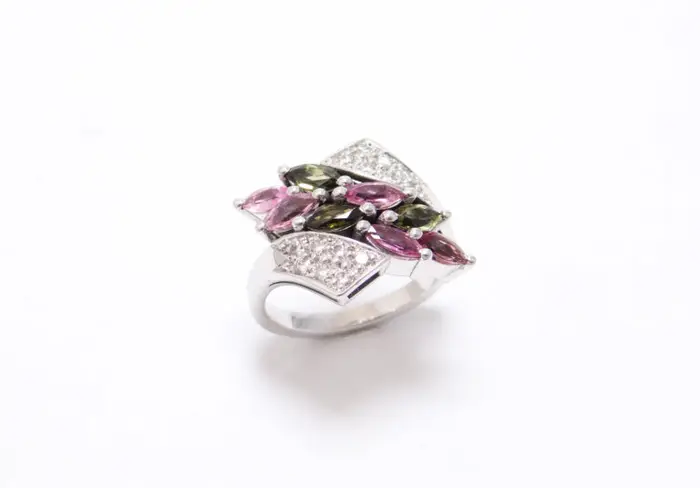
In my workshop in Saint-Sébastien-sur-Loire, near Nantes, I designed a ring that I often think back to. It brings together white gold, diamonds and two colours of tourmaline that look nothing alike, yet answer one another. Let me tell you how it came to life, because every stage mattered.
A bespoke ring for a birthday
With some appointments, you sense straight away that they matter. That day, a client walked in with a very clear idea: to mark a birthday with a ring that would exist nowhere else. He had brought the raw materials, green and pink tourmalines cut as navettes, and was looking for someone to give them a form worthy of the occasion.
I love those moments when the stones are set down on the tray and we fall silent for a moment. The light from the window passed through them, green on one side, pink on the other. We talked for a long time, less about jewellery than about what the date meant to him. Listening is the first step in any bespoke ring in Nantes, long before the first pencil stroke. A birthday ring must not merely be beautiful: it holds the trace of a moment, and must be able to carry it without overwhelming it.
My client wanted white gold, for its clarity, and diamonds around the tourmalines. For the rest, he left it to me to propose the balance. That trust carries a responsibility, and I felt it as a commitment from that very moment.
Green and pink tourmaline: choosing the stones
Green and pink tourmaline makes a rare pairing. The green is deep, almost botanical, and the pink softer, more tender. Set side by side, the two shades reinforce each other rather than compete. Their navette cut, elongated and pointed at the ends, naturally gives the jewel a sense of direction: the eye travels along the stone, then returns towards the centre.
These gemstones also carry their own symbolism, and my client cared about that. Green tourmaline is said to have soothing and restorative qualities, while pink is associated with love and compassion. I do not claim to prove anything on the subject. But I know that a stone charged with meaning is worn differently, with more attention, and that a jewel of this kind is more readily passed down.
The diamonds had a precise role: to frame without stealing the show. I wanted them to bring light and relief, while the colours of the tourmalines remained the first to captivate the eye. Hence the idea of two pavé diamond settings, accompanying the navettes like two musical phrases around a melody.
Why the design took time
The most delicate part was not imagining the ring, but deciding what to take away. Every superfluous line would have made noise around the stones. So I drew, erased, redrew, until the composition could breathe.
In the workshop: 18-carat white gold and grain setting
Once the design was approved, the work on the metal began. I first modelled the ring in wax, to check its volumes and how it would sit on the finger. Wax still forgives hesitation: you add, you carve, you adjust. Then came the casting, that moment when the project stops being a malleable form and becomes metal.
I had chosen 18-carat white gold for two reasons. It is strong enough to carry stones every day, and its pale tone enhances the colours without pulling them towards yellow. Once the piece came out of the casting, I reworked every surface by hand, first with the file, then with ever finer abrasives.
Then comes the setting, which demands absolute calm. Each tourmaline was carefully placed at the centre, then framed by the two rows of diamonds. These are grain-set: tiny beads of metal, raised one by one from the gold, hold each stone in place. Grain setting gives that delicate, almost embroidered look, where you see more of the diamond's light than of the metal that holds it. It demands precision, because a grain pressed too hard damages the whole, and a grain too timid leaves the stone loose.
Finally, the polishing. I love this last stage, quieter still than the others. The white gold takes on its lustre, the facets of the diamonds reveal themselves, and the tourmalines regain all their depth. When I placed the ring under the lamp, I knew the work was right.
Handing over the ring
On the day of the handover, my client came back to the workshop. I had prepared the case on the tray, in the very spot where, a few weeks earlier, the stones had lain, untouched by any shaping. When the lid opened, there was a silence, then a smile that spread across his whole face. Watching someone recognise their idea in a finished object is the finest reward a jeweller can have.
This project rested on close collaboration, from the first conversation to the final touch. The ring is not just a beautiful object: it has become the lasting symbol of the birthday it celebrates. It also shows what I love about my craft: combining patient, traditional workshop skill with the deeply personal wish of one person, and stones heavy with meaning.
If you have stones sleeping in a drawer at home, or a date you wish to mark with a jewel, come and talk to me at the workshop in Saint-Sébastien-sur-Loire, near Nantes. We will take the time to lay the stones on the table, watch the light play, and see together what they might become.