
Published on by Olivier Maupas-Sehikyan · Rings
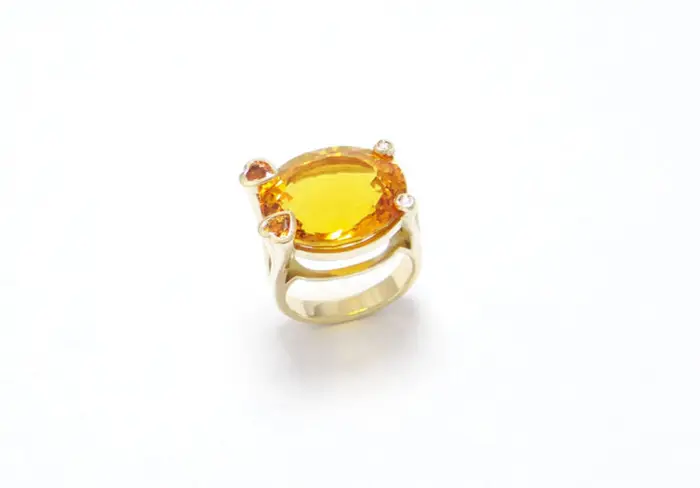
Some commissions begin with a sketch, others with a stone placed on the counter. This one began with a colour. A client walked into my workshop in Saint-Sébastien-sur-Loire, near Nantes, with a very clear idea of what he wanted to see come to life: a ring in which sunlight would seem to be held captive within a stone. I listened to him for a long time before touching a pencil.
An 18-carat yellow gold citrine ring born of a conversation
I count this project among those that have demanded the most of me. An 18-carat yellow gold citrine ring cannot be designed lightly: everything rests on the harmony between the stone and its metal. My client had his vision, and my role was to translate it into volumes, proportions and the gestures of the craftsman.
We talked about the hand that would wear it, the effect he was seeking, the place the stone should occupy. Then we came to the centre stone: a citrine of over 3 carats. A stone of that size demands character. It does not slip discreetly under a sleeve; it makes a statement. The mount therefore had to rise to its level without overwhelming it.
Choosing 18-carat yellow gold to bring out the citrine
The metal came almost naturally. I tested it all the same, as I always do: a stone placed in turn against different tones, to see how it responds. With the citrine, 18-carat yellow gold was the obvious choice. Its warm, slightly golden hue carries on from that of the stone rather than contradicting it. The eye passes from one to the other without a break, and the whole seems to have come into being in a single movement.
18-carat gold also offers a precious durability for a piece made to be worn. It can be worked with great finesse, polished to a deep lustre, and holds the setting of generously sized stones well. There is nothing spectacular to say about it: it is a choice of good sense, but it is what gives the ring its foundation.
A stone chosen, not simply found
Selecting the central citrine took patience. I looked at its cut, the clarity of its colour, the way it returns the light when turned between the fingers. A stone can be beautiful in itself and yet not match what the client had in mind. Here, it had to answer his vision exactly. When I found it, I knew before I had even measured it.
Heart-shaped citrines and diamonds on the claws
This is the detail that gives the piece its soul. Around the main stone, heart-shaped citrines are set on the claws. They bring a touch of tenderness to a ring that is otherwise bold. Their shape speaks for itself: love, attachment, passion. I did not try to explain it any further, because a piece of jewellery needs no instruction leaflet.
On two other claws, I chose to place diamonds. Why? For the contrast. Their white, lively, almost cool brilliance plays against the warmth of the gold and the honey of the citrine. They do not seek to steal the show: they bring the light back to life, rather like sparks around a fire. Their size and position were weighed with care, because too large and they would have dominated, too discreet and they would have been lost.
The result is a citrine and diamond ring in which every claw has its role. The hearts soften, the diamonds sparkle, and the great citrine reigns at the centre. The balance hangs on very little, and I spent long hours in thought before committing to any material.
From wax to polishing: making a bespoke ring
Once the design was approved, I sculpted the model in wax. It is the stage I enjoy most, because it finally gives the idea volume. You hold the ring in your fingers, turn it, correct a curve, refine a claw. The model was then cast in 18-carat yellow gold, and reworked by hand to remove every trace of the casting.
Then comes the setting, the stage that forgives nothing. Each stone must be held firmly without being constrained. For the heart-shaped citrines, the difficulty is particular: their silhouette demands a precise adjustment of each claw, to a tenth of a millimetre, so that the stone sits properly and the composition keeps its balance. I worked slowly, stone by stone, constantly checking the symmetry.
Polishing completed the work. It restores the gold's bright lustre and prepares the ring to meet the light. For a bespoke ring in Nantes, as for all those that leave my workshop, this is the moment when the piece stops being a manufactured object and becomes a jewel.
The moment the ring leaves the workshop
I always feel something particular when I place a finished piece in its box. For weeks, it has belonged to me a little: I have conceived it, held it, looked at it under every light. And suddenly it is about to set off towards someone else, towards a life I do not know.
When I presented this ring to my client, the citrine caught the light from the window and cast it onto the ceiling in a golden patch. He needed no grand speeches. I believe it is that silence I am looking for, the silence of an eye recognising what it had imagined, and even a little more.
I do not presume to say what this ring will become. I simply hope that it will be worn, loved, and marked a little by life as the jewels that matter always are, then handed down one day. It is the finest possible sequel for a piece made in the workshop.
Let's talk about your project at the workshop
If you dream of a coloured stone, a particular metal or a shape that reflects who you are, come and talk it over. My workshop in Saint-Sébastien-sur-Loire, near Nantes, is open to anyone with an idea, however vague. We will take the time to look at it together, over a coffee, with a few stones on the table.