
Published on by Olivier Maupas-Sehikyan · Pendants
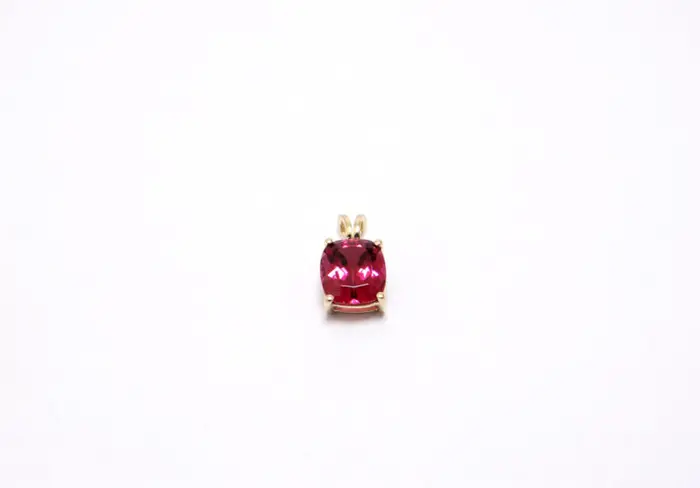
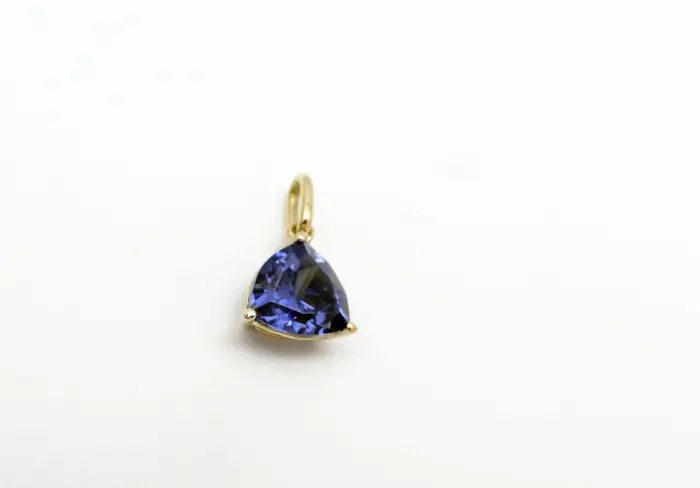
Some stones stop you the moment the case is opened. That day, a private collector entrusted me with a rhodolite garnet in a faceted cushion cut. Before I had even slipped it under the loupe, I knew this piece would captivate me. Here is how this bespoke yellow gold rhodolite pendant came to life in my workshop in Saint-Sébastien-sur-Loire, near Nantes.
A red-violet rhodolite garnet, entrusted by a collector
Rhodolite is a variety of garnet, and this one had a deep hue somewhere between red and violet, like a dark wine with light passing through it. Its owner, a discerning collector, had been keeping it for the day he met the right craftsman. He had no precise plan. He wanted to see what I could make of such a singular stone, and that trust touched me.
I remember turning the cushion-cut rhodolite garnet between my fingers for a long time. Its facets threw back raspberry flashes, almost purple depending on the angle. A collector's stone is not treated like any other: it asks to be observed before it is drawn. So I took the time to look at it, to listen to it in a way, before putting a single line on paper.
Designing a mount for a bespoke jewel in Nantes
Every bespoke jewel in Nantes or anywhere else begins with a pencil. I drew several designs for the mount, each time seeking the same balance: a setting that follows the contours of the cushion without ever stealing the show. Some sketches were too busy, others too timid. Gradually, a shape emerged, simple and enveloping, designed so that every facet remains visible.
Why the mount matters as much as the stone
The mount is one of the most decisive elements of a pendant. It must hold the stone securely while letting it breathe and catch the light. A faceted cushion suits settings that follow its rounded corners. A mount that is too thick smothers it, one that is too thin makes it vulnerable. I therefore adjusted my drawing until I found the happy medium, the point where the metal almost disappears.
The yellow gold mount: from heated metal to finished setting
For a rhodolite, yellow gold quickly became the obvious choice. Its warmth answers the red-violet tone of the garnet, where a cooler metal would have hardened the contrast. The two enhance one another: the stone appears more vivid, the metal softer.
Then came the time for the flame. The metal, heated and then worked with patience, slowly took the shape of a setting made for this particular garnet. It is a true ballet: heat, shape, check, begin again. In the workshop I have everything I need to sculpt, model and assemble with precision, but no tool replaces the eye. At every stage I placed the stone back in its seat to check that nothing was forcing it and nothing moved.
Setting the stone, a moment of total concentration
The setting demands a particular calm. The metal is closed over the stone, movement after movement, with measured pressure. A millimetre too much and the stone is damaged; a millimetre too little and it is not held. When the garnet found its place in its bespoke mount, I felt what I feel every time, but more strongly on this occasion: genuine pride, mingled with great relief.
Polishing remained. It reveals the lustre of the yellow gold and erases the traces of the work. It is a discreet, almost silent stage, yet it is what gives the jewel its finished look. Once complete, the gleaming metal set against the purple tone of the garnet was breathtaking. I stayed for a while, simply looking at it.
A pendant awaiting its owner
As I write these lines, the pendant is finished and awaits the person who will wear it. I do not yet know how it will be received when it is handed over, and I do not wish to invent anything. But I know what I hope: that its owner will find, in the way the gold embraces the stone, the care I devoted to every stage.
What I love about this kind of commission is that it starts from a stone and not from a model. Nothing is copied, nothing is standard. The yellow gold rhodolite pendant I have just described exists in a single example, shaped for a garnet that has no twin. For me, this is the meaning of craftsmanship: giving a gemstone the setting it deserves.
Discuss your project at the workshop in Saint-Sébastien-sur-Loire
Do you own a stone that lies forgotten in a drawer, a garnet, a rhodolite or an inherited gemstone you do not know what to do with? Step into my workshop in Saint-Sébastien-sur-Loire, near Nantes. We will take the time to look at it together, to talk about it, and to imagine what it could become. With no obligation, and with pleasure.