
Published on by Olivier Maupas-Sehikyan · Rings
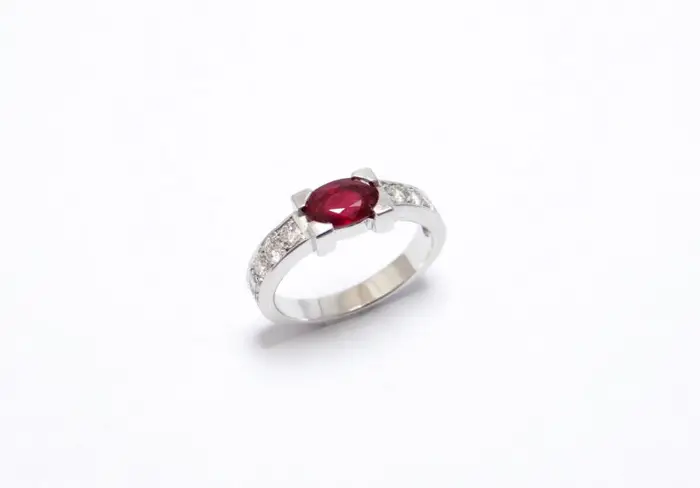
Some appointments begin with a ring box placed gently on the workbench. That day, a client came to see me at the workshop in Saint-Sébastien-sur-Loire, near Nantes, with an antique ring that had belonged to her grandmother. She handed it to me with great care, as one entrusts something fragile.
I studied it at length under the loupe. The mount showed its age: the metal was tired, the structure was weakening, and the whole piece no longer had the firmness it once had. The stones, however, a ruby and diamonds, sparkled with the same intensity as on the first day. Time had worn down the setting, but never the light.
A grandmother's ring, and the wish to bring it back to life
My client's request could be summed up in a few words. She did not want a new piece of jewellery that would erase the old one. She wanted this ring to leave the back of the drawer, to be worn, admired and loved. In other words, to make it more contemporary without taking away its essence.
I understood at once that the challenge went beyond technique. In my work as a designer, I often encounter stories and emotions attached to each piece, but a family heirloom always weighs a little heavier in the hand. One does not simply alter it, one extends it. So we took the time to talk it through, looking together at what had to remain (the stones, of course, and the spirit of the ring) and what could change: the mount.
Transforming an antique ring without betraying its story
To transform an antique ring, you must first listen to what it has to say. This one spoke of a grandmother, of something handed down, of a deep red colour surrounded by tiny white flashes of light. I suggested white gold, whose pale tone lets the ruby take centre stage while giving the diamonds a livelier, fresher brilliance.
My client had entrusted me with the gold I needed: that of the old setting. Nothing would be lost, and nothing would come from elsewhere. The metal of the ring of yesterday would be used to shape the ring of today. This idea meant a great deal to her, and to me too. There is something right about knowing that the material itself carries on its journey.
The stones, the starting point of the design
Before drawing a single line, I laid the stones on my bench, under good light. The ruby would sit at the centre, naturally. The smaller diamonds would accompany it without ever competing with it. I always design from the stones, never the other way round.
From drawing to casting: the birth of a white gold mount
I chose a clean, pared-back design. The idea was simple: to showcase the central stone, then arrange the other stones around it with a balance that is both bold and delicate. On paper, I explored the lines, the curves, the way the ring would sit on the hand. Then I refined, simplified, and removed a little more visual weight. A beautiful mount is often one whose structure you no longer notice.
Next comes the stage where the old makes way for the new. I melted down the old setting. When the metal passes from yesterday's form to a molten state, you feel how much symbolism that gesture holds. The gold was then carefully cast to give birth to the new mount. I worked it by hand, filing, adjusting and refining, until I achieved the modern line I had in mind.
In my workshop-boutique, almost everything happens in plain view. Clients can watch the melting, the shaping and every stage of the transformation. Many tell me how surprised they are by these gestures, which they imagine belong to another age. For me, it is a way of being honest: a jeweller near Nantes has nothing to hide about his work.
Setting the ruby and diamonds, one movement at a time
The setting is the moment I enjoy most, and the most demanding. Each stone must find its exact place and be held firmly, without the metal smothering it. The ruby comes first, at the centre, and is set with particular attention: it is what gives the ring its soul. Then the diamonds, one by one, around it. I work slowly, checking as I go, and start again if a stone is not perfectly aligned.
The chosen arrangement, at once bold and light, brings the contemporary touch my client had hoped for. The ruby remains the star, while the diamonds play their part as a luminous escort. Nothing tries to do too much.
Then comes polishing. I do it in several passes, with patience, until the white gold takes on a crisp, even shine. It is discreet work: once finished, it disappears behind the brilliance of the metal. Yet it is what gives the ring its softness to the touch, its comfort on the finger, its finish.
As the project unfolded, I saw not just a ring taking shape, but the meeting point of two eras.
A family story that lives on
When the ring was finished, I placed it in its box and waited for my client's visit. I never tire of those moments when, at a single glance, someone discovers what has been created in their absence. The ruby, the diamonds, the white gold: everything was there, familiar and yet new. Her grandmother's stones had not changed, but they seemed to have found a new home made to their measure.
This ring has become the symbol of a family story that is not frozen in the past. It lives on, with a touch of today, on the finger of the woman who inherited it. That is, I believe, the finest way to honour a memory: to give it a present.
Every piece that leaves my workshop tells a story, thanks to the time we devote to each stone and each gram of gold. Transforming, reinventing, creating: this is what fills my days as a jeweller.
If you, too, have a ring or an old piece of jewellery whose mount has aged but whose stones are dear to you, come and show it to me at the workshop in Saint-Sébastien-sur-Loire. We will look at it together, unhurriedly, and see what it might become.