
Published on by Olivier Maupas-Sehikyan · Pendants
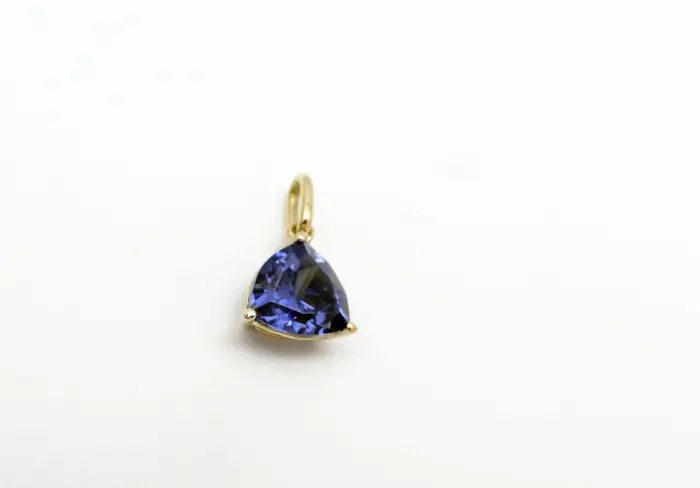
A trillion-cut tanzanite entrusted to my workshop near Nantes
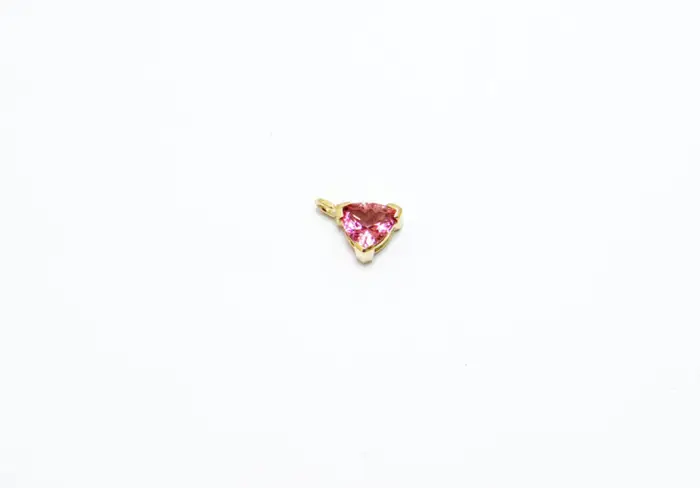
Some stones stop you in your tracks before you have even found the words to describe them. This one came into my hands by way of a discerning collector, a man who knows gemstones and understood exactly what he was entrusting to me: a faceted trillion-cut tanzanite. His request was brief. He wanted my craftsmanship to show the stone to its best advantage, and for it to become a pendant worthy of it.
When the stone arrived at my shop and workshop in Saint-Sébastien-sur-Loire, on the edge of Nantes, I took the time to look at it before saying a word. Its colour is the kind that casts a spell: a deep blue that, depending on the angle and the light, takes on violet flashes. The facets bring it to life. They catch every ray of light that crosses the workshop and return it with a depth one never tires of watching. I felt that small thrill you know when you realise a project will be unlike any other.
Entrusting a stone to a jeweller is a mark of trust. I received it as an honour, but also as a responsibility. A bespoke tanzanite pendant leaves no room for approximation: the stone is there, it is beautiful, and the task is to make sure nothing overshadows it.
Understanding the stone before designing the jewel
Before picking up a pencil, I studied the tanzanite. Every gemstone has its own character, and this one more than most. Mined in Tanzania, it shifts in tone as you turn it between your fingers, which means the mount must be conceived in response to the light, and not merely to the shape. I like to understand a stone before imagining its setting, because a good bezel is never drawn against the stone, but with it.
So I settled at my bench, tools within reach, the gemstone in front of me. Then I let contemplation do its work. The first sketches came in small touches, over hours spent watching how the stone responded to the daylight of the workshop. I tried out proportions, heights, ways of holding it without ever hiding it. Some drawings were abandoned, others put me on the right path.
Why yellow gold was the obvious choice
I chose yellow gold. Its warmth answers the violet-blue of the tanzanite the way a lamp answers the night: the contrast brings out the colour without ever hardening it. A colder metal would have simply placed the stone; this one envelops it. This yellow gold lends the pendant a softness that suits so deep a gemstone.
A pared-back setting, shaped before the eyes of passers-by
I settled on a pared-back setting, made entirely to measure. The idea was simple: the tanzanite should remain the only voice in the jewel. No excess, no ornament to distract the eye. A restrained design is often the hardest to carry off, because it forgives no hesitation. Every line must be true and every join clean, otherwise the eye notices at once.
I wanted this jewel to come to life in the heart of my shop. It was an experience I remember fondly: passers-by and clients would stop in front of the bench, intrigued, and watch the metal take shape. Some asked questions, others stayed silent, simply captivated at seeing an object being built before their eyes. In an age when everything moves fast, this attention to the gesture touched me.
Every stage, from cutting the metal to the setting, took place here, in Saint-Sébastien-sur-Loire. The metal was first cut, then shaped and fitted to the stone, millimetre by millimetre. Then came the polishing, which gives the gold its warm lustre and smooths the surfaces until nothing snags the light. Working this way, without outsourcing anything, guarantees the authenticity of a bespoke jewel made in Saint-Sébastien-sur-Loire and keeps me in command of every detail, down to the last.
Then came the moment I always await with a touch of apprehension: the setting. Placing the tanzanite in its mount demands a steady, patient hand, because a stone cannot be recovered once it is damaged. When I finally set it in place and looked up, the result took my breath away. The colour seemed to have found its natural home, and the metal had almost faded away to serve it.
A pendant that draws every eye
Today, when people push open the door of my shop, this pendant is the first thing they notice. Yet it does not seek to impose itself: it is the stone that draws the eye, its blue depth, its violet flashes, and the simplicity of the yellow gold that surrounds it. Visitors step closer, lean in, and ask which gemstone it is. I then tell them the story of this trillion-cut tanzanite and of the collector who placed his trust in me.
It is a unique piece, crafted with care, patience and a genuine devotion to work done well. For me, it sums up what I love about my work as a designer jeweller near Nantes: starting from a stone, listening to what it has to say, then building around it a jewel that reflects it.
If you own a stone that is dear to you, or if you dream of a pendant designed for one particular gemstone, come and talk to me at the workshop in Saint-Sébastien-sur-Loire. We will take the time to look at it together, over a coffee, and see what it calls for.