
Published on by Olivier Maupas-Sehikyan · Pendants
A velvet box on the workbench
That day, a client pushed open the door of my jewellery workshop in Saint-Sébastien-sur-Loire, near Nantes, holding a small velvet box close to her. She set it down on my worktable with a slowness I shall not forget. Inside lay a 5-carat pear-cut emerald, a deep green, almost liquid under the lamp. Around it, a small collection of old 18-carat yellow gold jewellery: chain links, a ring long out of fashion, a few broken pieces.
She told me the story in a low voice. The stone had belonged to someone dear to her, who had recently passed away. It had been handed down to her, along with the other family jewels. The emerald was set in an old period ring that my client could not wear, yet she refused just as firmly to leave it sleeping in a drawer. What she wanted was a piece that was truly her own, one she could slip beneath her collar each morning, resting against her skin.
I listened to her for a long time, without touching anything. In my profession, one learns quickly that transforming a family jewel never begins with a pencil, but with a shared silence.
Designing a pure, understated emerald pendant
We talked about her tastes. She likes clean, contemporary lines, and wanted the stone to remain the centrepiece. A piece discreet in its structure, but powerful in what it represents. The form of the emerald pendant almost chose itself: worn close to the heart, it would keep the person she had lost very near to her.
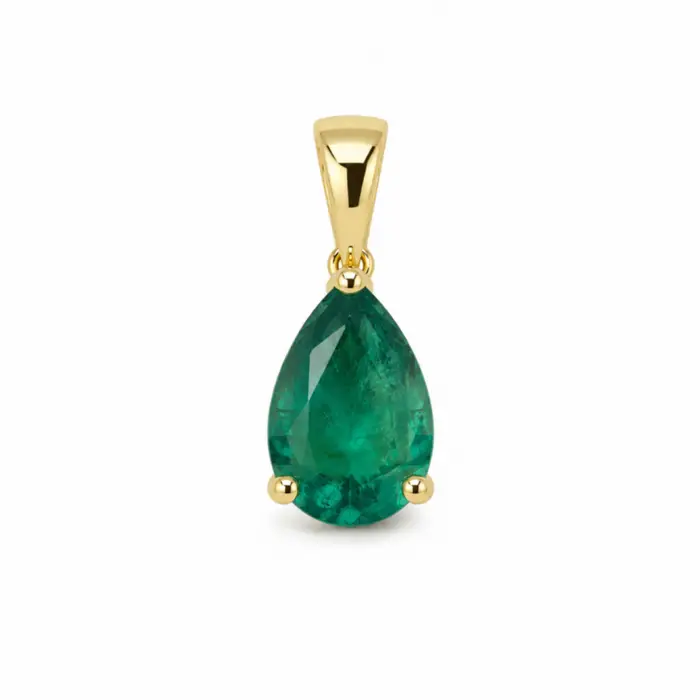
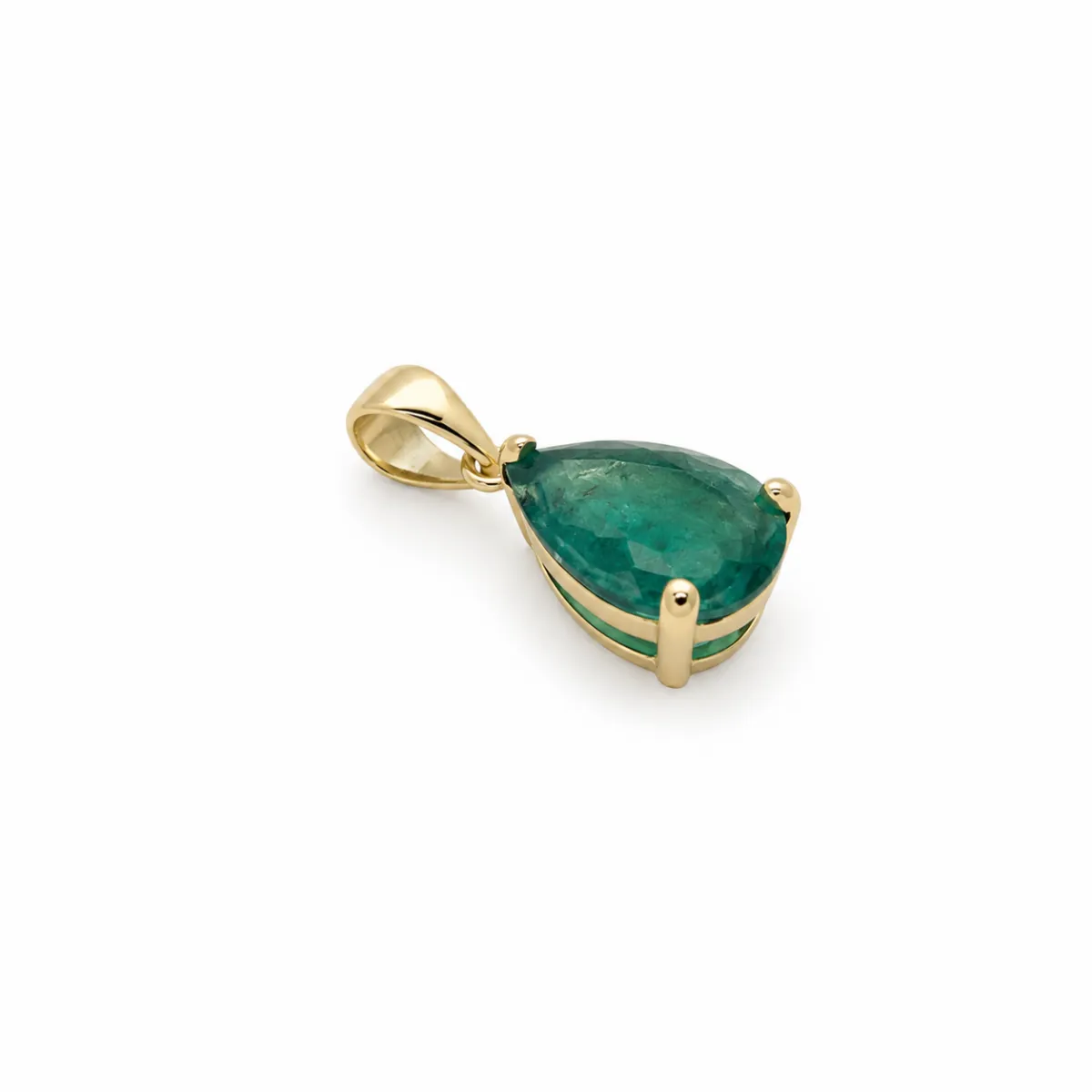
I took out my notebook and drew several sketches. The one we chose favours purity. The emerald would be held in a four-claw setting, mounted vertically, point downwards, and suspended from a simple, finely worked bail in 18-carat yellow gold. No superfluous decoration. My client studied the drawing for a moment, then nodded. The design was approved.
The 5-carat emerald and 18-carat yellow gold
Before beginning to make anything, one must understand the material one is about to work. Emerald is a variety of beryl, and its green colour comes from traces of chromium and vanadium within its crystal structure. Its rarity owes much to an improbable meeting: beryllium forms in the earth's crust, chromium comes from the deep mantle, and it takes intense tectonic movements for the two to cross paths. Colombia produces around 50% of the world's emeralds, from the mines of Muzo, Chivor and Coscuez. The Incas were already wearing them in their ceremonies more than 500 years ago.
A 5-carat stone deserves to be lingered over. Most cut emeralds on the market weigh between 0.5 and 2 carats. This one, in addition to its gemmological value, carried a value that no scale can measure.
Why a pear cut for a pendant
The pear cut is made for this purpose. Its elongated shape, halfway between the round and the marquise, evokes a frozen drop of light. Worn point downwards, it visually lengthens the neck and reveals the full depth of the green.
A beautiful but fragile stone
With a hardness of 7.5 to 8 on the Mohs scale, emerald is reasonably durable, but its internal inclusions, poetically known as "gardens", make it sensitive to knocks. The setting therefore had to take this into account from the outset. As for 18-carat yellow gold, an alloy of 75% pure gold enriched with copper and silver, its sunlit warmth answers the green of the stone as few other metals can.
Casting, claw setting and polishing in the workshop
Everything was done by hand, at my workbench. I first carefully dismantled the old ring to free the emerald. This unsetting calls for patience: one overly hasty movement and the stone could crack. I then examined it under a x10 loupe to be sure it was intact after removal.
The gold from the old jewellery was weighed, tested, then melted at around 1,064 °C, its melting point. Purified with borax, it was poured into an ingot. This stage always moves me a little: several inherited pieces melt into a single material, ready to become a new piece, yet filled with their memory.
The ingot was then rolled into a sheet, and drawn through the draw bench to obtain the sections required. I shaped the mount from a round wire. The four claws were cut one by one with a needle file, including a V-shaped claw, essential to protect the fragile point of the pear cut. The gallery beneath the stone was structured to let through as much light as possible. The bail was made separately, adorned with a small chased motif that adds a touch of finesse to the simplicity of the design, then soldered to the top of the mount.
Then came the moment of the claw setting. I placed the emerald in its seat, then closed each claw over it with my graver, applying a gentle, gradual pressure. Nothing could be rushed: an invisible fissure would have revealed itself years later. The V-shaped claw received particular attention.
All that remained was to sand, then polish with felt and cotton. Little by little, the yellow gold took on its lustre and the green of the emerald recovered all its depth.
The day the pendant found its place
When my client returned, I presented the bespoke piece of jewellery without a word, simply resting in my palm. She took it, looked at it for a long time, then fastened it around her neck. Her eyes misted over. She now wore, close against her, a loved one transformed into a piece that will never leave her.
I remained silent for a moment behind the workbench. It is for moments like these that I do this work.
If you too have a family jewel sleeping in a drawer, or a stone you do not know what to do with, come and talk to me at the workshop in Saint-Sébastien-sur-Loire, near Nantes. We shall take the time to listen to its story, and see together what it can become.