
Published on by Olivier Maupas-Sehikyan · Signet rings
He walked into my workshop in Saint-Sébastien-sur-Loire, south of Nantes, with a simple pouch in his hand. He emptied it onto the bench without ceremony: a worn curb bracelet, a broken chain, a ring he no longer wore. All of it in 18-carat yellow gold. Pieces inherited or gathered over the years, which had been sleeping in a drawer like a small forgotten reserve.
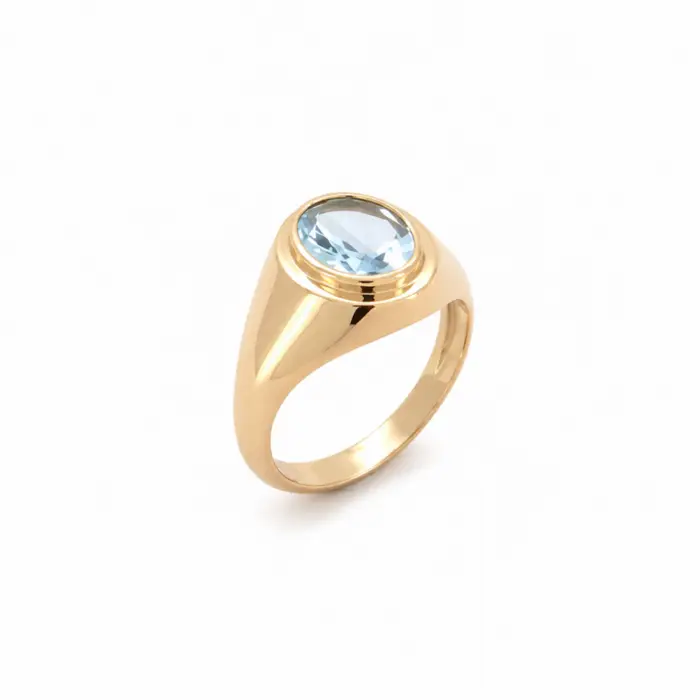
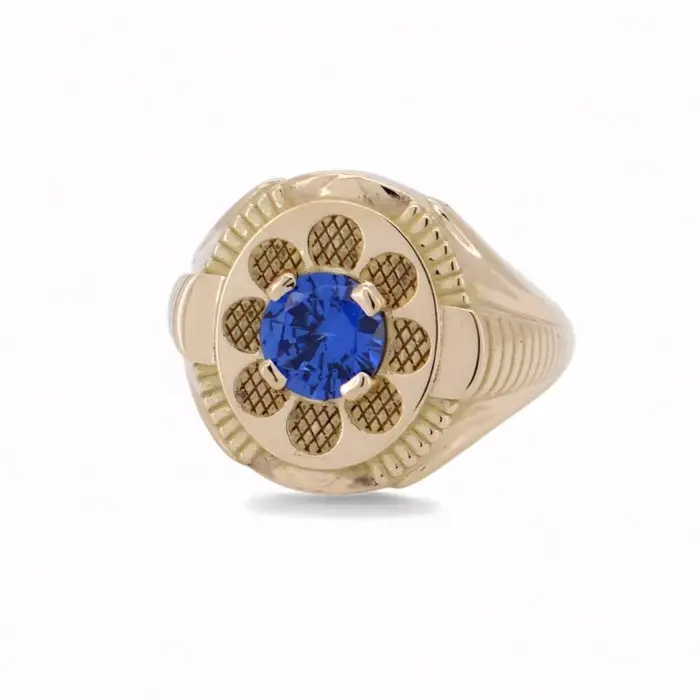
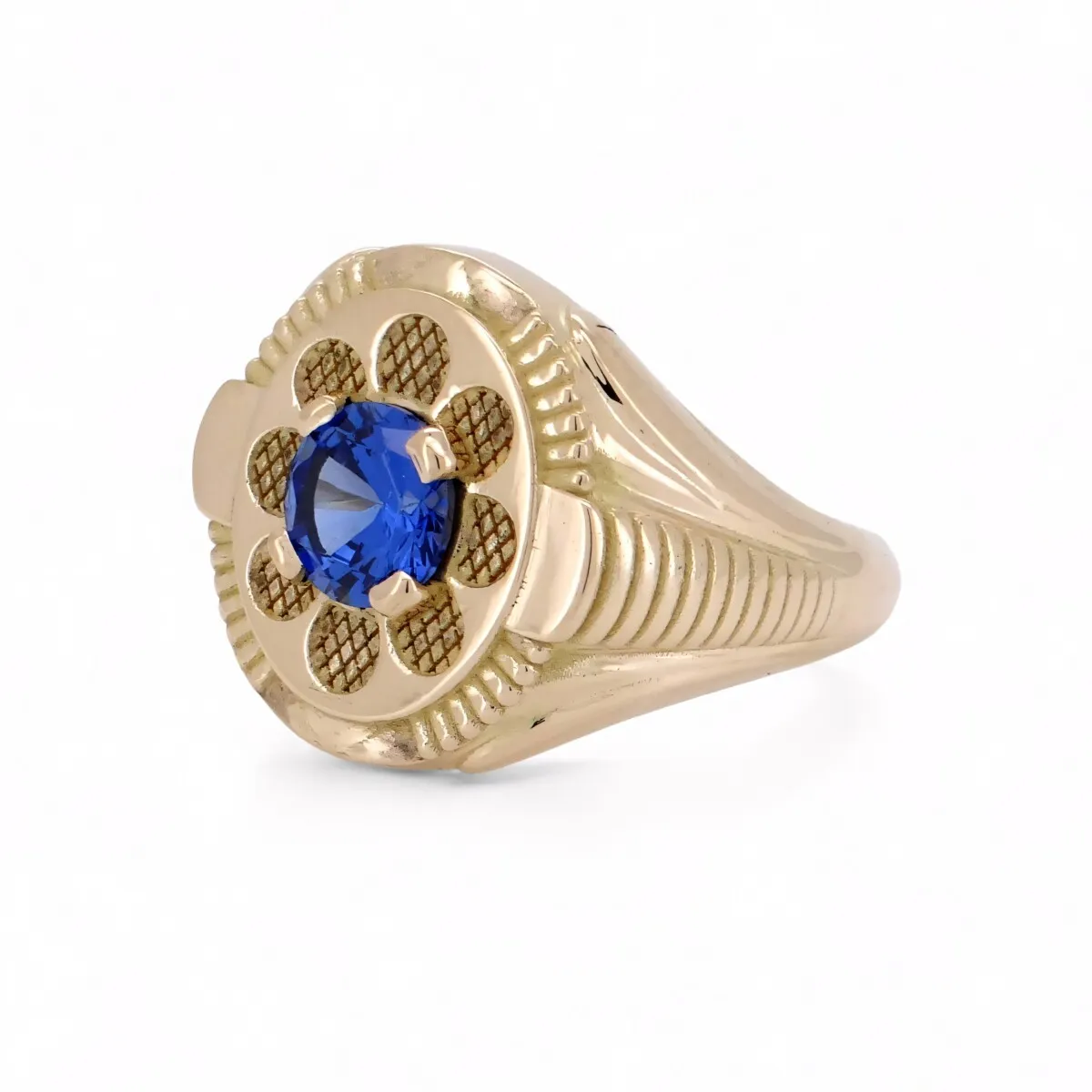
His request, however, was perfectly clear. He wanted a bespoke men's signet ring, strong, classic in spirit, with a blue stone at the centre. Blue, he explained, had always been his colour. He pictured a ring to wear every day, one that would mark a personal milestone in his life. Not a showcase piece: a piece that was his alone.
A blue-stone signet ring on a controlled budget
That left the question of budget, and he raised it frankly. He did not wish to invest a large sum in a stone. His first dream, a fine natural blue sapphire, would have exceeded his budget within the first few carats.
It is in moments like these that my work as a designer-jeweller makes the most sense. I did not want to push him towards a stone beyond his reach, nor to offer him a cut-price ring. So I spoke to him about blue cubic zirconia, sometimes called blue zirconia oxide: a synthetic stone, born in the laboratory, which captures the brilliance of a sapphire very well for a fraction of the price.
We talked at length. I told him things as they are: this stone is not natural. But it has real advantages: a lively brilliance, high hardness, wide availability and an accessible price. He appreciated this candour and confirmed his choice almost at once. What mattered to him was not wearing a rare gemstone, but having a signet ring that was beautiful, robust and personal.
What you should know about blue cubic zirconia
A word about this stone, because it is often confused with another. Blue cubic zirconia has nothing to do with zircon, which is a genuine natural mineral (it also exists in blue). Two distinct materials, even if their names sound alike.
Cubic zirconia, or zirconium dioxide (ZrO₂), was developed in the 1970s by Soviet researchers, initially as a low-cost diamond imitation. Its blue version is obtained by adding traces of cobalt or other metal oxides during crystallisation. Its hardness, between 8 and 8.5 on the Mohs scale, makes it perfectly suited to everyday wear: it resists scratches and minor knocks well. As for its high refractive index and strong dispersion, they give it a fire that one notices immediately.
In my view, a well-chosen synthetic stone, in a carefully made setting, can make a very beautiful piece of jewellery, on one condition: that it is presented for what it is. I never compromise on this transparency. The true value of this ring lies in the gold, a metal made of 75% pure gold, alloyed with copper and silver, and in the work of the hands that shaped it.
Design and making in the Saint-Sébastien-sur-Loire workshop
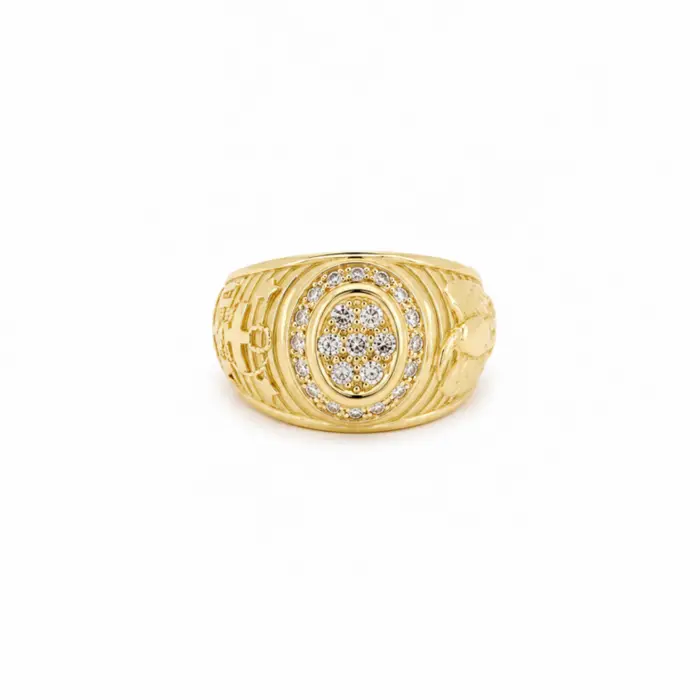
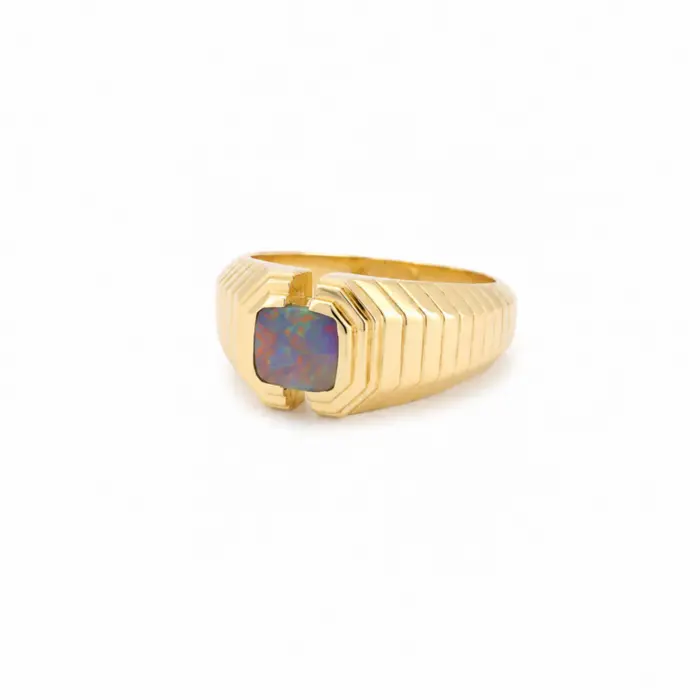
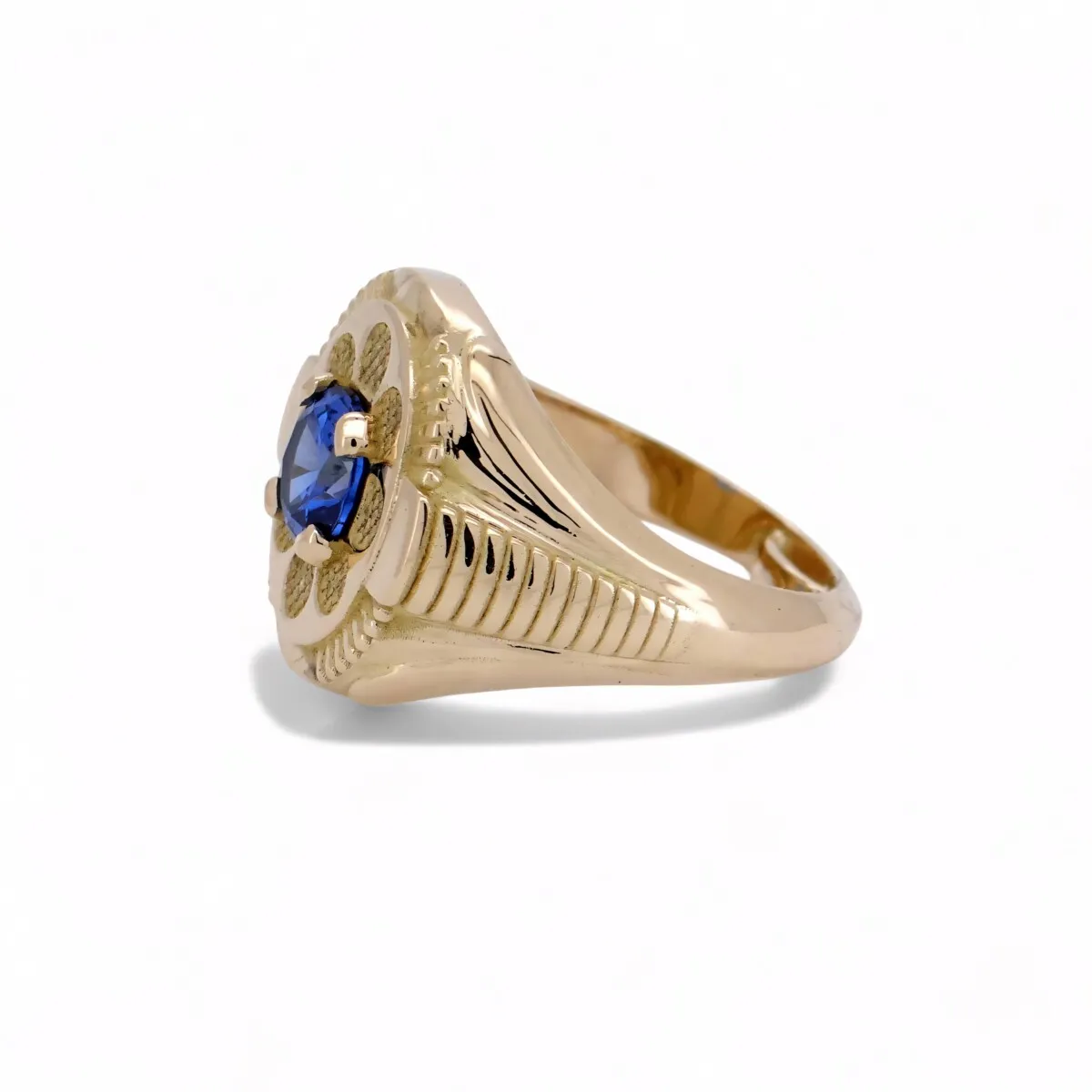
I took out my sketchbook and drew several designs. The one we chose had a flat top plate with, at its centre, the round blue cubic zirconia in a claw setting, surrounded by a sculpted hexagonal rosette. On the shoulders, stepped chased grooves gave the whole piece its rhythm. The design was approved on the spot.
From pouch to ingot
Everything was then made in my jewellery workshop. I first weighed and checked each old piece, then melted it down at around 1,064 °C, the melting point of gold. The metal was purified with borax and cast into a clean ingot. Seeing a tired bracelet and a broken chain become fresh, gleaming material, ready for use, always moves me.
The ingot was rolled into a thick plate, then drawn through the drawplate to obtain the sections required. The oval top plate was cut out with a piercing saw. The shank was shaped separately from a thick gold wire, bent on the ring mandrel and then soldered to the top plate.
The rosette, the grooves and the claws
Then comes the stage I like best: the decoration. With a chasing tool and hammer, I traced the floral motif by hand around the central setting. Each petal was gradually hollowed out, then refined with a needle file to achieve exactly the right relief. The grooves on the shoulders were incised with the same rigour, in a regular rhythm. This work demands total concentration: an error of a tenth of a millimetre would be enough to break the symmetry.
The central mount was then built as a claw setting. Each claw, cut from gold wire, was adjusted with a file to follow the outline of the stone. The blue cubic zirconia was placed in its seat, then the claws were closed over it with a graver. Thanks to the stone's hardness, the setting could be done with confidence, and the stone is held securely.
Finally came the finishing: sanding, filing to bring out every detail of the relief, then polishing with felt and cotton mops. It is at this point that the yellow gold took on its warmth and the blue truly responded to the light.
Handing over the signet ring
When he slipped the signet ring onto his finger, there was a brief silence. He turned his hand, letting the stone catch the daylight. He was not simply wearing a piece of jewellery: he was wearing the proof that a beautiful creation is still possible on a controlled budget, when materials are chosen with complete clarity. And his own gold, the gold of before, had found a second life.
If you too have jewellery forgotten in a drawer, or a desire for a yellow gold men's signet ring that truly reflects you, come and talk to me at the workshop in Saint-Sébastien-sur-Loire, near Nantes. We will take the time to look at what you have, to talk about your wishes and your budget, and to imagine your next piece together.