
Published on by Olivier Maupas-Sehikyan · Creations
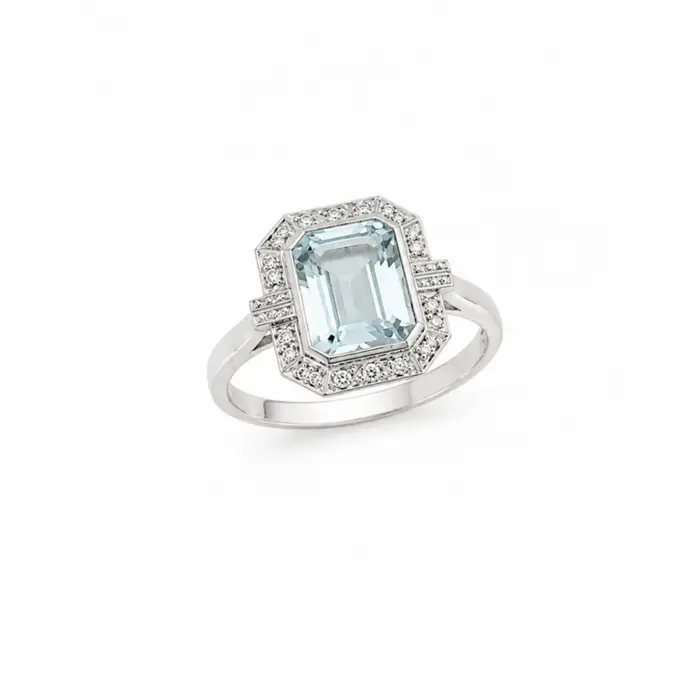
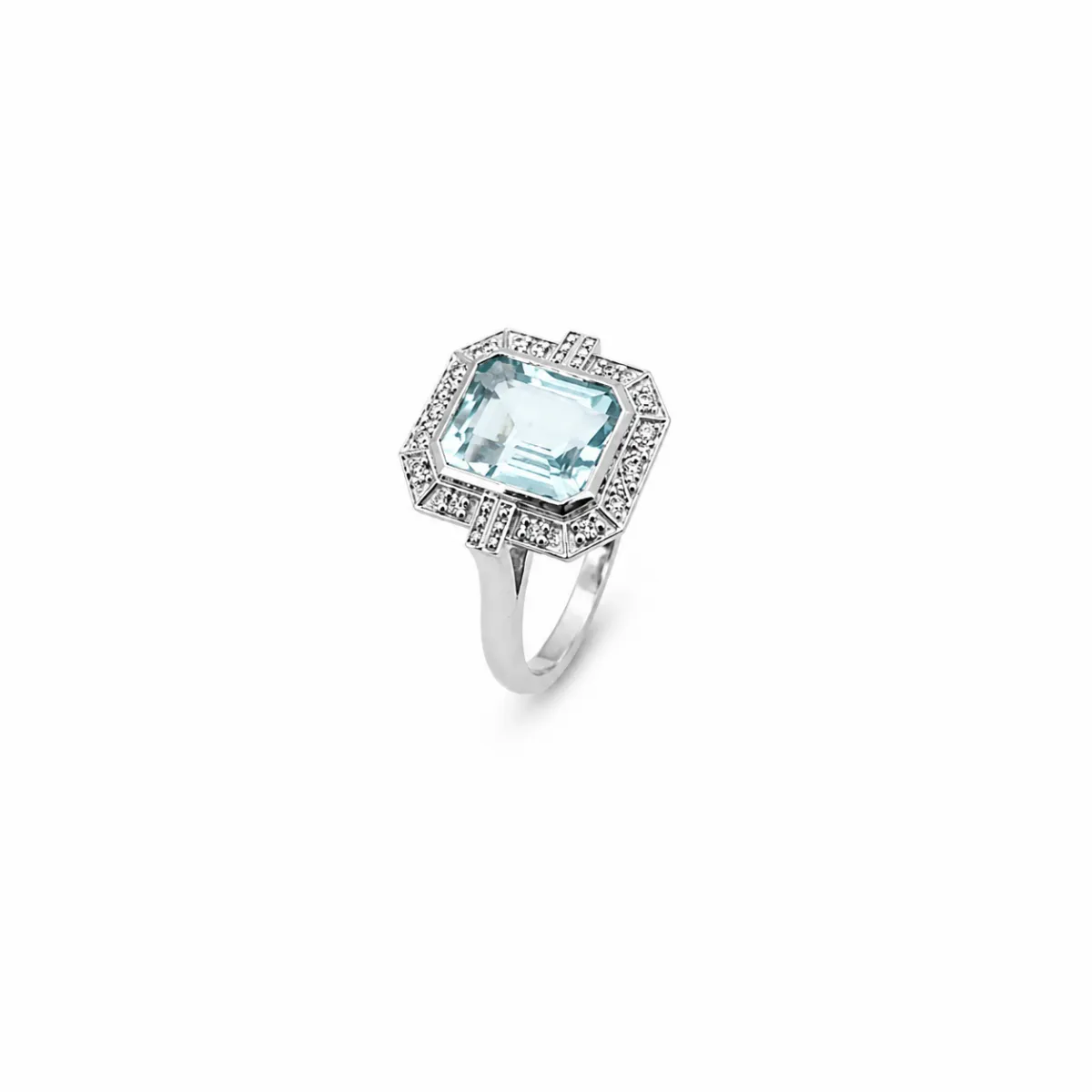
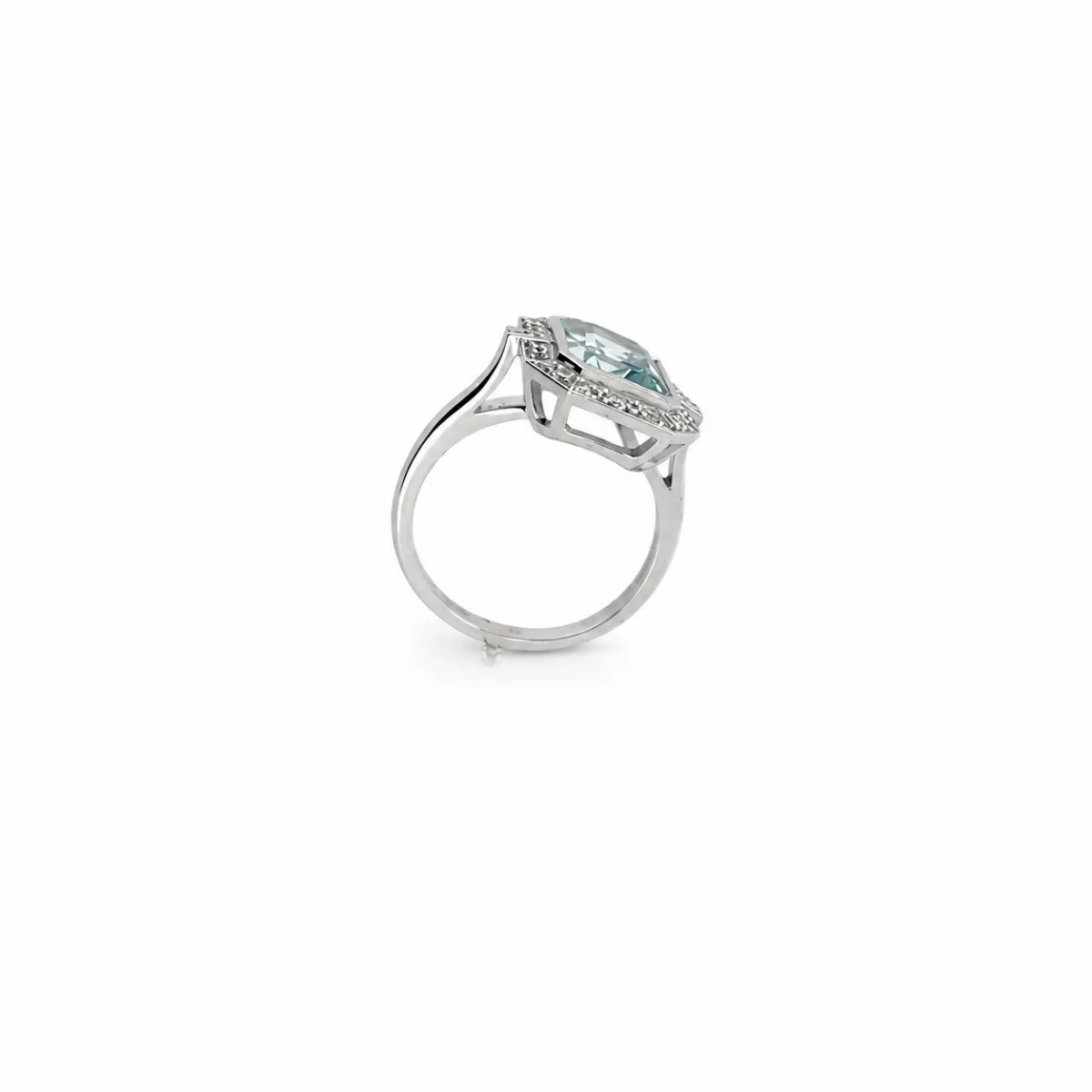
Some pieces of jewellery are born of a tight budget and a great desire for beauty. This is one of them: an Art Deco blue topaz ring in 18-carat white gold, with an emerald-cut stone at the centre and a halo of small diamonds with softened corners. I made it entirely by hand in my workshop in Saint-Sébastien-sur-Loire, south of Nantes, for a client who wanted to recapture the spirit of the Roaring Twenties. Here is its story.
A box on the counter: the brief for an Art Deco ring on a controlled budget
One day, a client pushed open the door of my workshop with a small box in her hands. She opened it in front of me: two 18-carat white gold rings she no longer wore, a broken chain, a few small diamonds kept over the years. These pieces, inherited or accumulated, had been sleeping in a drawer. She cherished them, without knowing what to do with them.
She then told me about what had always thrilled her: the Roaring Twenties and the Art Deco style. She imagined a geometric ring, with a rectangular blue stone at the centre, in the spirit of what Cartier was designing in the 1920s and 1930s. Elegant, but not ostentatious. A ring for every day, not for a shop window.
She did, however, set one condition, quite frankly: her budget had to remain under control. She had first thought of an aquamarine. But a fine emerald-cut specimen of more than two carats would have far exceeded her budget. The project seemed as though it might end there. It was at that moment that my experience as a gemstone dealer proved invaluable.
Sky Blue topaz or aquamarine: I explain the difference
I suggested an alternative: a Sky Blue topaz cut in the emerald style, generous in size, with a limpid colour very close to that of aquamarine. My rule is transparency. So I told her clearly that this was a topaz and not an aquamarine, explaining their true gemmological differences. I also explained that this blue is obtained through a time-honoured heat treatment, universally accepted in the trade.
Her answer was immediate. For her, what mattered was not the name of the stone, but how it looked and how well it suited the style she loves. This blue topaz would give her the same soft colour at a fraction of the price.
A few landmarks of the Art Deco style
The Art Deco style officially emerged in 1925, at the International Exhibition of Modern Decorative and Industrial Arts in Paris. It was born in reaction to the curves of Art Nouveau and champions geometry, symmetry and purity of line. Jewellery produced some of the most striking pieces of the twentieth century in this style, at Cartier, Boucheron and Van Cleef & Arpels. Its codes are easy to recognise: clean lines, rectangles, hexagons, cut corners, and a halo of diamonds around a coloured stone. They have not aged a day, which explains the constant popularity of these rings.
What topaz brings to an everyday ring
Topaz is an aluminium fluorosilicate, with the formula Al₂SiO₄(F,OH)₂. With a hardness of 8 on the Mohs scale, it is among the hardest minerals used in jewellery, which makes it perfectly suited to a piece worn every day. In France, decree no. 2002-65 reserves the term "precious stone" for diamond, ruby, sapphire and emerald: topaz is a semi-precious stone. This takes nothing away from its beauty. It comes in three main shades: Sky Blue (a soft sky blue, the one I chose), Swiss Blue (more vivid) and London Blue (deeper). Its hardness does not protect it from everything, however: it retains a cleavage weakness, and I took this into account in designing the setting.
As for the 18-carat white gold, it is an alloy of 75% pure gold, enriched with palladium. It provides a sober, luminous setting, which a final rhodium bath perfects, bringing out the contrast between the whiteness of the diamonds and the tender blue of the topaz.
From sketch to polish: a ring handmade in Saint-Sébastien-sur-Loire
I took out my notebook and drew several sketches in front of her. The design we chose places the topaz at the centre, in a closed setting, surrounded by a hexagonal halo of small diamonds with softened corners. The shank, split in two for a contemporary effect, carries a pavé of diamonds on each branch. She approved the design. All that remained was to make everything, on site, in my workshop near Nantes.
I began with the gold. The old pieces were weighed, tested, then melted down, the metal purified with borax and cast into a clean ingot. This stage always moves me: several pieces that no longer shared a life together merge into a single material, ready to become something else. The ingot was then rolled into a sheet, then drawn through the draw bench to obtain the sections required.
The split shank called for particular care. Two separate branches were cut out with the piercing saw, bent separately on the ring mandrel, then joined into a split band. The hexagonal plate was cut out in the same way from a thin sheet, scrupulously respecting the Art Deco geometry. Its cut corners are a signature of the style: they give the piece its modernity.
For the topaz, I bent a thin strip of gold to the exact perimeter of the stone to form the closed setting. This technique protects the sharp corners of the emerald cut very well, precisely where the cleavage makes the stone vulnerable. The small diamonds came from my client's old jewellery. I sorted them under a x10 loupe, checking clarity, colour and calibration, so that the crown of the halo would be perfectly even. Their seats were then cut with a conical burr, at a regular rhythm: in the Art Deco style, symmetry must be accurate to the millimetre.
Then came the time for setting. I placed the topaz in its closed setting, then folded the gold strip over its girdle with the pusher, by gradual pressure. Each diamond of the halo and the pavé was grain-set, with the graver and then the beading tool. The ring was finally smoothed, polished with felt and then cotton, before its rhodium bath.
Handing over the ring: the style of her dreams on her finger
When my client slipped this bespoke Art Deco ring onto her finger, her smile said it all. She was at last wearing the style she had long dreamed of, fashioned from her own jewellery and within her budget. A broken chain, two outdated rings and a few forgotten diamonds had become a piece she will wear every day.
If you too keep old jewellery in a box, and an idea keeps turning over in your mind, come and talk to me at my workshop in Saint-Sébastien-sur-Loire, south of Nantes. We will look at what you have, talk about your wishes, and see together what it is possible to imagine.