
Published on by Olivier Maupas-Sehikyan · Necklaces
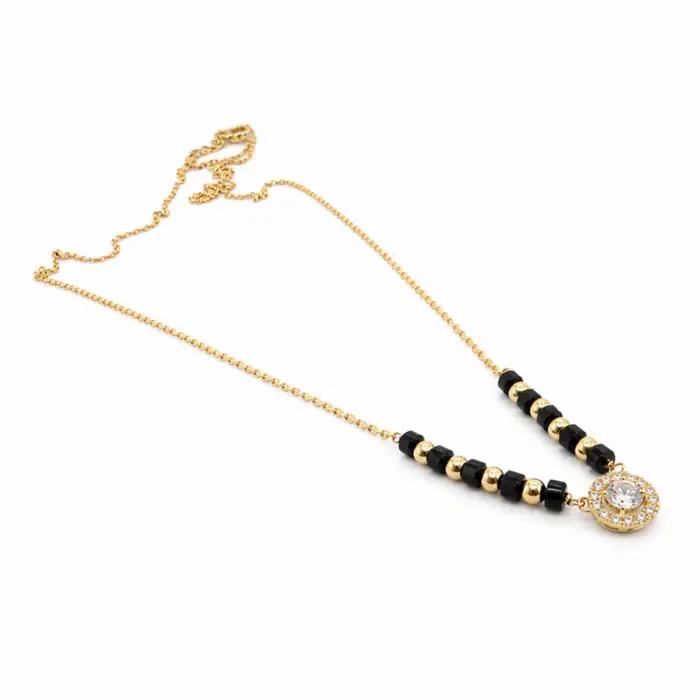
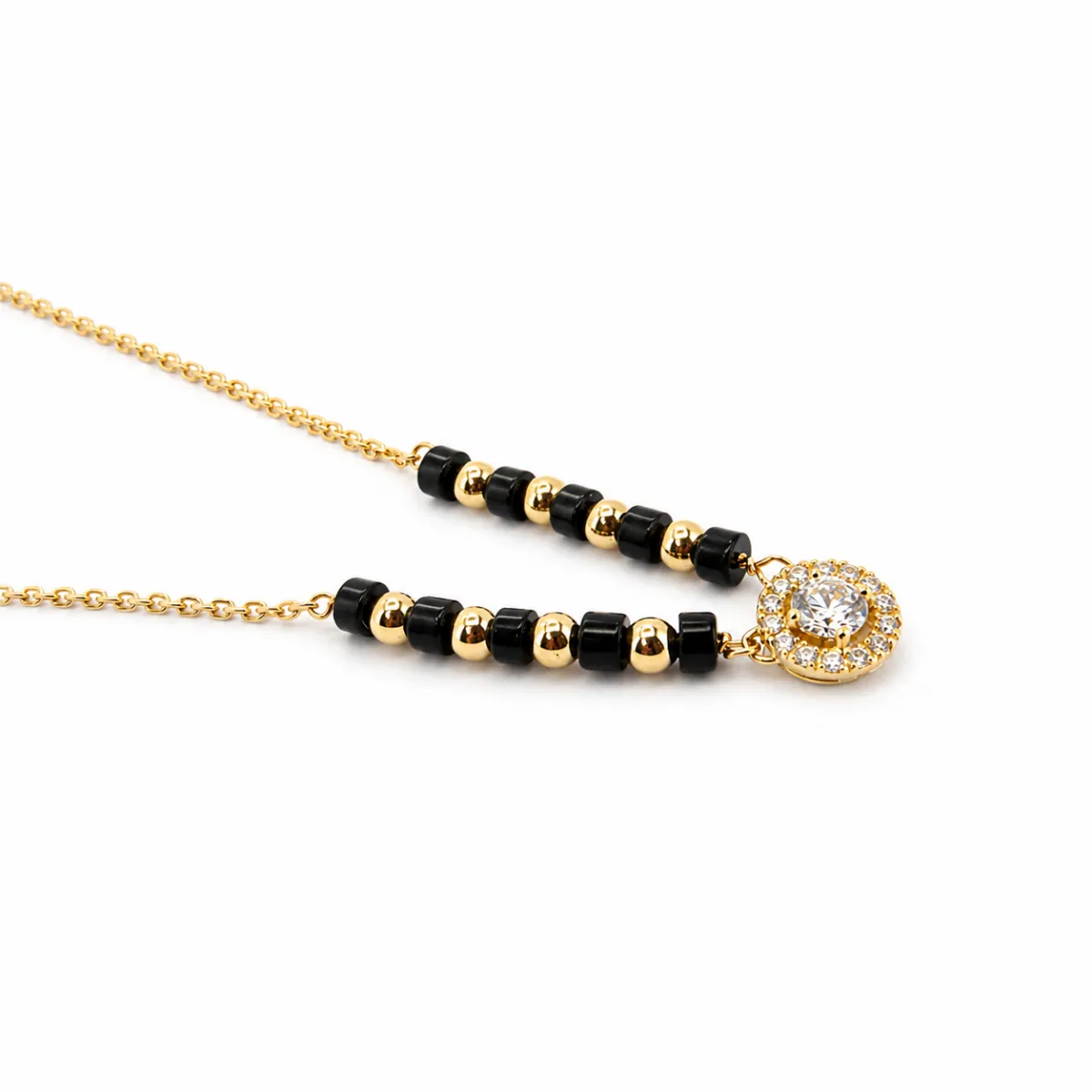
Some creations are born where two cultures meet. The one I want to tell you about today is a bespoke mangalsutra necklace, made of black onyx beads separated by gold beads, extended by an 18-carat yellow gold chain and centred on a pendant set with laboratory-grown diamonds. I made it by hand, in my workshop in Saint-Sébastien-sur-Loire, south of Nantes, for a couple about to be married in the Indian tradition. Here is how it came to be.
A bespoke mangalsutra necklace for an Indian wedding
It all began with a visit to the workshop. A young couple pushed open the door, smiling, clearly very close. They were preparing their wedding according to Hindu traditions, a ceremony rich in symbolism that would bring their two families together.
Their request was clear. The groom wished to give his future wife a mangalsutra, the sacred wedding necklace that would be tied around her neck during the Mangalya Dharanam, the "sacred tying". It is the most solemn moment of the wedding. She would then wear it for the rest of her married life.
We talked for a long time. I listened as they described what they hoped for from this Indian wedding jewel: to respect the essential codes of tradition while keeping a contemporary design, true to a modern couple settled in France.
Three elements had to appear on the necklace without fail. First, the black onyx beads, which protect the bride from the evil eye. Then the gold beads, symbols of prosperity and family blessing. And finally a finely worked central pendant, to embody the union.
The bride-to-be added a wish that touched me: she dreamed of diamonds at the heart of the pendant, but without any mining. I suggested laboratory-grown diamonds, which offer the same beauty as natural diamonds. The couple accepted without hesitation. The choice suited them, somewhere between tradition and modernity.
I then opened my notebook and drew several sketches. The one chosen shows a long 18-carat yellow gold chain, punctuated at its centre by a line of onyx beads interspersed with small gold beads. In the middle sits a round pendant, with a central laboratory-grown diamond surrounded by a halo of small diamonds. The design was approved.
Mangalsutra, black onyx and gold: what the symbols tell us
Before moving to the bench, I like to take the time to understand what I am about to make. The word "mangalsutra" comes from the Sanskrit mangala sutra, the "auspicious thread". Indian texts mention it as early as the 4th century, notably the Lalita Sahasranama and the Purananuru. That is a measure of its antiquity.
During the ceremony, the groom traditionally ties three knots. The first expresses his commitment, the second the union of the two families, and the third (sometimes tied by the groom's sister) the bride's promise to her new family. Regional variations are many: in northern India, the necklace combines black beads with a gold pendant, while in the south it is called thali or thaali, with a heavier pendant. The meaning, however, does not change: to protect the wife and make the union visible.
Black onyx belongs to the chalcedony family. With a hardness of 6.5 to 7 on the Mohs scale, it is well suited to a piece worn every day. Since antiquity it has been credited with the power to absorb negative energies, which is why it holds a central place in this necklace.
As for 18-carat yellow gold, an alloy of 75% pure gold with copper and silver, it is the traditional metal of the mangalsutra. Its sunlit warmth evokes prosperity and abundance.
That leaves the laboratory-grown diamond. It is chemically, physically and optically identical to a natural diamond. Produced by the HPHT (high pressure, high temperature) or CVD (chemical vapour deposition) process, it reaches the same hardness of 10 on the Mohs scale and shows the same brilliance, without the footprint of the mine.
Making a yellow gold and diamond necklace in Saint-Sébastien-sur-Loire
Then came the craftsmanship. Everything was made on site, by hand, in my workshop near Nantes.
From molten gold to chain
I began by melting the 18-carat yellow gold to produce a clean ingot. The metal was brought to around 1,064 °C, its melting point, then purified with borax and poured. The ingot was then rolled and drawn on the draw bench to obtain the wire I needed.
The chain was assembled link by link, patiently bent and then soldered. I checked every link, since the suppleness and strength of the whole depend on it.
The gold beads and the pendant
The gold beads were shaped separately from thick wire, sculpted and then polished until they formed the perfect sphere of the mangalsutra. I drilled them so that they could be threaded onto the central chain.
The round pendant, also in 18-carat yellow gold, was built piece by piece. I fashioned the claw setting for the central diamond, then cut the seats for the halo with a conical bur, in strict symmetry.
Assembly, setting and polishing
The assembly demanded real concentration. The onyx beads were aligned with the gold beads according to the traditional rhythm, then fixed at the centre of the chain. A sturdy soldered ring links the pendant to the chain, so that it carries the weight without any worry.
Then came the setting. The central diamond was delicately placed in its claws, which were closed over it with a knife-edge tool. Each small diamond in the halo was then grain-set, using a graver and a beading tool. Finally, the necklace was sanded, then polished with felt and cotton, until the yellow gold regained all its light.
The day the couple discovered their mangalsutra
When I handed over the necklace, the couple's eyes filled with tears. Nobody spoke at first. They looked at the black beads, the little gold spheres, the pendant catching the light, and I think they could already see the day of the ceremony. I admit I had a lump in my throat myself. Making a jewel that will carry a promise is a responsibility I never take lightly.
This necklace will now accompany them throughout their life together. It keeps the essential symbols of tradition, and it was designed according to their values, with laboratory-grown diamonds and gold worked by hand.
If you are preparing a wedding with cultural traditions, or if you carry within you a piece of jewellery whose outline you cannot quite draw yet, come and talk to me at the workshop in Saint-Sébastien-sur-Loire, south of Nantes. We will take the time to listen to you, and to imagine your next piece together.