
Published on by Olivier Maupas-Sehikyan · Rings
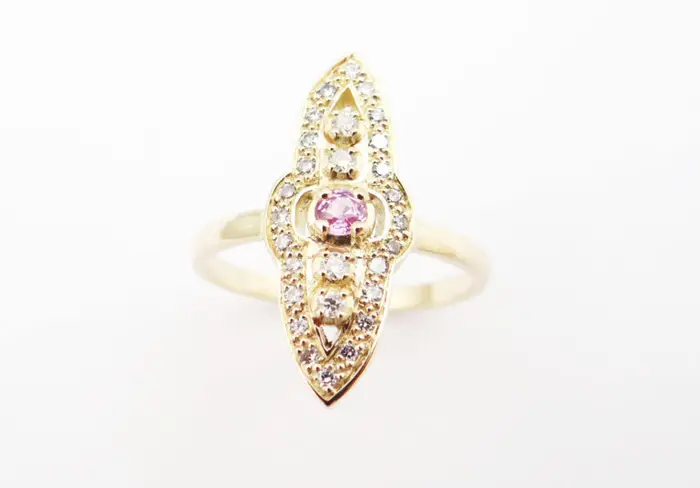
There are afternoons when the light enters the workshop in Saint-Sébastien-sur-Loire with a particular softness, as if it knew that something beautiful was in the making. That was the case on the day a client set a few small pouches down in front of me and explained what she hoped for. She wanted a marquise ring for a birthday that meant a great deal to her. I listened, and I understood very quickly that this would be no ordinary commission.
A birthday request: a yellow gold marquise ring
She already had her idea: an elongated shape with fine points, which would sit gracefully on the finger. At the centre, a pink tourmaline. All around it, diamonds. She wanted yellow gold, warm, to give the stone its most vivid colour. I liked the clarity of her request straight away. She was not looking for a fashionable piece of jewellery, but for an object that would mark a date and then stay, for a long time, in the hollow of her hand.
We took the time to talk about the occasion itself, and what it represented for her. In my trade, this is the part I enjoy most: before the first stroke of the pencil, one must understand what the piece of jewellery is meant to carry. A birthday ring is not merely a beautiful object. It is a landmark, a way of saying "that day happened".
Supplying your own gold and stones: the meaning of the making charge
What made this project unusual is that my client entrusted me with the materials herself. Both the gold and the stones came from her. These raw materials carried a history that I did not need to know in detail in order to sense it: one does not hand gold and stones to a craftsman without attaching a personal value to them.
She therefore paid only for the making. The French word, "façon", is old and little known outside the profession: it refers to the work of the hand, the design, the casting, the setting, everything that turns a raw material into a piece of jewellery. I find that this principle gives a particular dimension to the bespoke ring in Nantes that I offer. The money does not buy stones, it pays for a craft. And my responsibility is great: I am holding between my fingers something that cannot be replaced.
A material to be respected
Before beginning, I examined each stone under the loupe, then laid them side by side on my workbench. I look at their size, their colour, their character. A pink tourmaline, for instance, never shows quite the same shade depending on the light that touches it. One has to learn to read it before deciding how to surround it.
Designing a ring around a pink tourmaline
The design began with the marquise shape. Its boat-like silhouette, with its elegant curves and its two points, visually lengthens the finger and lets the central stone breathe. It was the right choice for a pink tourmaline: the pink gains in length and softness, and the ring never looks heavy.
I then considered the placement of the diamonds. I did not want them to compete with the tourmaline. Their role is that of a luminous frame, a discreet yet crisp sparkle that underlines the colour without rivalling it. Each stone was therefore chosen, then positioned on paper with care, so that the balance between the brilliance of the diamonds and the warmth of the pink holds at a single glance.
I showed my sketches to my client, we adjusted two or three details, and the project took its final form. It is always a moment I enjoy: the piece does not yet exist, but it is already there, between us.
From casting 18-carat yellow gold to setting the diamonds
Next came the work on the metal. 18-carat yellow gold has a richness that other alloys lack: a full colour, an almost living warmth. I melted it, then shaped it, before taking it up again with file and tool to form the body of the ring. At this stage, everything depends on the precision of the gesture. A curve pressed too hard, a point slightly misaligned, and the marquise shape loses its elegance.
The mount was shaped to receive the tourmaline at the centre and the diamonds all around it. Then came the setting, the stage that demands the most concentration. Each stone must find its exact place, aligned with its neighbours, held firmly enough to withstand the years without the metal smothering it. One works with tiny tools, almost holding one's breath. When the last claw closes, you know the stone is there to stay.
Polishing, the final gesture
Polishing completes the work. It erases the tool marks, restores the warm lustre of the gold and reveals the light of the diamonds. It is a stage one might take to be insignificant, and yet it changes everything: the ring ceases to be a piece of work and becomes a piece of jewellery.
Handing over the ring, and what it tells
I will not claim to be a detached craftsman. When I placed this ring in its box, I felt what I feel every time: a mixture of pride and reserve. Pride, because I had worked with a material of very fine quality, and every stage had been carried out with the rigour I demand of myself. Reserve, because I knew that this piece of jewellery no longer belonged to me. It belonged to my client's birthday, to what it meant to her.
This, I believe, is the finest reward of my trade: knowing that a piece leaving my workshop will accompany a precious moment, and then thousands of others. A yellow gold marquise ring, a pink tourmaline, a few diamonds: the elements are simple, but they now carry a date, a gesture, a story.
If you too have family gold, stones kept in a drawer, or simply the wish for a piece of jewellery that reflects an occasion in your life, come and talk to me at the workshop in Saint-Sébastien-sur-Loire, near Nantes. We will take the time to look at what you have and to see together what it might become.