
Published on by Olivier Maupas-Sehikyan · Signet rings
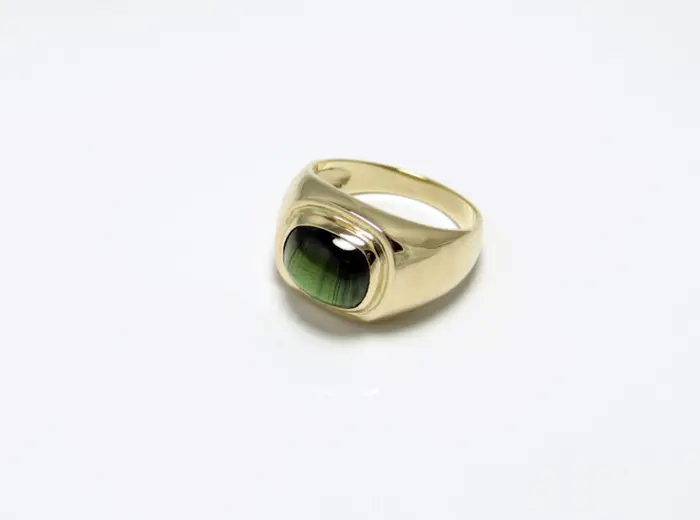
Some projects begin with a sketch, others with a stone laid on the workbench. This one began with both. A client pushed open the door of my workshop in Saint-Sébastien-sur-Loire, near Nantes, bringing gold he already owned and a green tourmaline cut as a cabochon. His idea could be summed up in a single sentence: to turn that gold into a bespoke men's yellow gold signet ring, elegant, with this stone at its centre.
A commission born of gold and a stone
I remember the way he placed the tourmaline in my palm. Without ceremony, but with the care one reserves for objects that matter. The green was deep and vibrant, and its nuances shifted as I turned the stone towards the window or towards the work lamp. The smooth, rounded cabochon cut gave it an almost liquid softness.
I did not try to learn more than he wished to share with me. What mattered to me was the desire I could sense behind his request: to wear on his hand a piece of jewellery that resembles him, made from materials that already belong to him. Working with a client's own gold means receiving trust as well as metal. It is not something one handles lightly.
We talked about the shape, the volume, the way the signet ring should sit on the finger. He wanted a solid, masculine piece, without unnecessary heaviness. I therefore took the exact measurement of his finger with great care, because a signet ring that spins or pinches is never truly worn.
The design, then the melting of the 18-carat yellow gold
Before touching the metal, I drew. A few lines at first, then more precise proportions: the width of the band, the thickness of the shoulders, the position of the stone. A signet ring is a piece with presence. It must have character while remaining comfortable, even when you forget you are wearing it.
The choice of metal was obvious. 18-carat yellow gold offers a warm, rich hue that naturally complements the green of a tourmaline. It is also firm enough for a piece worn every day, while remaining a pleasure to work.
To begin with, the gold brought by the client was melted down, then refined to achieve the desired purity. It is a stage that still fascinates me. Dull pieces with no apparent connection to one another become a luminous liquid metal, ready to take on a new form. There is something of a rebirth in it, and I never tire of it.
From wax to metal: giving the ring its form
Next comes the time of the model. I sculpted the ring in wax, taking the finger measurement into account, then made the mould into which the gold was cast. Nothing is left to chance at this stage: the slightest irregularity in the model would be reproduced in the metal.
Once the ring was out of the mould, the true work of sculpting began. With file, scorper and graver, I reworked the volumes, refined the edges and brought out the details. Every gesture aims at the same thing: that the signet ring should look inevitable, as though it could never have taken any other form.
The closed setting of the green cabochon tourmaline
The heart of the project remained. For the green cabochon tourmaline, I chose a closed setting (also known as a bezel setting), a technique in which the stone is surrounded all the way round by a rim of metal. This choice met a twofold requirement. On the one hand, the hold is very secure, which matters for a man's jewellery that lives, works and travels with him. On the other, the gold rim draws a clean, discreet frame around the green.
To make this setting, I had to adjust the bezel seat, the small recess that receives the stone, to the exact outline of the tourmaline. Then I gently folded the metal over it, millimetre by millimetre, with the patience this gesture demands. Too little pressure and the stone moves. Too much, and one risks damaging it. You listen to the metal as much as you guide it.
Why green tourmaline is so appealing
Green tourmaline is a fascinating stone. It is credited with healing, protective and balancing virtues, which lend it a very personal dimension for the person who wears it. Beyond these symbols, it is also a stone prized in jewellery for its durability and its ability to catch the light.
As a cabochon, it reveals something else: a depth of colour, and reflections that glide across the rounded surface with the movements of the hand. For a green tourmaline signet ring, this is a rare asset. The eye pauses on it, then returns.
The polishing and handing over of the signet ring
Polishing is the final stage, and one of the most important. It takes the ring from a fine piece of metal to a finished jewel. I carried it out in successive passes, ever finer, until I achieved a luminous yellow gold, crisp surfaces and a perfectly smooth setting rim around the stone. One last check of the fit, the comfort and the security of the setting, and the signet ring was ready.
On the day of the handover, the client slipped it onto his finger. It fitted perfectly. He turned his hand towards the light, watched the green of the tourmaline deepen in its gold setting, and his satisfaction showed without his needing to say much. For me, that is the finest reward. Every detail had been considered, then executed with care, and the result lived up to the trust he had placed in me.
Creating a piece of jewellery from materials the client brings himself strengthens the bond between the craftsman and the person who will wear it. The gold and the stone already had a history before they came to me. They now have a new one, which continues each time he puts on his signet ring.
If you too have gold or a stone lying forgotten in a drawer, or if you dream of a signet ring made for your hand, I would be delighted to talk it through with you. Come and meet me at the workshop in Saint-Sébastien-sur-Loire, near Nantes. We shall take the time to look, to talk and to see what your materials might become.