
Published on by Olivier Maupas-Sehikyan · Signet rings
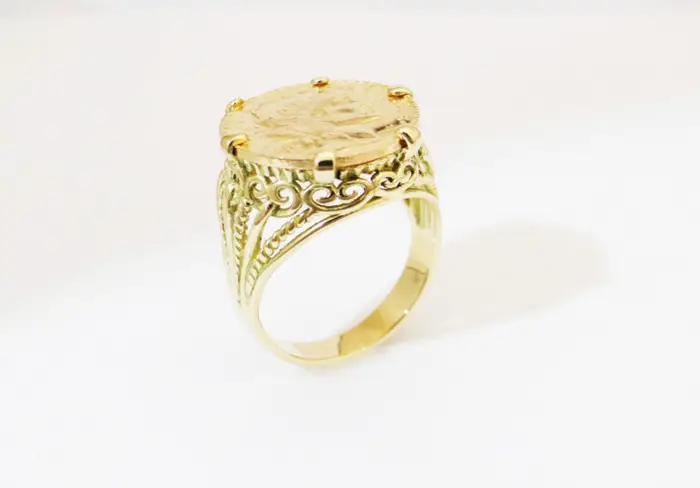
A precise request, at the workshop in Saint-Sébastien-sur-Loire
Some clients push open the workshop door with a project already very clear in their mind. The man I am telling you about today was one of them. He held in his hands pieces of gold, the remains of several old pieces of jewellery he no longer wore, and he knew exactly what he wanted to do with them: a bespoke yellow gold signet ring, for a man, with a Napoléon laureate head 20-franc coin at its centre.
He explained to me where this gold came from, without any fuss. Jewellery gathered over the years, which no longer had a place on his finger or around his neck, but which he could not bring himself to part with for good. Selling it felt strange to him. Leaving it at the back of a drawer felt a little sad too. He was looking for a third way, and that was when I understood that we were going to do some lovely work together.
In my workshop in Saint-Sébastien-sur-Loire, near Nantes, this approach is not unusual, but it moves me every time. Reusing the gold you already own is a way of continuing a story rather than closing it. We laid the pieces out on the bench, then talked about the finger size, the placing of the coin, and the weight the ring should have in the hand.
The Napoléon laureate head, a coin that carries history
A word about the coin itself, for those who do not know it. The Napoléon laureate head is a gold coin struck in France during the reign of Napoléon III. It is also known as the gold Napoléon. It weighs about 6.45 grams, which you can feel in the palm of your hand. The emperor's profile is crowned with laurel, hence its name.
Making a 20-franc coin signet ring demands real respect for the object. The coin must on no account be melted down: it must remain whole and legible, with its relief and its lustre intact. The signet ring becomes its setting. All the work therefore lies in building a mount that shows the coin to its best advantage without ever overpowering it, or doing it the slightest harm.
My client looked at it with a kind of tenderness. It would be the focal point of the piece, the element around which everything else would be organised. I believe that it was at that moment that the shape of the future ring began to take form in my mind.
From drawing to casting: making a men's 18-carat gold signet ring
The first stage was to melt my client's pieces of gold to obtain an 18-carat yellow gold alloy, homogeneous and ready to be worked. I love this moment. Fragments of varied origins blend in the crucible and become a single metal, of an even colour. This piece of jewellery in reclaimed gold then takes on another dimension: the old gold has not disappeared, it has simply changed its face.
Then came the time for the design. I conceived it always keeping in mind the size of the coin and the perfect fit on my client's finger. A man's signet ring must have presence, of course, but it must also be forgotten in daily life: a well-rounded interior, edges that never dig in, and a seat that does not turn on the hand. Every detail was measured, from the width of the coin to the thickness of the band.
Shaping, gesture after gesture
Using traditional jewellery techniques, the gold was shaped step by step. The metal was worked, filed and refined until it reached the desired form. Every curve and every angle called for precision, because a men's 18-carat gold signet ring must be a pleasure to look at, but also sturdy, designed to last.
The coin was then placed at the centre and fitted into its mount. This is the stage that demands the most calm. One gesture too forceful, and you damage what you meant to honour. I take my time, I check, I go back over it if necessary, until the coin sits perfectly and no play remains.
Polishing, then handing over the signet ring
What remains is the polishing, which I enjoy the way one enjoys a final reread of a letter. The surfaces soften, the tool marks disappear, and the light begins to glide over the yellow gold. At this stage, the signet ring is no longer a project: it exists, with its weight, its warmth, its presence.
When my client returned to the workshop, I handed him the piece. He slipped it on, turned his hand in the light, and his expression was enough for me. He did not need a grand speech, and neither did I. Seeing old pieces of gold, long left in the shadows, brought together in a single piece that he would now wear every day: that is what makes my profession so beautiful.
As the gold came from him, he paid only for the labour. I find that fair: the material already had its value, and it was for craftsmanship to do the rest. This signet ring is therefore not merely a band of 18-carat yellow gold. It is an object steeped in personal history and sentimental value, and this experience gave me deep satisfaction.
Come and talk to me at the workshop, near Nantes
If you too have old jewellery at the back of a drawer, or a gold coin that matters to you, come and talk to me at the workshop in Saint-Sébastien-sur-Loire, near Nantes. We will look together at what they might become, without haste. Sometimes a simple conversation around the bench is enough for an idea to be born.