
Published on by Olivier Maupas-Sehikyan · Rings
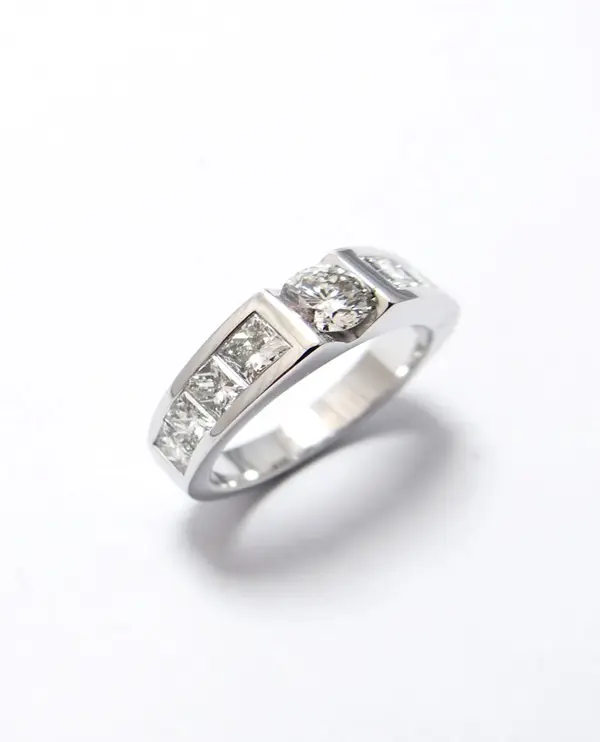
A 0.50-carat diamond ring in white gold, born of a vision
Some pieces of jewellery reveal themselves from the very first conversation. This one was born of a vision, that of a client who knew exactly what she wanted to see on her finger: a white gold ring, a diamond at the centre, and on either side a line of square stones, crisp and luminous. She walked into my workshop in Saint-Sébastien-sur-Loire, near Nantes, with that image in mind. It was up to me to make it real.
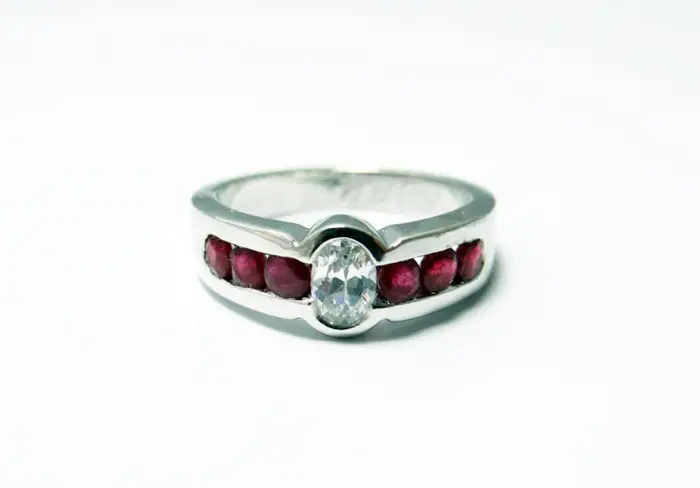
The brief was short, but it demanded great precision. The aim was to create a 0.50-carat diamond ring in 18-carat white gold. The centre diamond, at 0.50 carat, had to remain the focal point. On the shoulders of the ring, on either side, princess-cut diamonds would be channel-set, like a thread of light that accompanies the stone without ever stealing the show.
I remember thinking, as I listened to her, that I was going to enjoy this project. It combined technical rigour, which is my daily work, with the freedom of designing a piece that would exist nowhere else. A bespoke white gold ring only makes sense if it resembles the person who wears it. So I needed to take the time to understand her tastes, her hand, the way she lives with a piece of jewellery.
The wax model: seeing the ring before it exists
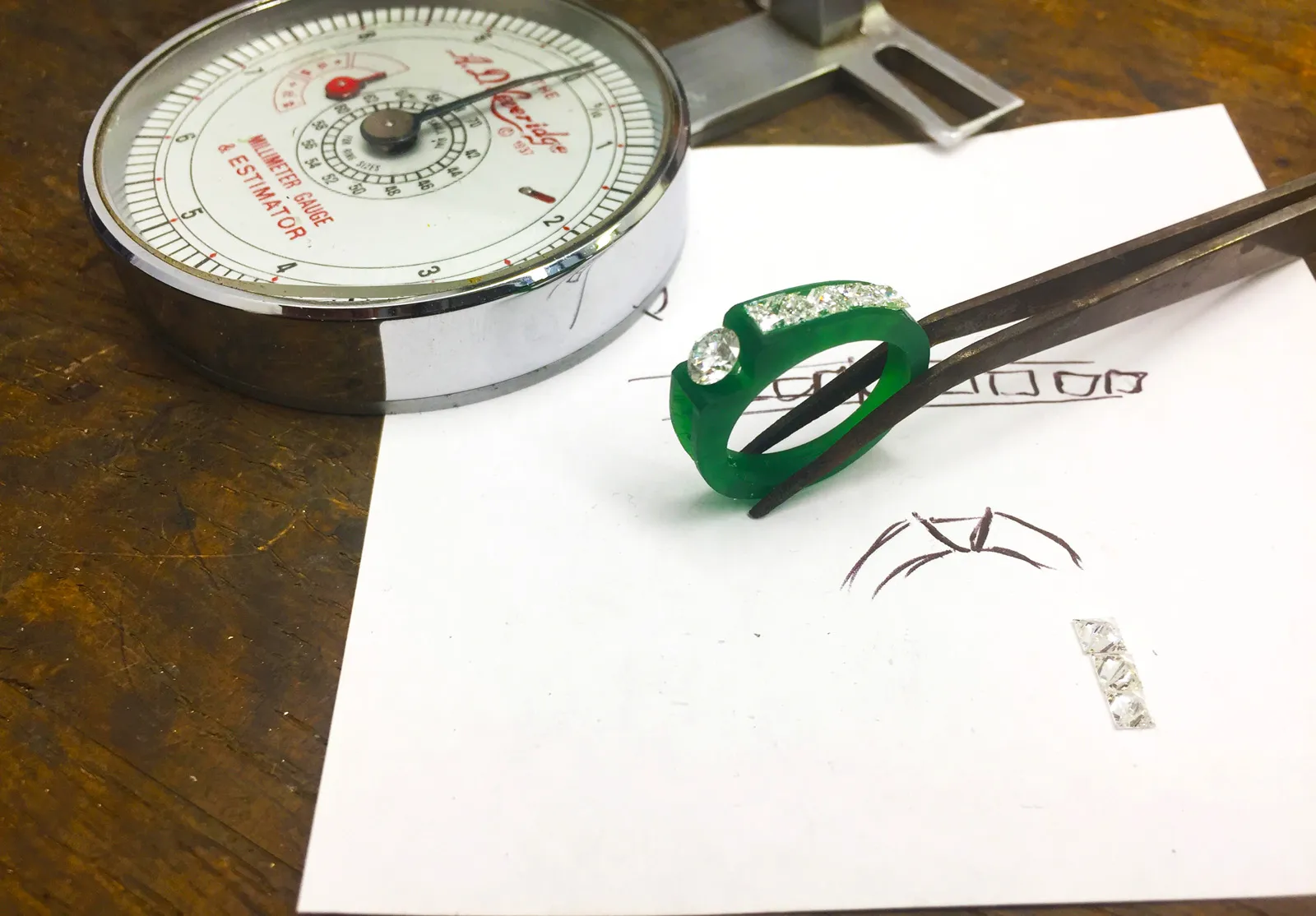
It all began with the wax model. It is a stage I never skip, because it changes everything. On paper, a ring remains an idea. In wax, it takes on volume, weight and proportion. You can hold it between your fingers, try it on, turn it under the light.
I carefully sculpted the form: the height of the setting, the thickness of the band, the width of the channels that would receive the princess-cut diamonds. My client watched the prototype take shape before her eyes. This moment is precious to me, because it makes her a participant in the creation. She no longer chooses from a catalogue, she takes part. Every adjustment, however small, brings the ring closer to what she had imagined.
This model also allows us to check what the eye does not always see: comfort on the finger, the balance between the centre stone and the channels, the way the ring will sit alongside other jewellery. Once the wax was approved, we could move on to the precious metal, with the confidence of those who know where they are going.
Why 18-carat white gold
The choice of metal came almost naturally. 18-carat white gold has a cool, crisp brilliance that shows diamonds to their best advantage and lets their clarity shine through. It is sturdy enough for everyday wear, yet fine enough to be worked with delicacy. Around a 0.50-carat diamond, it plays the part of a discreet setting.
Channel-set princess-cut diamonds: the workshop's craft
Next comes the part I love most, where precision becomes almost an art. The wax was turned into metal by casting, then the rough band passed through my hands to be refined, adjusted and finished. It is at this stage that the ring begins to have real presence.
Setting demands total concentration. Channel-set princess-cut diamonds are particularly exacting: their square cut forgives nothing. Each stone must be perfectly aligned with its neighbour, at exactly the same level, with a minuscule gap between them, so that the line appears unbroken. The corners of the princess cut are also more fragile than those of a round brilliant, which means working slowly, with measured movements. A successful channel is recognised by the fact that you barely see the metal, only the light running from one stone to the next.
The centre diamond was set with the same care. It had to be held securely, without the claws weighing down the look of the ring. I oriented it so that it would catch the light from every angle, then checked under the loupe that every detail was in order.
Polishing, the final touch
Last comes the polishing, which I always do myself. It gives the metal its deep lustre, removes the last traces of the tool and brings out the lines of the piece. It is an almost silent moment, in which the ring changes its look from minute to minute. When it had taken its final form, I knew it was ready.
Everything took place in my workshop, without the piece ever leaving my benches. This allows me to control every stage, from the selection of the diamonds to the last pass of the polishing wheel. Nothing is left to chance, and that is what gives a bespoke jewellery creation in Nantes and the surrounding area its authentic character.
Handing over the ring: the emotion of discovery
On the day my client came to collect her jewel, I admit to feeling a small pang. After weeks spent with this ring, one has to accept seeing it leave. But I know of no better way to let it go than to see the face of the person for whom it was made.
I presented the ring to her in its box. She looked at it for a moment without a word, then slipped it onto her finger. The 0.50-carat diamond caught the light, the princess-cut diamonds drew their fine, clear line on either side, and her delight was immediately plain to see. It was no longer a drawing or a wax model, but a living piece of jewellery, made for her.
For me, that is the true reward of this craft. A ring is not merely a beautiful object. It carries expertise, a story, and the emotion shared between a jeweller and the person who entrusted him with her idea. This one will stay on her finger for years, and she will keep, I hope, the memory of how it came to be.
Talking about your project at the workshop
If you dream of a ring with a diamond, princess-cut stones or a metal you love, come and talk to me at the workshop in Saint-Sébastien-sur-Loire, near Nantes. We will take the time to look together, to sketch, to handle the wax. Even a still-vague idea can become a piece of jewellery; often, all it takes is a conversation to begin.