Published on by Olivier Maupas-Sehikyan · Rings
Some visits to the workshop announce themselves the moment the door opens. That day, a client walked in with a broad smile and a very clear idea: she wanted to give a ring to her future husband. Not the other way round, no. She was the one planning the proposal, and she was determined that the piece should look like the two of them.
A proposal ring conceived as a sun
She told me about what they share: joy, energy, fits of laughter. The white diamond solitaire, far too predictable in her eyes, held no appeal. What she was looking for was a stone with a story to tell. A stone able to say who they are.
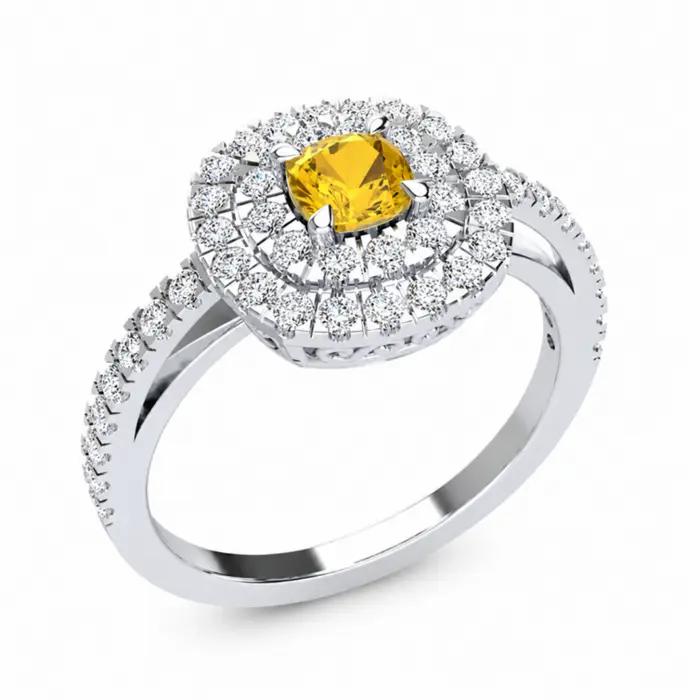
We talked for a long time, around my workbench. She loves colour, she dares to wear bold outfits, she laughs easily, and yellow has followed her around for as long as she can remember, like a signature. So the idea came almost by itself: a yellow diamond at the centre, surrounded by white diamonds that would make it sing. For a proposal ring given to the man she loves, I could not think of a finer symbol.
I opened my safe and took from my collection a round brilliant-cut yellow diamond of remarkable saturation. Under the light of the workshop in Saint-Sébastien-sur-Loire, it shone like a little sun resting in my palm. She did not hesitate for a second.
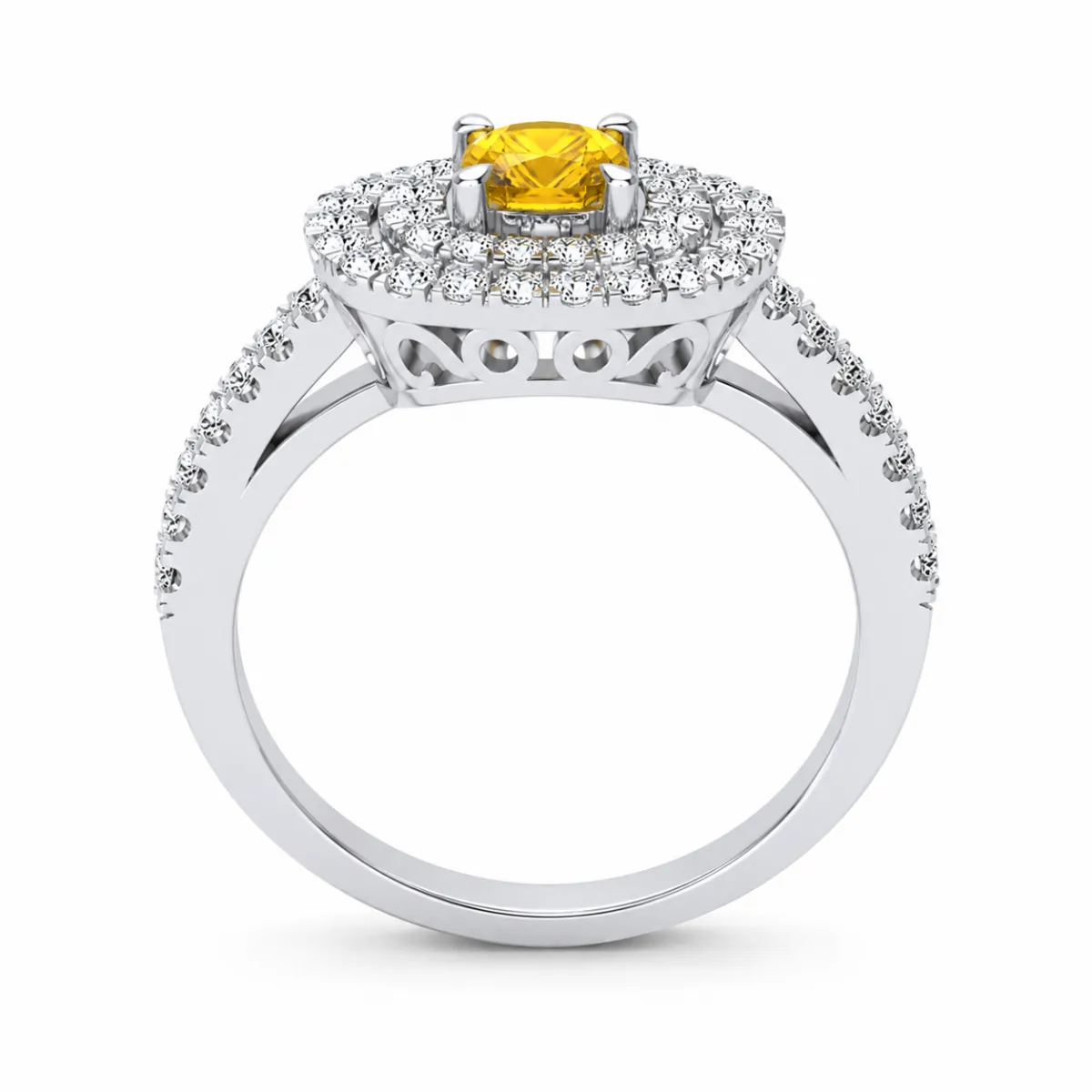
Out came the sketchbook, and the drawings followed one after another. We settled on a yellow diamond in a claw setting, encircled by a first halo of white diamonds in bezel (collet) settings, then a second in grain setting. The ring body would be double, each shoulder paved with small diamonds. The design was approved that very day.
The fancy yellow diamond, a colour born of nitrogen
Before I touch the metal, I always take the time to explain the stone, because we wear best what we understand.
The fancy yellow diamond belongs to the family of coloured diamonds, which the Gemological Institute of America (GIA) grades separately. Colourless diamonds are graded from D, perfectly clear, to Z, slightly tinted. When the tint goes beyond Z, we leave the classic scale: the stone becomes "fancy", and its colour becomes its value.
This sunlit hue comes from nitrogen, trapped in the carbon as the crystal formed. Unlike many impurities, it does not weaken the stone. On the contrary, it gives it the warmth we look for. The intensity comes in several grades, from Fancy Light to Fancy Vivid, by way of Fancy Intense or Fancy Deep. Some very vivid yellows call to mind a canary, while softer ones recall a daffodil.
Another piece of good news for a ring meant to be worn every day: a yellow diamond has exactly the same hardness as any other diamond, 10 on the Mohs scale. I examined this one with a x10 loupe, with great care, then sorted the small white diamonds for the double halo and the ring body to the same standards of purity and calibration. Nothing was allowed to mar that light.
A hand-built diamond double halo
Then came the work of the bench. Everything, or almost everything, was made here, by hand, in my shop-workshop near Nantes.
I began by melting the 18-carat white gold into an ingot, then rolled it into a sheet and drew it through the draw plate to obtain the sections I needed. The double ring body called for particular attention. Two separate shoulders were cut with the piercing saw, bent individually on the mandrel, then joined into a shared band with a resolutely contemporary look. Each would carry its own rail of small diamonds.
Next came the central mount. The claws for the yellow diamond were shaped from round wire, then fitted one by one with a needle file. It is a slow gesture, one that tolerates neither haste nor approximation.
The first halo in bezel settings
The first diamond double halo begins here, right beside the yellow stone. Each small diamond rests in its own little casing of metal, a circular bezel. This technique shows off each stone individually and creates a beaded, very luminous effect that surrounds the central diamond like a crown.
The second halo prepared for grain setting
The outer halo was prepared on a white gold plate to receive a grain setting, more fluid and more continuous. Each seat was cut with a conical burr, to the nearest millimetre. The slightest shift would be enough to break the symmetry, and it is precisely that symmetry which gives a double halo its strength.
Grain setting, polishing and handing over the ring
Setting is the moment when everything is decided. I first seated the yellow diamond in its claws, delicately closed with the pusher. Then each diamond of the first halo was set, bezel after bezel, with the burr and the pusher. Finally, the second halo and the ring body were mounted in grain setting, with the graver and the beading tool. Tiny beads of metal were raised one by one to hold the stones, and sparkling lines appeared before my eyes.
The finishing touches remained. The ring was sanded, polished with felt and then with cotton, and rhodium-plated to achieve a dazzling, almost mirror-like white that makes the yellow stand out like a flame.
When my client came back to collect it, I had set it on a little cushion in the middle of the bench. She looked at it for a moment without saying a word, then slipped the ring onto her finger, simply to see. Her joy was contagious. I believe I laughed with her. After weeks of work, seeing a drawing become a piece of jewellery that has already found its recipient, or rather its male recipient, remains for me the finest reward.
If you, too, dream of a bespoke yellow diamond ring in Nantes or elsewhere, or of a piece that tells your story, step through the door of my workshop in Saint-Sébastien-sur-Loire. We will take the time to talk it through, over a coffee and a sketchbook.