
Published on by Olivier Maupas-Sehikyan · Rings
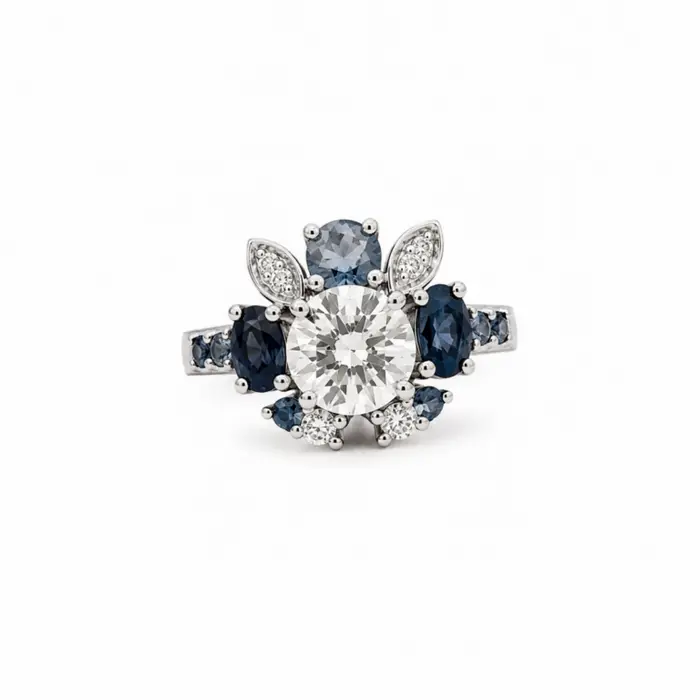
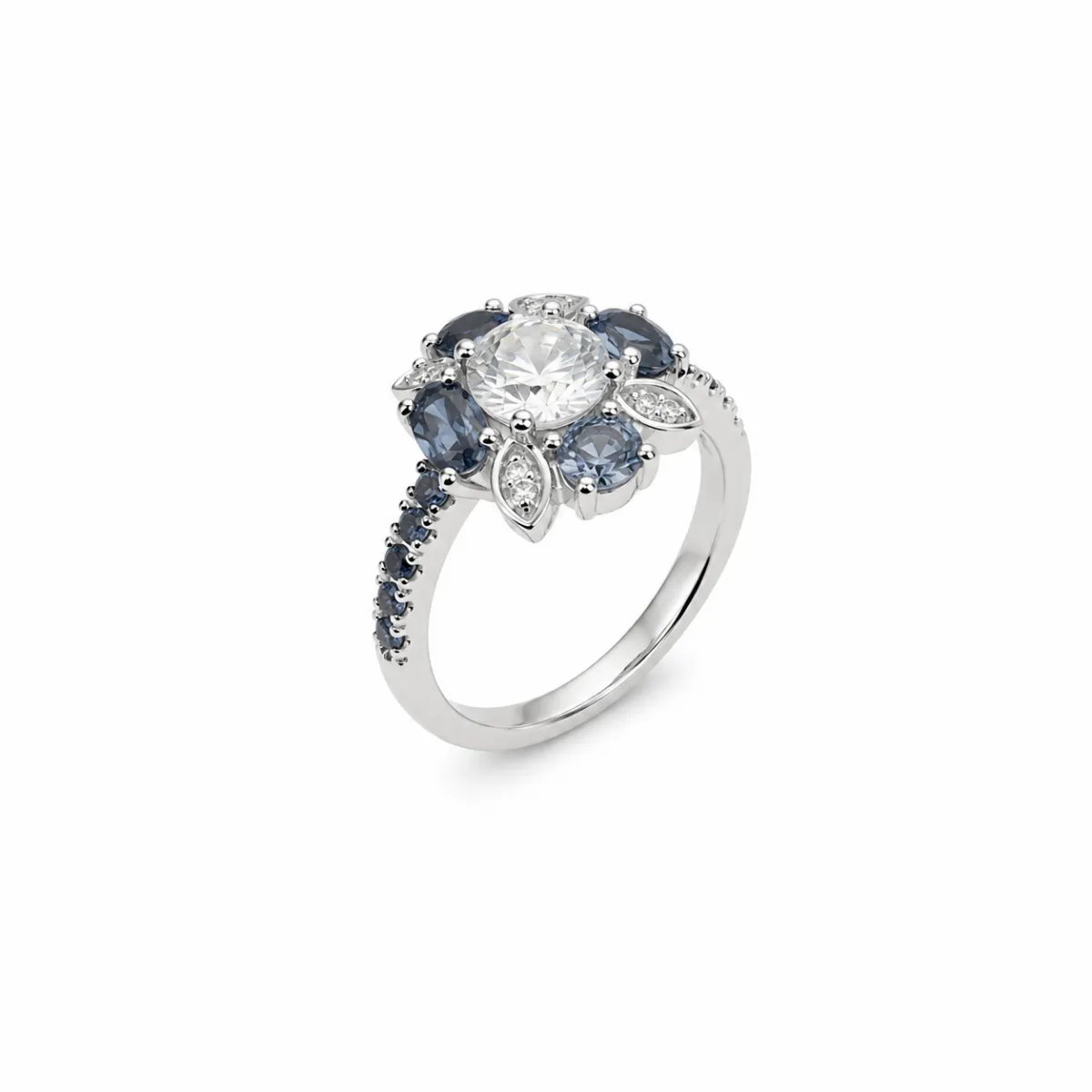
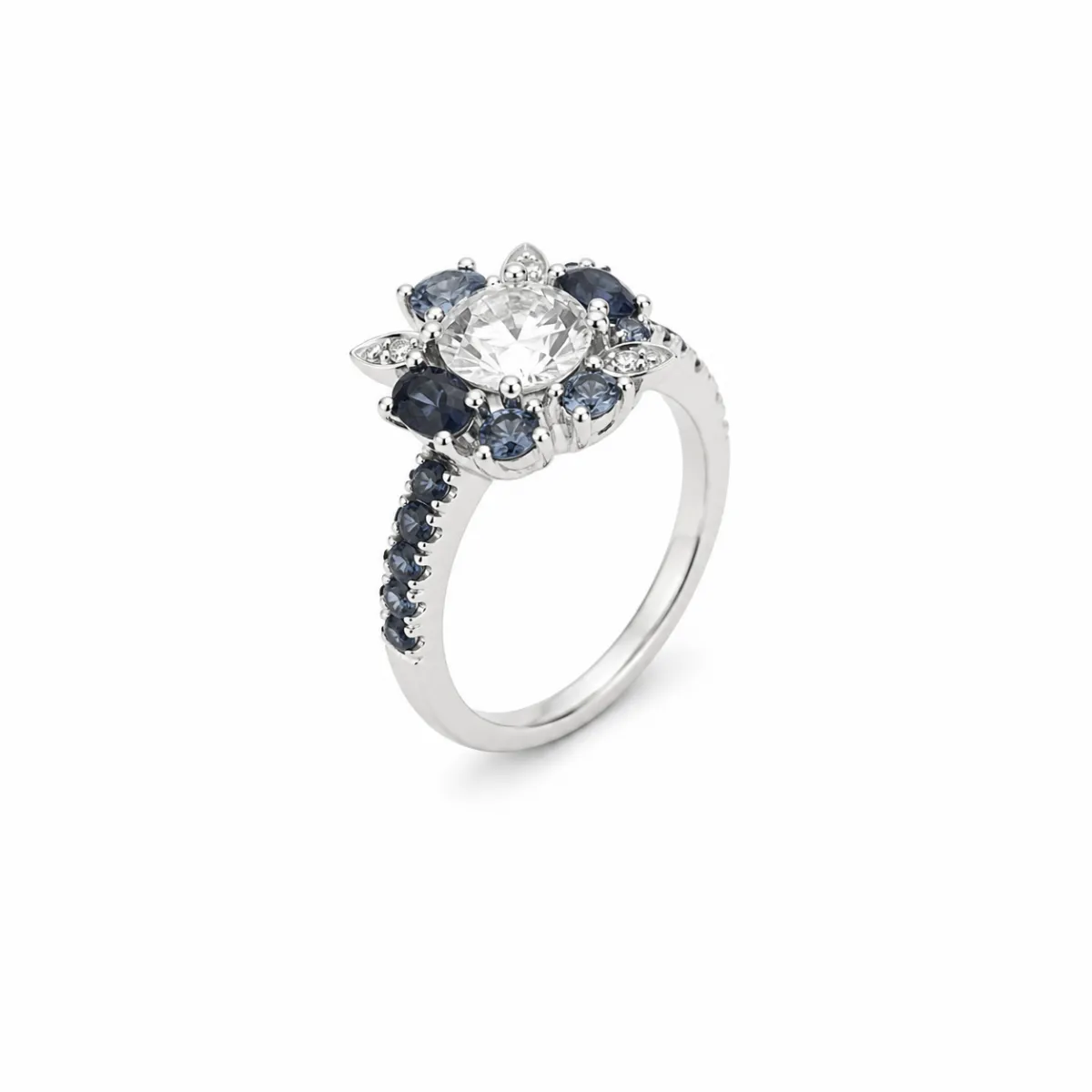
There are days when the workshop in Saint-Sébastien-sur-Loire, near Nantes, takes on the air of an art classroom. The day my client pushed open the door was one of them. She carried a leather box under one arm and a cardboard folder under the other. In one, her family's memory. In the other, her dream, drawn in pencil. This white gold floral ring was born from the meeting of the two.
A client, a leather box and a hand-drawn sketch
When she opened the box on my workbench, I discovered jewellery handed down by her grandmother and her mother. Rings that had gone slightly out of fashion, in 18-carat white gold, a few small diamonds, and a lovely assortment of blue sapphires: rounds, ovals, calibré stones of different sizes. Nothing had been sold, nothing had been forgotten in a drawer. It had all been waiting.
Then she opened the folder. Several sheets of drawing paper, covered in patient lines. A flower in full bloom around a luminous heart, each petal carefully sketched. She is an amateur artist, and it showed: she had worked on her sketch at home, at length, before showing it to me.
She then told me why. Her grandmother, who had passed away recently, spent her summers painting the flowers in her garden. Painting, botany, watercolours: it was her passion. My client had inherited her jewellery, but also her love of drawing. She wanted a bespoke ring made in Nantes that would allow her to wear, every day, a flower inspired by those watercolours. I listened without interrupting. Sometimes, a jeweller's work begins with knowing how to stay quiet.
Sapphires, diamond and white gold: composing the garden
Before touching the metal, we took the time to look at the stones. The sapphire belongs to the corundum family, and its blue colour comes from the presence of iron and titanium in its crystal. With a hardness of 9 on the Mohs scale, just behind diamond, it copes very well with the demands of a ring worn every day. Since antiquity, it has been associated with fidelity, wisdom and depth of feeling. Here, its blue evoked above all the sky, memory, the thread that links generations.
I sorted the sapphires and diamonds brought by my client one by one. Each stone was measured, examined under a x10 loupe and compared with its neighbours. The final selection almost drew itself: a round sapphire at the top of the flower, oval sapphires on either side like lateral petals, two small round sapphires at the bottom, and a row of calibré sapphires running along the shoulders.
At the centre, the heart of the flower: a round brilliant-cut diamond, also taken from the family jewels. Its 57 facets return the light with a liveliness that holds the eye. Around it, I designed two leaves pavé-set with small diamonds, at the top, like stylised marquise shapes that extend the composition.
For the metal, 18-carat white gold was the obvious choice. This alloy contains 75% pure gold, combined notably with palladium. Its restrained whiteness acts as a setting in itself: the deep blue of the sapphires looks richer, the sparkle of the diamonds purer.
From 3D render to casting: making the flower by hand
We studied the sketch together, sheet by sheet. I suggested a few technical adjustments, nothing that betrayed the drawing, only what was needed for the ring to withstand the years. A claw that is too fine, a petal that is too exposed: these are details that paper forgives and that the finger does not.
I then modelled the ring in 3D, working from her drawing. Every sapphire, every diamond, every claw was drawn to scale. My client could turn her flower on the screen, see it in profile, from above, in volume. She approved every detail before I lit the torch. I care a great deal about this stage: it avoids surprises and allows the client to make the piece their own before it even exists.
Then it was time to work the material. I melted down the white gold of the old rings, heated to around 1,064 °C, then cast it into a clean ingot. The ingot was rolled into sheet and drawn through the draw bench to obtain the sections required. The body of the ring was cut out with a piercing saw, bent on the ring mandrel and soldered into a band. The shoulders were hollowed out with a conical burr to receive the calibré sapphires.
Building the flower, petal by petal
Now came the most delicate part. Each petal, each small claw setting, was shaped separately from white gold wire. The claws were cut one by one with a needle file, then positioned to follow the exact shape of their stone. The two upper leaves demanded the same patience: I cut their marquise outline from a thin sheet, then hollowed out the seats for the small diamonds at a steady pace.
All these elements were then assembled with the flame, in an order planned in advance so as not to distort the petals already fixed in place. Here, there is no hurrying.
Setting, polishing and handing over the ring
The central diamond was set first, its claws adjusted with the onglette graver. Then each sapphire found its place in its own setting: the round at the top, the lateral ovals, the small rounds at the bottom. The sapphires on the shoulders were grain-set. The small diamonds of the leaves were secured with the graver and the beading tool, one gesture after another.
The ring was then sanded, then polished with felt and cotton mops. A rhodium bath gave it its mirror-white finish. Resting on my workbench, under the lamp, it already looked like what my client had imagined: an open flower, a little of the garden held in metal.
On the day of the handover, I held out the box without a word. She slipped the ring onto her finger, gazed at the sapphires for a long while, and then her eyes filled with tears. She now wore her grandmother's flower. I believe we both thought of the same garden, the one in the watercolours, without needing to say so.
If you, too, keep a sketch in a notebook or family jewellery in a drawer, come and talk to me at the workshop. I am a jeweller in Saint-Sébastien-sur-Loire, near Nantes, and I will gladly welcome you, with no obligation, over a coffee and your ideas. Together we will see what these treasures can become.