
Published on by Olivier Maupas-Sehikyan · Rings
One day, a client pushed open the door of my workshop in Saint-Sébastien-sur-Loire, near Nantes, a small box held close against her. She set it down on the bench and opened it with care, the way one opens a book of memories.
A Box of Old Jewellery and the Wish for a New Chapter
Inside lay years of life, put away without ceremony: two 18-carat white gold rings she no longer wore, a broken chain, a pair of earrings long forgotten and a few diamonds gathered over time. Nothing dazzling, but a great deal of history.
Her request was clear. She was reaching an important milestone in her life: the launch of a new professional venture. She wanted to mark the moment with a piece of jewellery that reflected who she is today, neither ostentatious nor ordinary. A delicate, feminine ring that she would wear every day as a quiet reminder of her success. To achieve this, she wished to transform old jewellery and bring these memories together in a single contemporary creation.
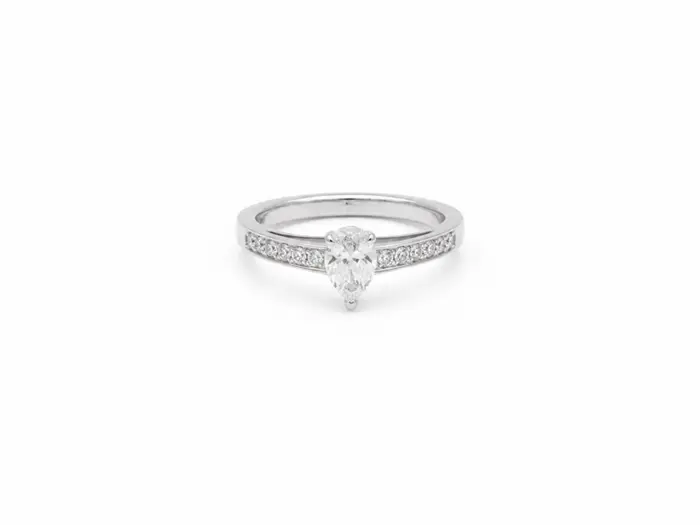
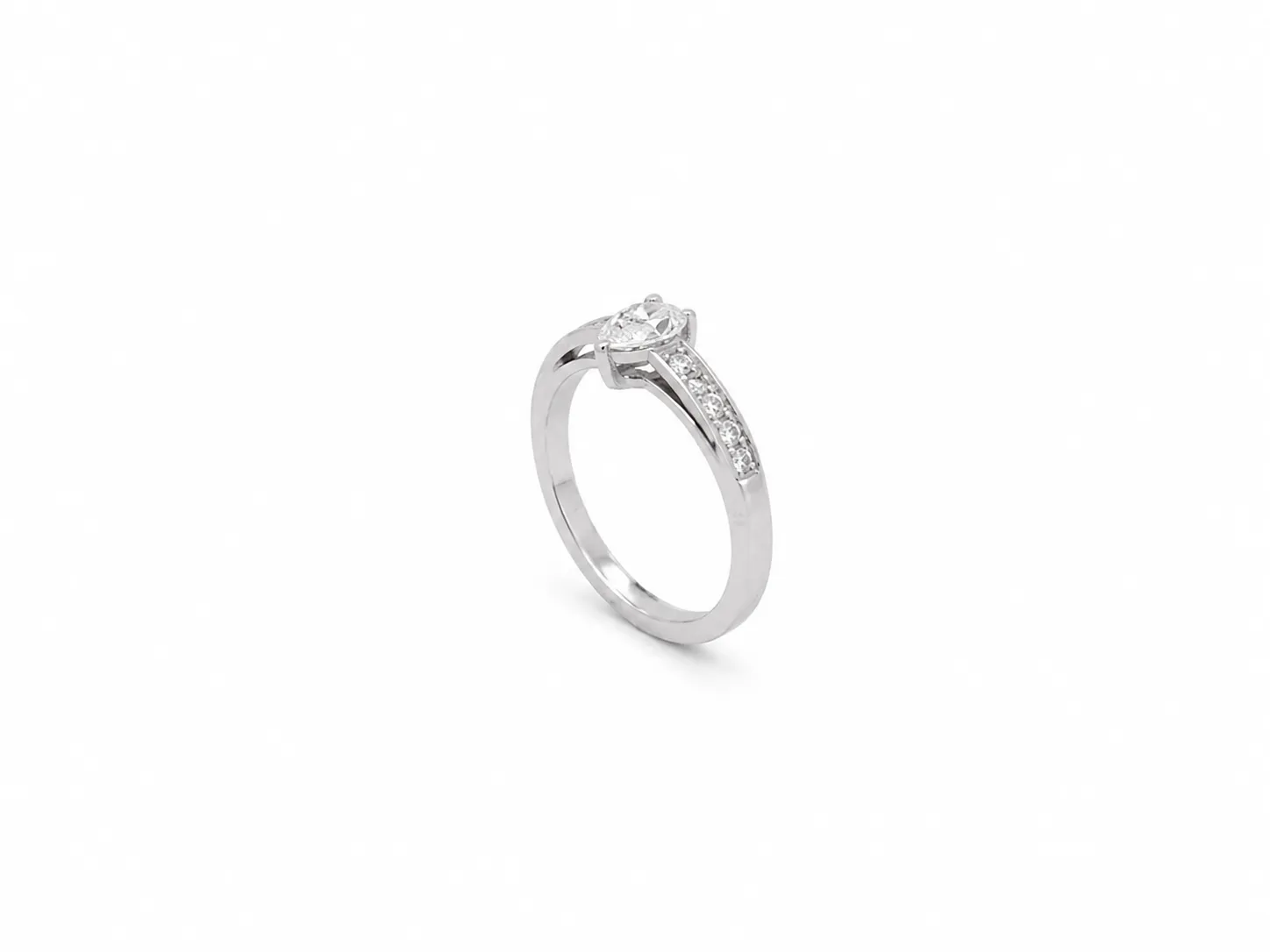
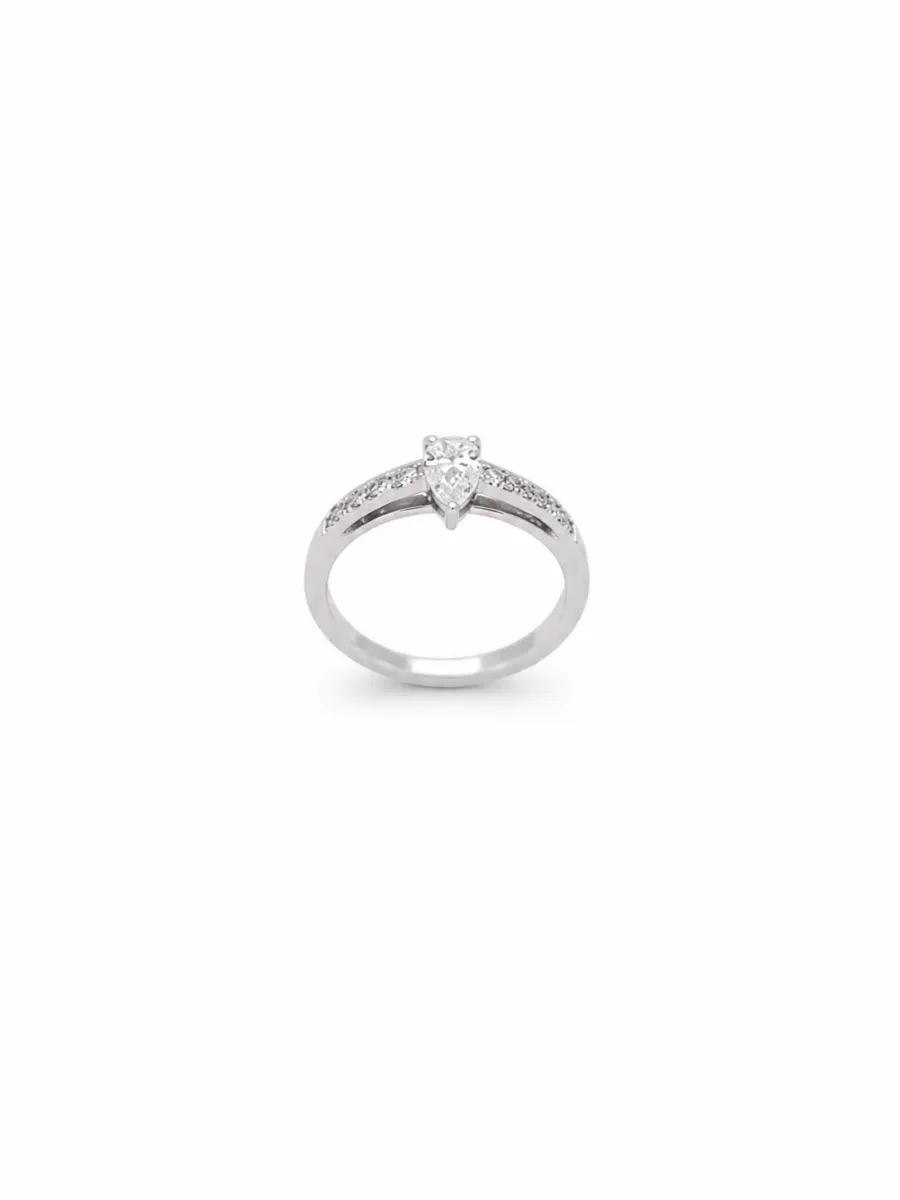
We talked at length about her tastes. She loves clean lines and the kind of elegance that is felt rather than seen. The classic solitaire seemed too conventional to her. I suggested instead a solitaire ring with side stones: a central stone, enhanced by smaller diamonds that extend its line.
Why a Pear-Cut Diamond for Her Bespoke Ring
The shape of the centre stone remained to be chosen. She hesitated. The round brilliant seemed too expected, the princess cut too modern. I put the idea of the pear cut to her, an elongated, graceful silhouette, halfway between the brilliance of the round and the sophistication of the marquise.
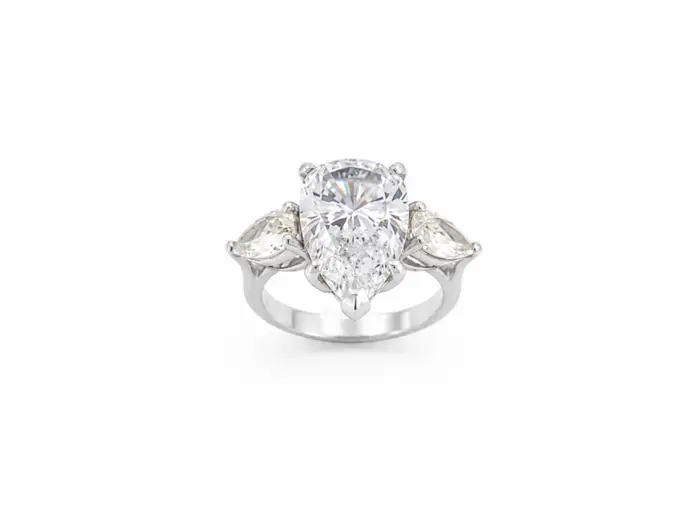
She was won over almost at once. Worn with the point towards the fingernail, this shape lengthens the finger and adds a touch of understated romance. For a pear-cut diamond ring in white gold, it is a choice that calls for a little extra care, but one that more than repays it.
I took out my sketchbook and drew several designs. The one we chose sets the pear-cut diamond in claws, mounted vertically, flanked by two shoulders pavé-set with small diamonds in grain setting. The band remains slender and pared back. The design was approved the same day.
18-Carat White Gold and the Pear Cut: What I Considered
Before I touch the metal, I like to explain to my clients what they are going to wear. The pear cut, also known as the pendeloque, is among the oldest in jewellery. It is attributed to the Flemish cutter Lodewyk van Berquem in the 15th century. It gives the stone 56 to 58 facets, arranged to return an intense fire. To me, it evokes a drop of light caught in mid-air.
It does, however, have one weakness: its point. A knock can chip it. This is why it is protected by a dedicated claw, the V-prong, without which I would never set a pear.
The central diamond was chosen from those in the box, the finest of the lot. I examined it under a x10 loupe: colour, clarity, proportions and above all the integrity of the point. The other stones were sorted and matched to form the pavé on the shoulders.
As for 18-carat white gold, it is an alloy of 75% pure gold, combined with palladium or silver. Its natural tone is slightly grey. A rhodium plating at the end of the process gives it its mirror-white brilliance and protects it from wear.
From Melting to Grain Setting: The Work in the Workshop
Everything was made on site, in my workshop, with no intermediary. I began by gathering the gold from the old rings, the chain and the earrings. Each piece was weighed and assayed, then melted together. The metal was purified with borax before being cast into an ingot. This stage always moves me: several separate pieces of jewellery become a single material again, ready to tell a different story.
The ingot was then rolled into a sheet, then drawn through the draw bench to obtain the sections required. I cut the band with a piercing saw and shaped it on the ring mandrel so that it fitted her finger exactly. It was soldered into a ring, then refined with great attention: the slenderness of the shank is what preserves the discreet character of the piece.
The Setting for the Pear-Cut Diamond
Next I built the central mount. The five claws were shaped one by one with a needle file, including the V-prong that watches over the point of the stone. The basket beneath the diamond was structured to let in as much light as possible.
The Grain Setting
On both shoulders, I cut the seats for the small diamonds with a conical burr, keeping a perfectly even rhythm. Then came the setting. The pear-cut diamond was gently lowered into its seat, and its claws were closed with a pusher, applying gradual pressure. The V-prong received particular attention.
The small diamonds were then set in grain setting, with a graver and a beading tool. Each grain of metal holds a stone in place. Together they form two sparkling lines that extend the central diamond.
The ring was sanded, filed, then polished with felt and cotton. Finally, it received its rhodium plating.
Handing Over the Ring
On the day my client returned, I had placed the ring on a small cushion by the window. She slipped it on her finger without a word. She gazed at it for a long while, turned her hand in the light, then smiled. A quiet smile that spoke for her. Her old jewellery had not vanished: it now lived on in a single piece, which will accompany her through this new chapter.
If you, too, keep old jewellery in a drawer that you no longer wear, come and show it to me at the workshop in Saint-Sébastien-sur-Loire. We will talk it over simply, with a coffee, and see together what it might become.