
Published on by Olivier Maupas-Sehikyan · Rings
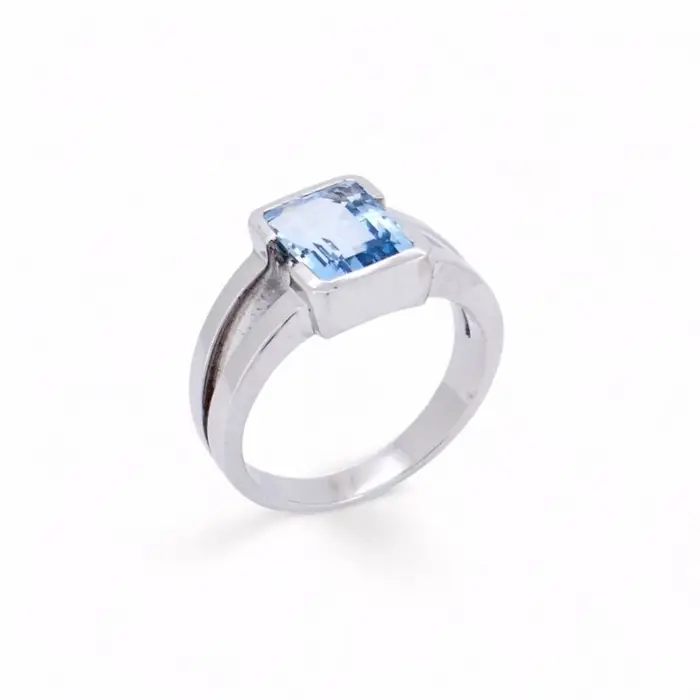
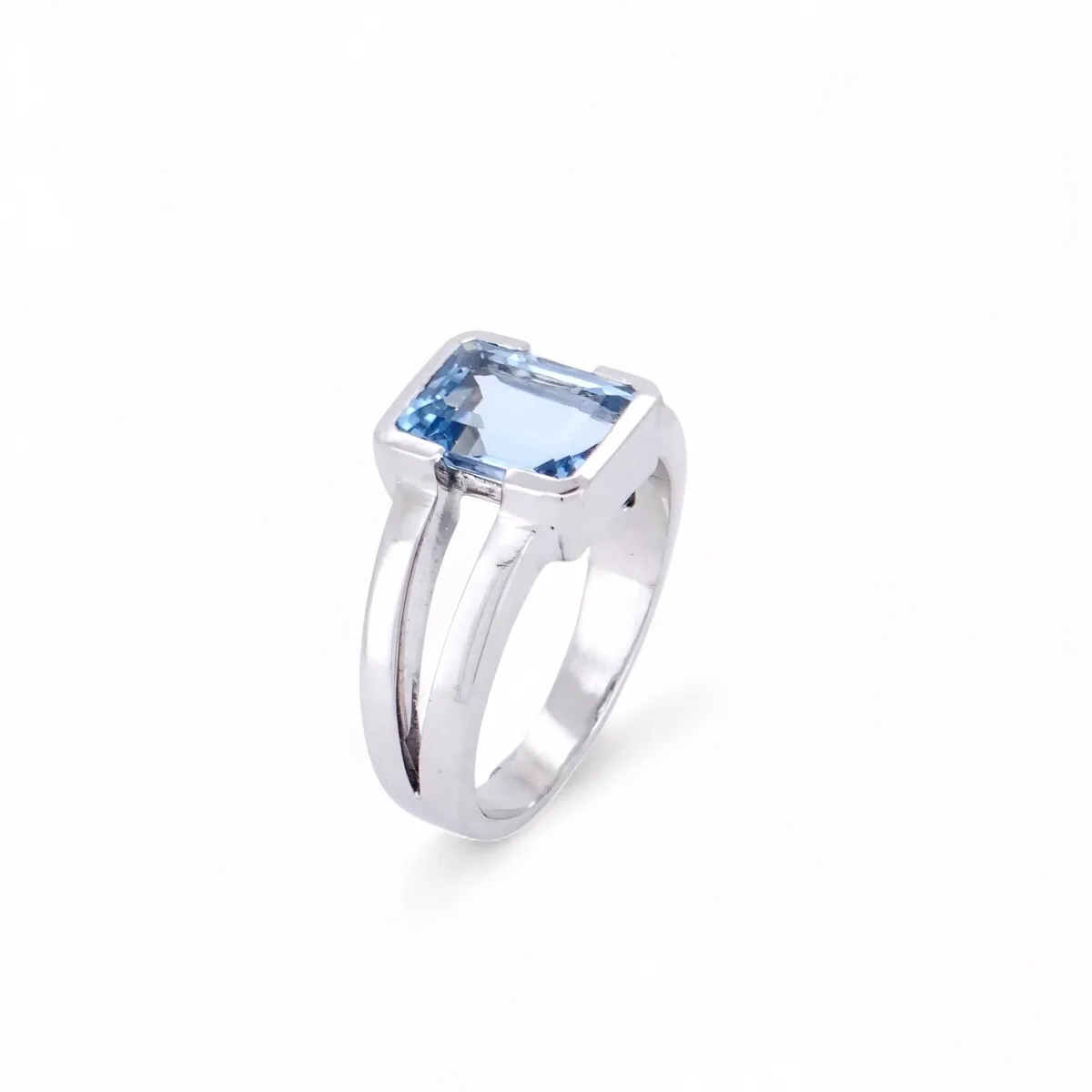
There are appointments where you understand, the moment the door opens, that the conversation is going to be demanding and fascinating. That day, a client walked into my workshop in Saint-Sébastien-sur-Loire, near Nantes, with a very precise idea. An architect by training, passionate about modernism and the Bauhaus, she had long been looking for a bespoke aquamarine ring that could reflect her world.
No classic piece, no showy jewel. She wanted something graphic and pared back, in keeping with her taste for minimalist architecture.
She had searched extensively. She had been through the windows of the great houses without finding anything: too restrained here, too ornate there. What she hoped for rarely exists in a production line: a piece of jewellery in which every line has been weighed, considered and drawn for her alone. I listened to her with pleasure, because this is exactly the kind of request that makes me love my craft.
From the Bauhaus to the Blank Page: Designing a Geometric Ring
We talked for a long time about her inspirations. She mentioned Le Corbusier, the Villa Savoye, the taut lines of Mies van der Rohe's buildings. She loves the purity of rectangles, the precision of angles, the rhythm of repetition. Art Deco appeals to her too, for its structured geometric forms. I took notes, and little by little, the bespoke geometric ring took shape in the conversation.
That left the centre stone. She wanted it luminous yet discreet, transparent, with clean angles. I laid out several aquamarines from my stock in front of her. One of them caught her eye almost at once: a 10 by 8 mm cut-cornered rectangular cut, with a limpid, almost crystalline blue. Its rectangular shape with softened corners already evoked the architecture she loves.
I then took out my notebook and drew several sketches. The design we chose places the aquamarine in a closed (bezel) setting, at the centre of a raised platform bordered by rhythmic lines. On the shoulders, parallel strata in white gold recall the floors of a modernist building. She approved the project.
Cut-Cornered Rectangular Aquamarine and 18-Carat White Gold: Choosing the Materials
Before touching the metal, I always take the time to talk about materials, because they decide everything.
Aquamarine belongs to the beryl family, like emerald, morganite and heliodor. Its name comes from the Latin aqua marina, "sea water". It is an aluminium beryllium silicate with a hardness of 7.5 to 8 on the Mohs scale, which makes it perfectly suited to a piece of jewellery worn every day. Its colour comes from traces of iron within the crystal, and its shades range from very pale blue to deep blue-green. Stones from Santa Maria, in Brazil, are renowned for their intense blue, and Pakistan, Russia and Madagascar also supply beautiful gems.
It has another characteristic that touches me: it is dichroic. Depending on the angle of observation, its hue shifts subtly, like the sea under changing light.
Why the Cut-Cornered Rectangular Cut
The cut-cornered rectangular cut derives from the emerald cut. It was conceived for transparent, pure stones. Its large facets do not seek to multiply fire: they reveal the depth and clarity of the gem. The softened corners, in turn, protect the stone from chipping. The elongated proportions of this stone suited my client's aesthetic perfectly.
Why White Gold
For the metal, I chose 18-carat white gold, an alloy of 75% pure gold enriched with palladium. Its cool whiteness, brightened by a final rhodium plating, converses with the bluish freshness of the aquamarine. For such a graphic composition, I could not see a better partner.
Handcrafted in My Workshop near Nantes
Everything was made on site, in my workshop, by hand. I began by melting the white gold into an ingot, heated to around 1,064 °C, its melting point, then refined and cast. The ingot was then rolled into a sheet and drawn through the draw bench to obtain the sections needed for the various elements.
The body of the ring was cut with a jeweller's saw, bent on the ring mandrel to fit the finger size exactly, then soldered into a comfortable band. I paid particular attention to the flat surfaces of the shank, which visually extend the lines of the platform.
The upper platform was built separately. I cut out its rectangular outline with softened corners, then shaped the closed setting by bending a fine strip of gold to the exact perimeter of the stone. This technique offers the best protection for the gem's cut corners.
Next comes the stage that gives the ring its character: the geometric lines. From thin sheets of white gold, I cut parallel strata to border the platform and give rhythm to the shoulders. Each one was fitted with a needle file, then positioned to the millimetre. This work demands total concentration, because the slightest asymmetry would ruin the harmony of the design. The strata were soldered with a flame, in a carefully considered order, with controlled heating so that no line would warp.
Setting and Finishing
Setting is a moment of silence in the workshop. The aquamarine was gently placed in its closed setting, then the gold strip was folded over the girdle of the stone using my pusher, with soft, progressive pressure. Despite its hardness, this gem remains sensitive to side impacts, and I allow myself no haste.
The ring was finally sanded, taken back with the needle file to refine every edge, then polished with felt and cotton. To finish, it received its rhodium plating, which gives it that mirror-white brilliance.
The Day She Put the Ring On
When my client slipped the ring on her finger for the first time, she immediately recognised her own world. This creation, now her manifesto on her hand, spoke of her admirations, her lines and her architect's eye. For me, there is no finer reward.
If you, too, dream of a ring designed for you, whether you have a precise drawing or only a desire, push open the door of my workshop in Saint-Sébastien-sur-Loire, near Nantes. We will take the time to talk it over together.