Published on by Olivier Maupas-Sehikyan · Rings
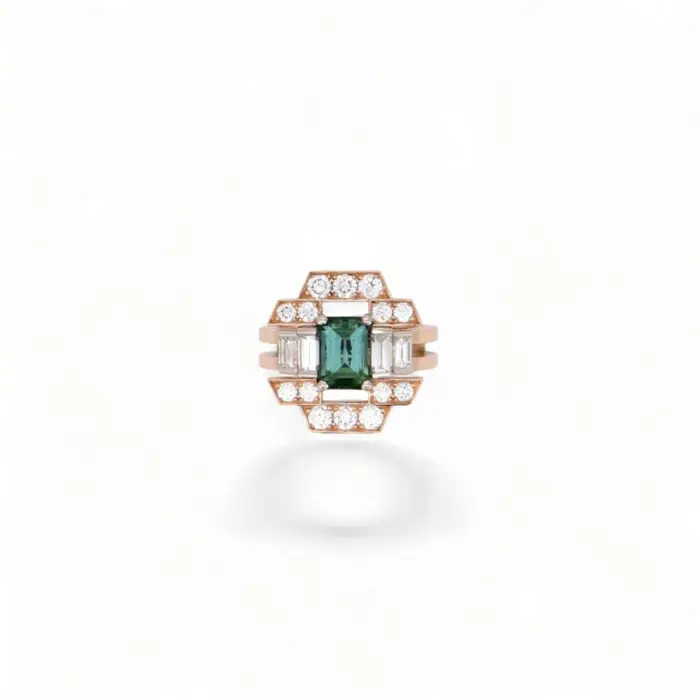
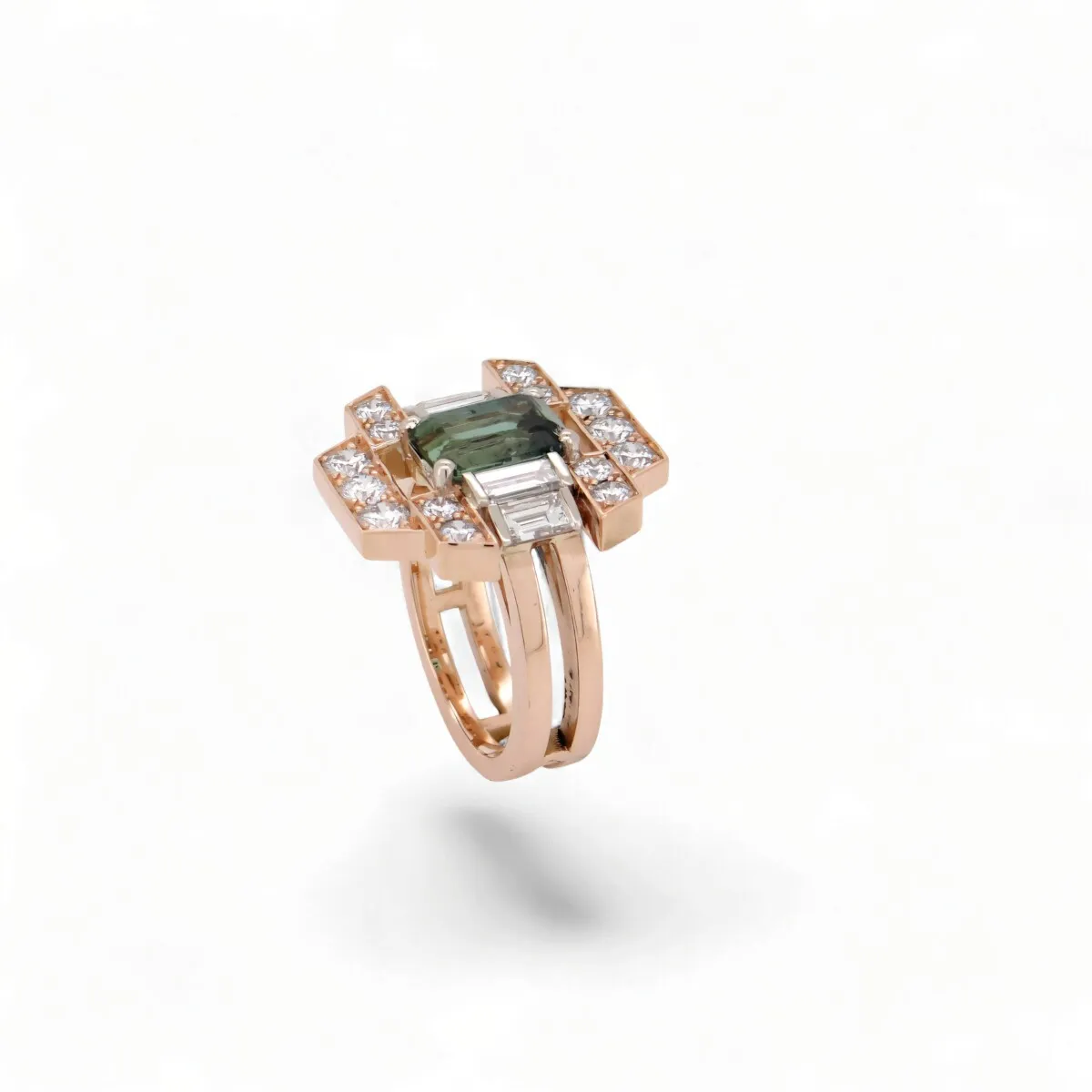
Some commissions are more like architectural projects. This was one of them. A client came to see me with a very clear dream: a rose gold Art Deco ring, imposing, a true statement piece in the spirit of the Roaring Twenties, built from jewellery she had kept for many years. Here is how it came to life in my workshop in Saint-Sébastien-sur-Loire, near Nantes.
A leather casket and the wish for a bold Art Deco ring
She walked into the workshop holding a leather casket close to her. She opened it in front of me, unhurried. Inside were rose gold chains, a white gold ring she no longer wore, a few small diamonds gathered over the years and, set apart, a green step-cut tourmaline inherited from her mother.
Her brief was short, but it was full of passion. She loves the Art Deco style of the 1920s and 1930s, its pure geometry, its symmetry, its luxury without frills. She had in mind the great pieces of the 1925 International Exhibition of Decorative Arts. Rather than let each jewel sleep on its own, she wanted to bring everything together in a single bespoke ring.
We talked at length about the codes of the style. An open-work shank, to lighten the whole. A hexagonal shape, one of the most emblematic of the period. And above all several superimposed tiers, to give the ring that architectural depth so typical of the interwar years.
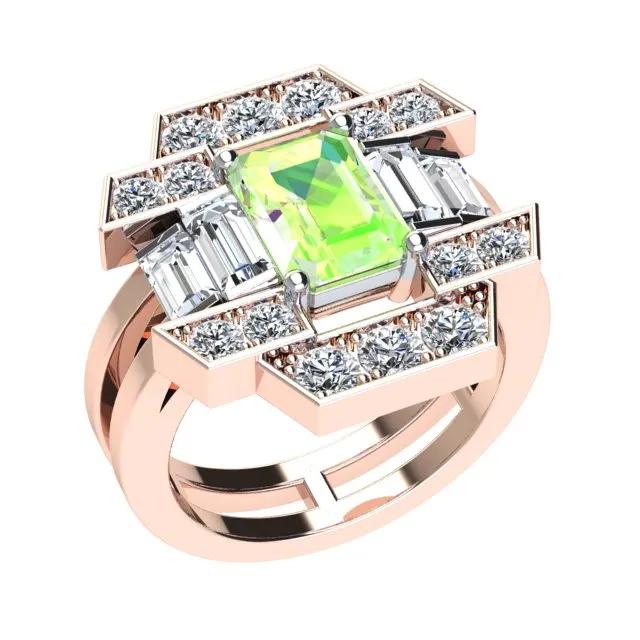
I took out my notebook and began to draw. The design we chose places the tourmaline at the centre, framed by two baguette diamonds, within a hexagonal halo of small round diamonds. Beneath it, a second rose gold tier holds an additional pavé. The open shank lets the whole piece breathe. She approved the sketch without hesitation.
Green tourmaline, rose gold and white gold: choosing the materials
Before touching the metal, I took the time to tell her about the stone. Green tourmaline, also known as verdelite, takes its name from the Sinhalese turmali, "stone of many colours". Its green comes from the presence of chromium and vanadium. With a hardness of 7 to 7.5 on the Mohs scale, it is well suited to jewellery.
I am very fond of its history. For centuries it was mistaken for emerald, so similar are the colours. Some European court jewels, wrongly attributed to emerald, actually held tourmalines. It was not until the 18th century that it was recognised as a mineral species in its own right. This stone, with its step cut close to the emerald cut, reveals the depth of its green through its rectangular, parallel facets. It is a hallmark of Art Deco.
For the metal, I suggested a two-tone marriage: 18-carat rose gold and 18-carat white gold. Rose gold brings its warmth, a touch romantic, while white gold answers with its coolness. In the 1920s, houses such as Cartier, Boucheron and Van Cleef & Arpels did not hesitate to play on such contrasts.
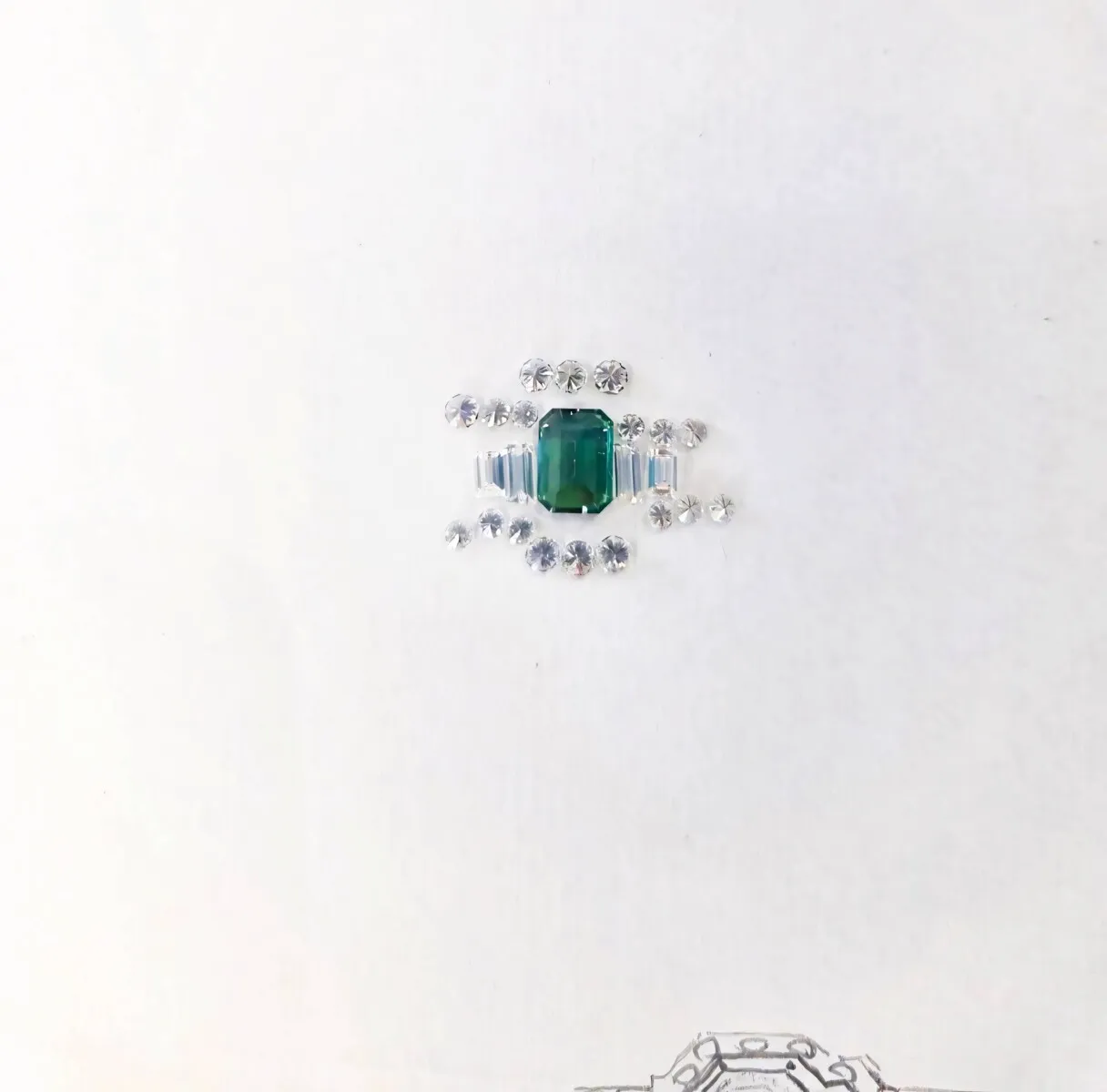
The client's small diamonds were sorted, re-matched and distributed according to size. The baguettes, elongated and highly graphic, went on either side of the tourmaline. The brilliants formed the halo and the pavé of the second tier. Three cuts (step, baguette, brilliant) echoing one another: yet another typical feature of the style.
In the workshop: building a ring in several tiers
Everything was made on site, in my workshop, without intermediaries. I began by melting the rose gold and white gold recovered from the old jewellery separately. Each metal was brought to around 1,064 °C, its melting point, then refined and cast into separate ingots. These were then rolled into sheets, to obtain the volumes I needed.
Shaping the tiers
The main tier came first. With a jeweller's saw, I cut the hexagon from a sheet of white gold, respecting the angles of the design to the degree. The setting for the tourmaline was shaped to fit the stone exactly. The seats for the baguette diamonds were cut with a graver, those of the halo prepared with a conical bur.
The second tier, in rose gold, was cut on the same principle, with a slightly offset pattern to create the visual rhythm so prized in Art Deco. The two levels were then soldered to one another, separated by a fine gold spacer.
The open shank and the setting
The open shank required particular care. Instead of a solid band, I shaped two fine lines of gold that follow the finger without enclosing it. This detail lightens a piece that is imposing nonetheless.
Then came the setting of the diamonds, my favourite moment. The tourmaline was set in a closed setting, which protects its sharp corners well. The two baguettes were channel-set, held between two lines of gold. As for the round diamonds of the halo and the second tier, I fixed them with grain setting, using a graver and a beading tool, one bead at a time.
Finally, the ring was sanded, then polished with felt and cotton. The white gold received a rhodium bath to heighten its whiteness, while the rose gold kept its natural warm hue.
The day she slipped the ring on
When my client put the ring on for the first time, she stayed silent for a moment. Her wonder answered all my questions. In this jewel there was her mother's tourmaline, her chains, her small diamonds: nothing was lost, everything had simply changed form. The ring is now the crowning jewel of her collection.
If you too keep antique jewellery in a drawer or a casket, and dream of an Art Deco creation, come and talk to me at the workshop in Saint-Sébastien-sur-Loire, near Nantes. We will look together at what you have, and at what it could become.