Published on by Olivier Maupas-Sehikyan · Necklaces
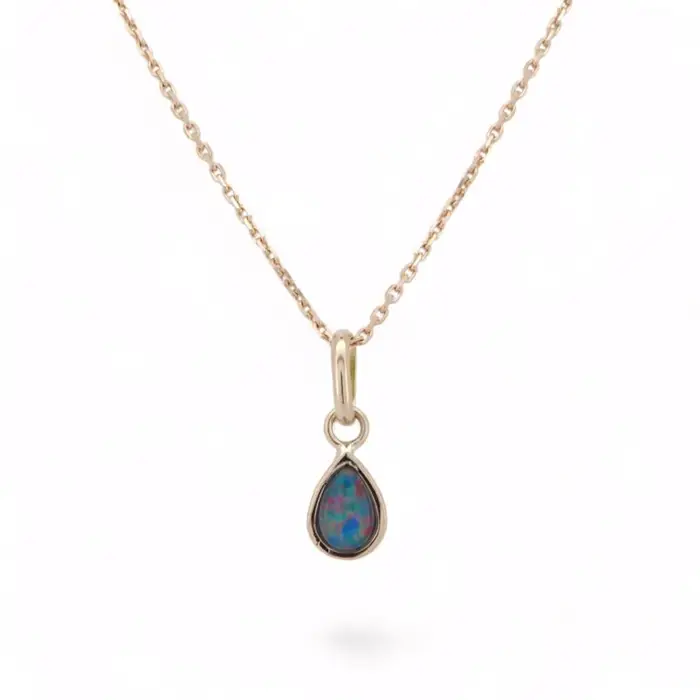
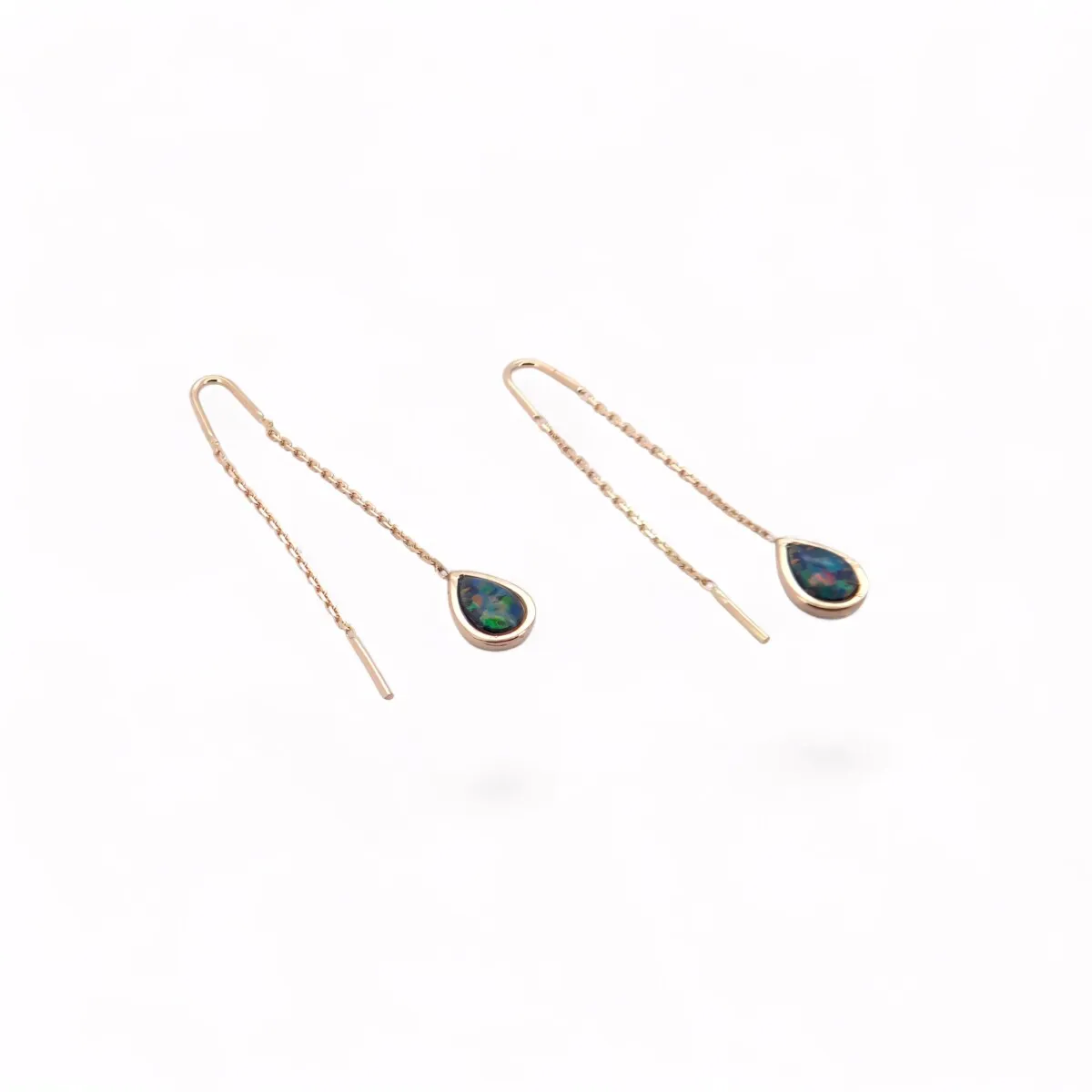
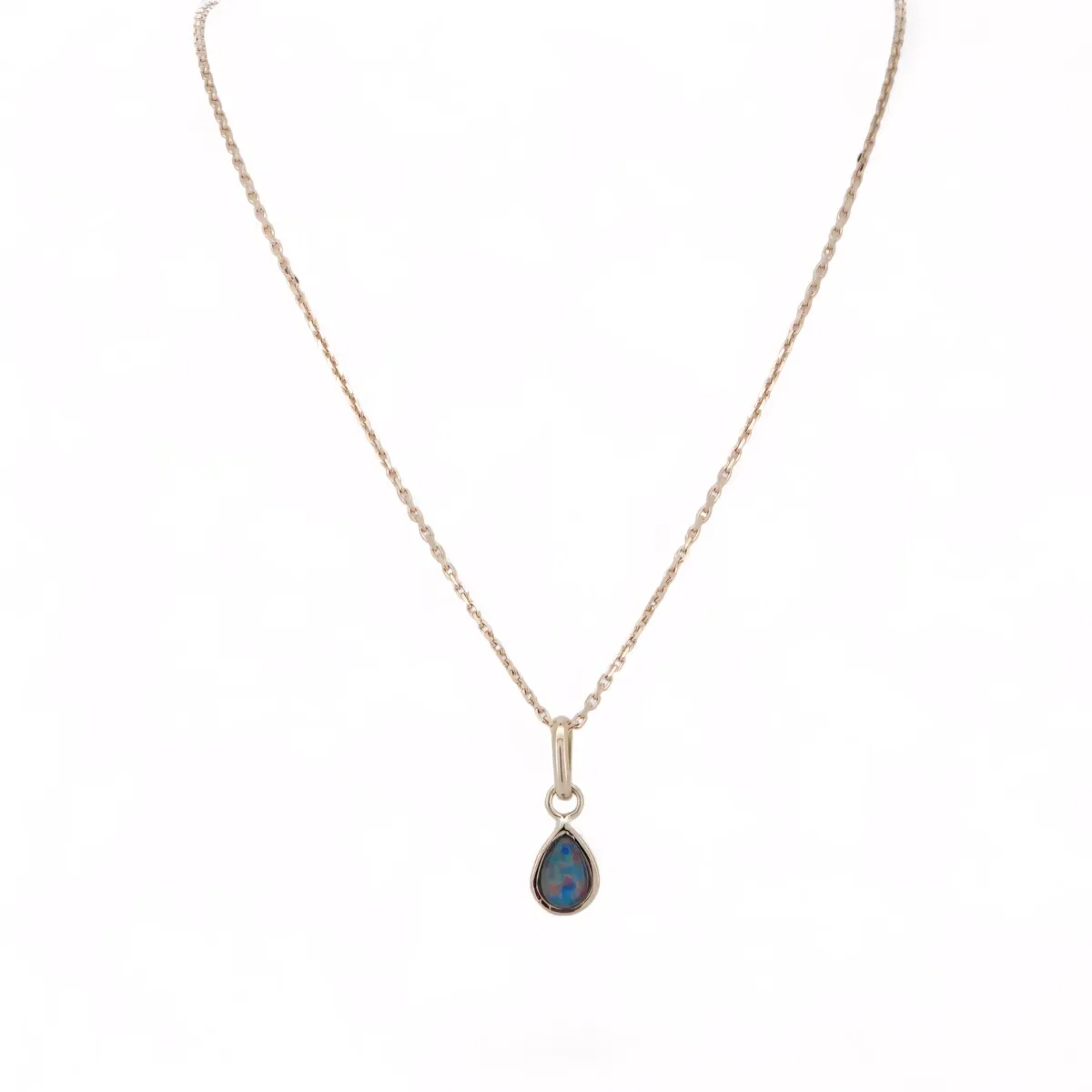
Some stones hardly need to do anything to draw the eye. This client's opals are among them. One day, she pushed open the door of my workshop in Saint-Sébastien-sur-Loire, near Nantes, holding a small blue velvet case close to her. What I found inside gave rise to an 18-carat yellow gold opal necklace, together with a matching pair of earrings. Let me tell you how it all came together, from our first conversation to the final stroke of the polisher.
Three pear-shaped opals, a family heirloom and a precise wish
Inside the case were three pear-shaped opals, entirely unmounted. They had belonged to her grandmother, who had brought them back from a trip to Australia several decades ago, and they had lain there for years. My client handed them to me with great care, the way one entrusts something fragile, and not only because of the stone itself.
Her request was clear. Not a single piece of jewellery, but a bespoke opal set: a pendant to wear every day and a pair of drop earrings for special occasions, all in the same spirit. We talked at length about style. The opal is a living stone, full of play of colour, so the setting had to step back and let it take centre stage. We settled on clean lines in 18-carat yellow gold, whose warmth answers the bluish, fiery tones of the gems.
I took out my notebook and drew several sketches. The design we chose features a pear-shaped opal in a closed setting, suspended from a fine yellow gold bail and carried on a diamond-cut curb chain, whose facets catch the light with restraint. The earrings would follow the same principle, with two identical opals. The project was approved.
Why opal calls for 18-carat yellow gold and a closed setting
Before I touch the metal, I always take the time to talk about the stone, because it dictates everything. Opal is hydrated silica. Its name comes from the Sanskrit upala, "precious stone", and it can contain up to 21% water. This peculiarity gives it its unique brilliance, but also its fragility.
Its play of colour comes from microscopic silica spheres that diffract light: blue, green, red and orange seem to dance at the slightest movement. The more regular the spheres, the richer the spectrum. Australia supplies around 75% of the world's opals. Lightning Ridge is famous for its black opals, the rarest of all, and Coober Pedy for its white opals, more accessible but just as captivating. Ethiopia, Mexico and Brazil complete the map of deposits.
With a hardness of 5.5 to 6.5 on the Mohs scale, opal is vulnerable to knocks, sudden changes in temperature and chemicals. Hence my choice of a closed setting for an opal: a fine band of metal surrounds the stone and protects it. As for 18-carat yellow gold, it contains 75% pure gold, alloyed with copper and silver, which give it its warm hue. That warmth brings out the orange and red flashes of the opals, like an ember stirring back to life beneath the ashes.
From loupe to polish: bespoke jewellery made in the workshop
Everything was made here, at my bench, with no intermediary. I began by examining each opal under a x10 loupe: shape, dimensions, play of colour, integrity of the surface. The two best-matched stones were reserved for the earrings. The third, the most spectacular, became the heart of the pendant.
Then came the gold. I melted it, refined it and cast it into an ingot, then rolled it into sheet and drew it through the draw plate to obtain the wire I needed. For each setting, I cut a fine strip of gold with a piercing saw, to the exact dimensions of the stone. It was bent around a pear-shaped former with pliers, then soldered. A backplate, soldered with the flame with great precision, supports the opal from beneath.
The bails followed, shaped one by one from round gold wire bent around a mandrel, then soldered. I took the same care over the ear wires of the earrings: fine, light and perfectly balanced, so that one forgets them once worn.
Setting the stones, the most delicate gesture
Each opal was placed in its golden cradle. With my burnisher, I folded the band down over the edge of the stone, applying gentle, gradual pressure. One abrupt movement, and an invisible crack could have settled in for good. I won't hide it: I hold my breath with every stone.
The diamond-cut curb chain
That leaves the chain. The curb link is an old design, and its French name, forçat, recalls the convoys of convicts once bound together by similar chains. In its diamond-cut version, the links are faceted with a file, which gives them a discreet sparkle. I attached it to the pendant, then adjusted it to the length my client wanted. Finally, the set was polished with felt and cotton until the yellow gold and the play of colour of the opals shone out in full.
The day the opals found the light again
When my client saw the finished set, her emotion confirmed something I have long believed: a bespoke piece of jewellery is, above all, an act of transmission. Her grandmother's stones were no longer sleeping in blue velvet. They would live alongside her, every day and on festive evenings alike, and carry on their story in a new way.
If you too keep opals at the back of a drawer, or any other stone laden with memories, come and talk to me at the workshop in Saint-Sébastien-sur-Loire, near Nantes. We will look at the stones together, unhurriedly, and see what piece of jewellery they long to become.