
Published on by Olivier Maupas-Sehikyan · Rings
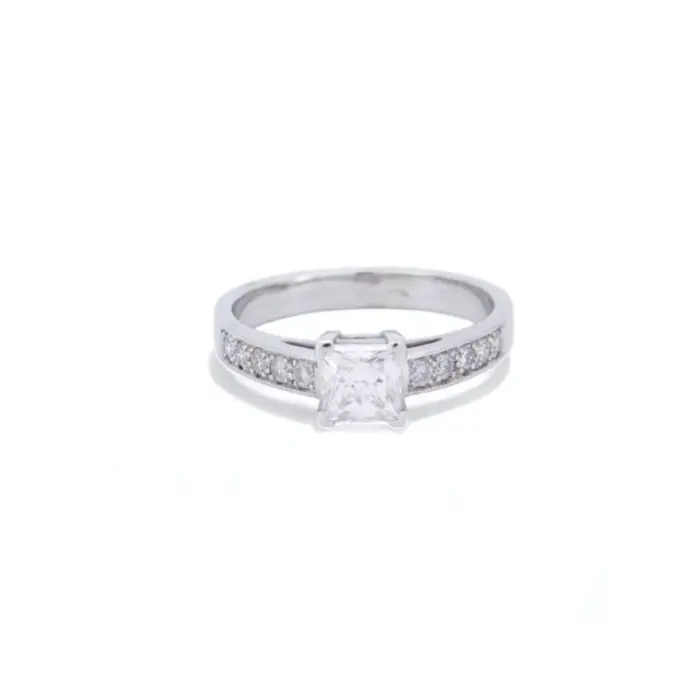
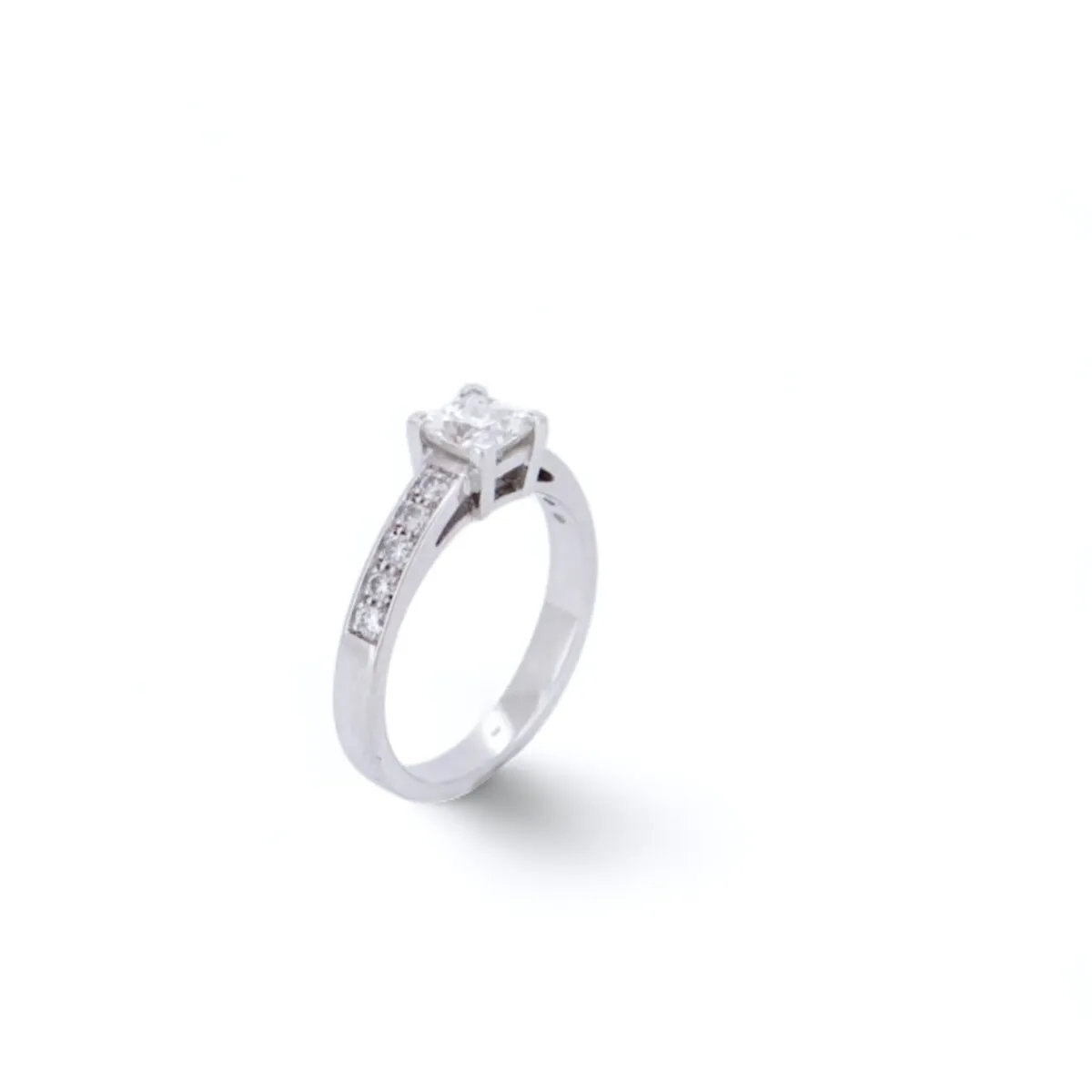
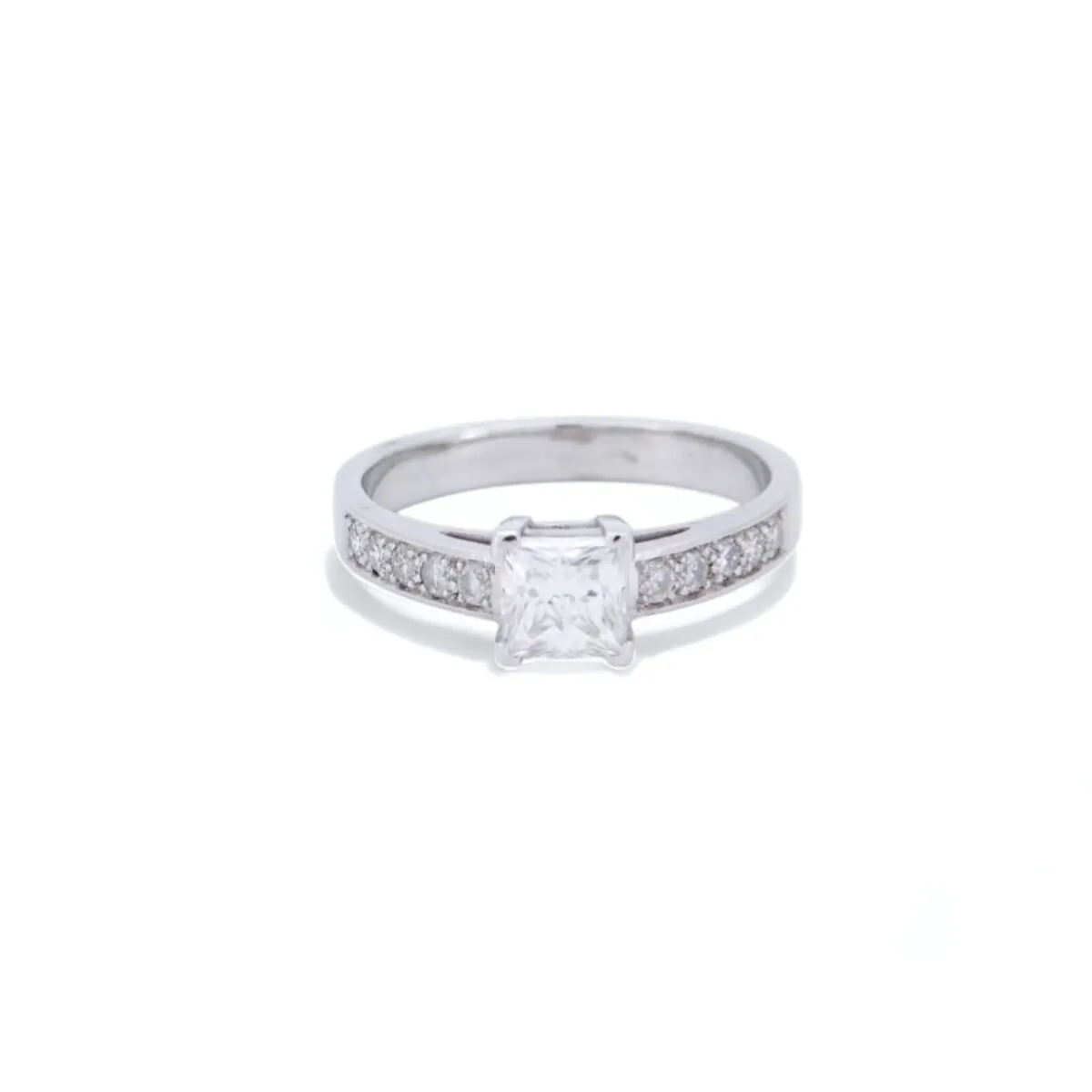
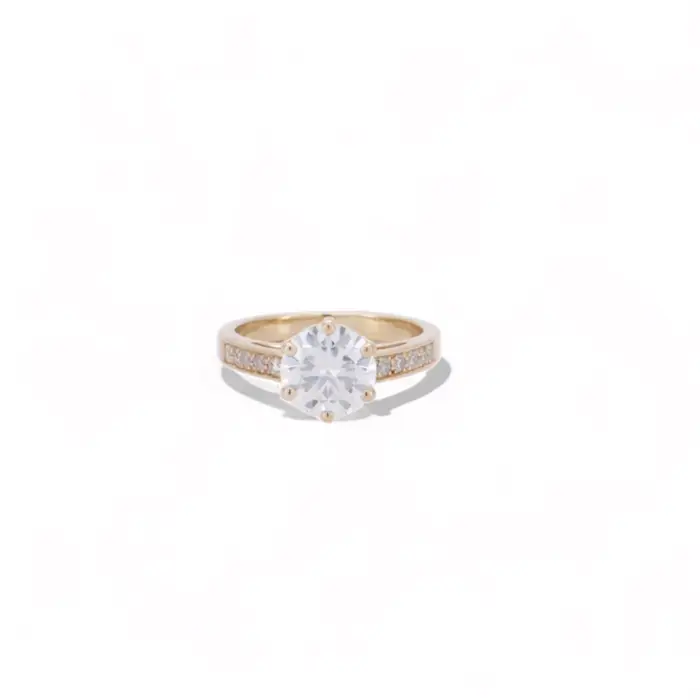
Some creations mark a turning point. This one, an accented solitaire ring in white gold set with a princess-cut diamond, began the day a client pushed open the door of my workshop in Saint-Sébastien-sur-Loire, near Nantes, holding a leather box close to her. Let me tell you its story, from the first sketch to the final polish.
A client, a box and the wish to give herself a jewel
She opened the box on my workbench. Inside were antique rings, broken chains and a few diamonds gathered over the years. All of it had been lying in a drawer for far too long. She knew it, and it saddened her a little.
Her wish was clear, and deeply personal. She was approaching her fiftieth birthday, a symbolic milestone, and wanted to mark it in her own way. Rather than wait for a present, she had decided to give one to herself: a statement piece, to be worn every day, that reflects who she is and celebrates her own story. I must admit that sentence touched me.
We then talked at length about her style. Clean lines, geometric shapes, understated elegance: the classic round diamond did not speak to her. She was looking for something more modern, more architectural. When I took several princess-cut diamonds from my stock, her eyes lit up at once.
The project then took shape. It would be an accented solitaire, that is, a solitaire whose central stone is enhanced by smaller diamonds set along the shoulders. As for the metal, 18-carat rhodium-plated white gold seemed the obvious choice. I took up my notebook and drew several sketches. The design we chose has a pared-back silhouette: a princess-cut diamond in a four-claw setting at the centre, framed by two shoulders pavé-set with diamonds in grain setting. She approved the design without hesitation.
The princess-cut diamond and 18-carat white gold
Before starting to make a piece, I always take the time to explain to my clients what they will be wearing. This time again, I spoke about the princess cut.
A recent cut, designed for light
The princess cut is one of the most recent cuts in jewellery. It was developed in the 1980s by two Israeli diamond cutters, Betzalel Ambar and Israel Itzkowitz, from the Barion cut patented in 1971. It has become the second most popular shape in the world, just behind the round brilliant, and has between 57 and 76 facets. Seen from above, it forms a square; in profile, an inverted pyramid. This structure disperses light with a thoroughly modern sparkle.
It also has an economic advantage: for the same weight, a princess-cut diamond costs around 30% less than a round brilliant. The reason lies in the yield of the cut, about 60% of the rough stone, against 25 to 30% for the round.
Protecting the corners, choosing the right metal
But this shape has a weakness: its four pointed corners are vulnerable to knocks. The setting must therefore protect them, and the four-claw setting, which wraps around each corner, is the best answer. Before any mounting, I examined the central diamond under a x10 loupe: clarity, colour, calibration, and the integrity of the corners. The small diamonds from her old jewellery were then sorted and calibrated for the shoulders.
As for 18-carat white gold, it contains 75% pure gold, alloyed with other white metals such as palladium or silver. Its natural, slightly greyish tone is brought out by a rhodium bath that gives it its mirror-white finish.
Bespoke making in my workshop
Then comes the technical phase. Everything was made here, in my workshop, without intermediaries. For me it is the quietest and most absorbing part of the craft.
I began by melting the 18-carat white gold recovered from her old jewellery. Heated to 1,064 °C, the metal was purified and then cast into a clean ingot. I rolled it into a sheet, then drew it through the draw bench to obtain the wire needed for the shank. A part of her past was thus becoming the material of her bespoke ring.
The body of the ring was cut with a piercing saw, shaped on the ring mandrel to fit her finger exactly, then soldered into a band. The shoulders, slightly tapered towards the sides, create the slope that guides the eye to the central diamond.
Next I built the mount. The four claws, shaped from round wire, were fitted one by one with a needle file. Each must cover one corner of the princess-cut diamond: precision here is measured in fractions of a millimetre. For the pavé, I cut the seats for the small diamonds with a conical bur, having first planned the rhythm of the stones so that the alignment would be perfect.
Then came the moment of setting, the one that cannot be redone. The princess-cut diamond was lowered into its seat, and the claws were closed over it with a pusher. The pressure must hold the stone firmly without ever cracking its fragile corners. The claw tips were rounded with a bud bur for a clean finish. The diamonds on the shoulders were grain-set, using a graver and a beading tool, and form that luminous line that extends the central stone.
Finally, the ring was sanded, polished with felt and then with cotton, before receiving its rhodium bath.
Handing over the ring: a smile worth any confirmation
When my client first saw her ring, she hardly said a word. Her smile was worth any confirmation. This bespoke accented solitaire ring, born from the transformation of jewellery left sleeping in a drawer, now marks a new chapter in her life. She will wear it every day, just as she had wished.
If you too have antique jewellery waiting to be given new life and would like to create something that reflects who you are, come and talk to me at my workshop in Saint-Sébastien-sur-Loire, near Nantes. We will take the time to look at what you have, and to imagine together what comes next.