
Published on by Olivier Maupas-Sehikyan · Rings
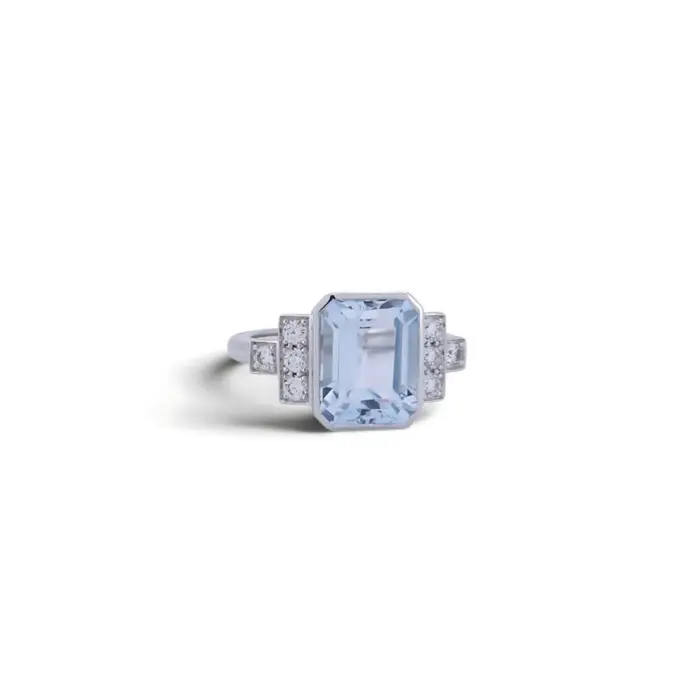
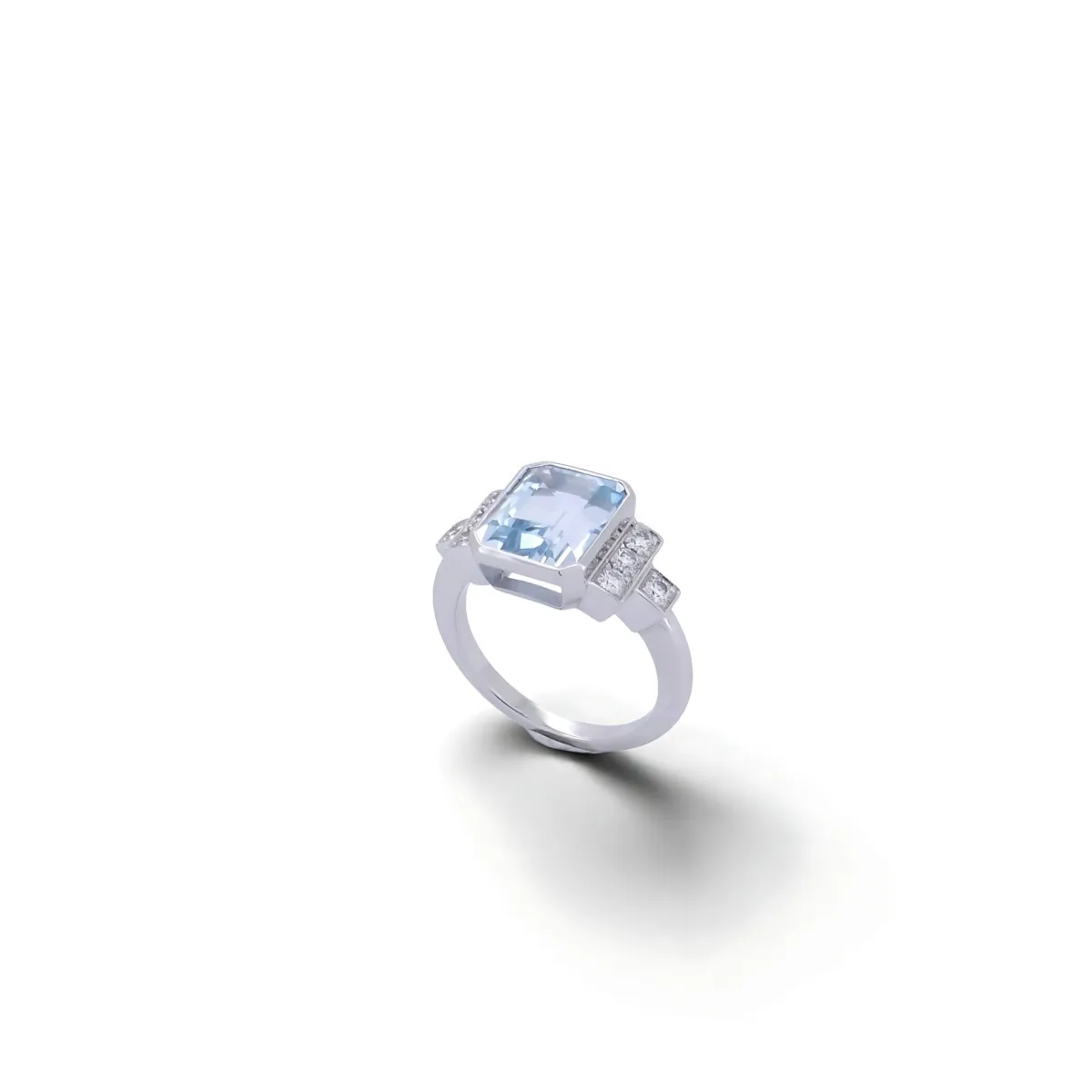
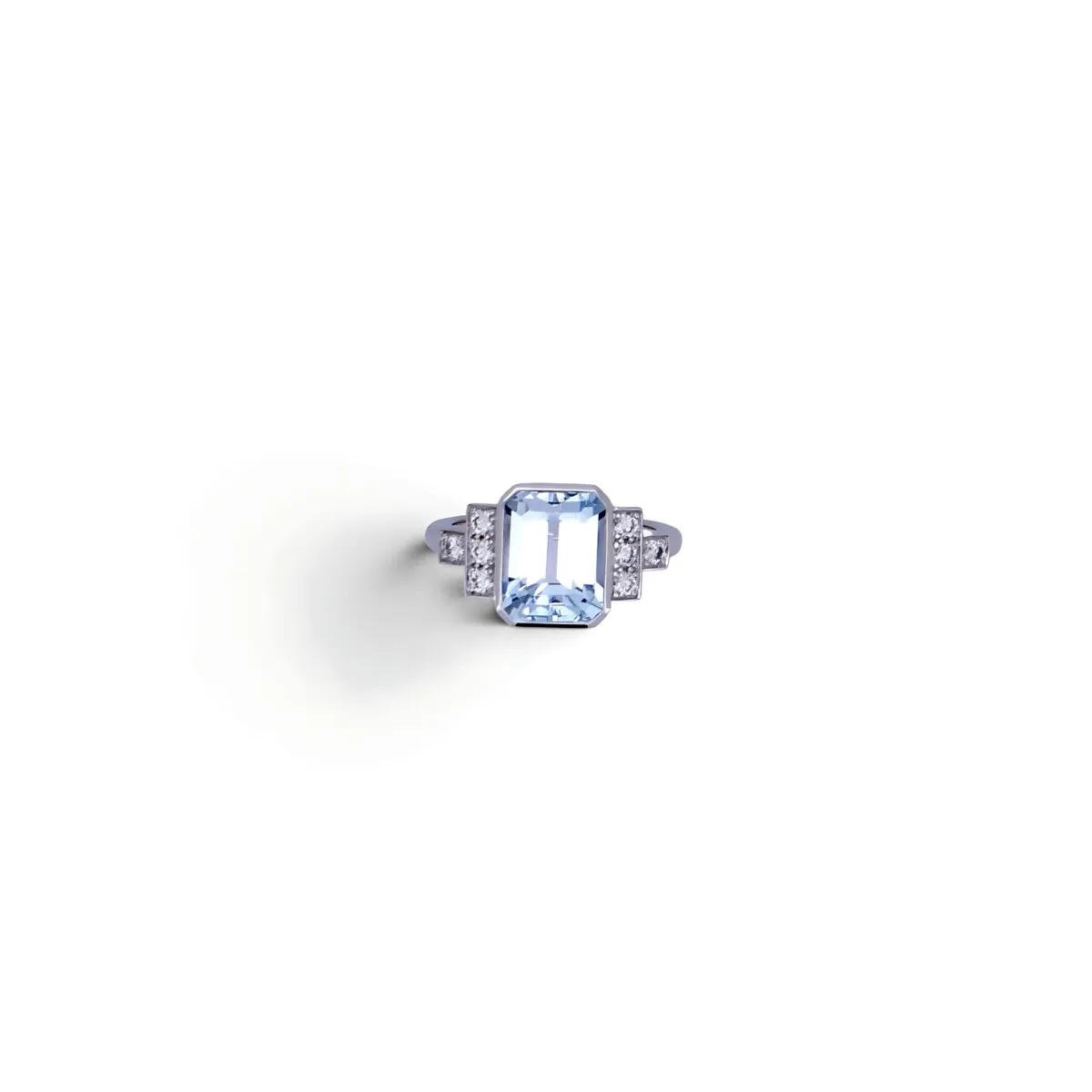
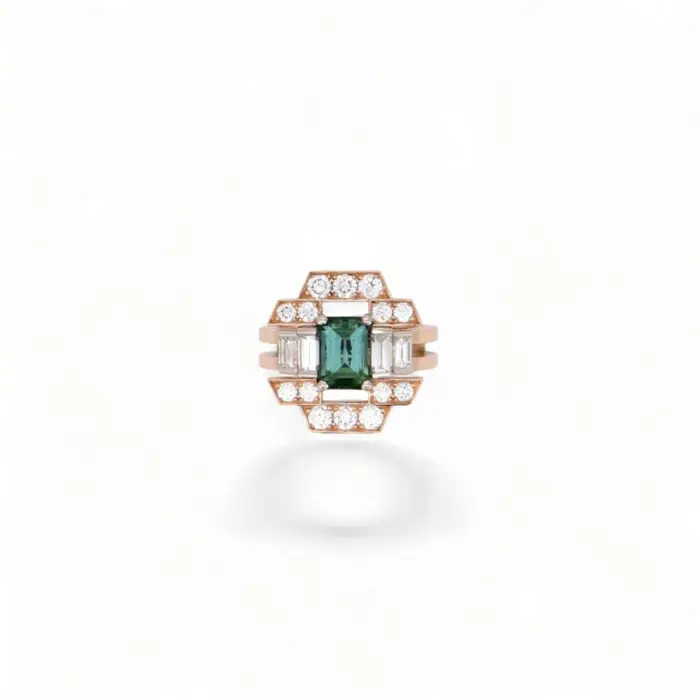
Some pieces of jewellery tell a life story before they even exist. This one began with a small leather box placed on my workbench in Saint-Sébastien-sur-Loire, near Nantes. I would like to tell you how an Art Deco ring in 18-carat white gold, set with an aquamarine and diamonds, was created to celebrate a client's birthday, using her own gold and her own stones.
A bespoke ring for a milestone birthday
My client pushed open the workshop door with this box in her hands. Inside were several old white gold pieces, a few small diamonds kept over the years, and one stone that immediately caught the eye. It was a step-cut rectangular aquamarine, brought back from a trip to Brazil in her youth. I held it between my fingers for a moment, and I understood that this would be no ordinary bespoke ring project.
She was approaching sixty and wanted to give herself a piece that truly reflected her. A jewel to wear every day, as a reminder of everything she had been through and built. She was born in March, the month of the aquamarine: she needed to say no more, the stone chose itself.
We then spoke at length about her tastes. Classic cinema, modernist architecture, the graphic design of the Roaring Twenties: everything pointed towards Art Deco. She dreamed of a ring that was pared back yet bold, with the rigorous geometry that defines the 1920s.
I opened my notebook and drew several sketches, a little haphazardly at first, then more and more precisely. We settled on a rectangular central aquamarine in a closed setting, framed by two pyramid-shaped shoulders set with diamonds in a stepped arrangement. The band would remain slender, so that all the attention would fall on the architecture of the whole. The design was approved that very day.
Aquamarine and white gold: the sea and the sky
Before touching the metal, allow me to say a few words about this stone. Aquamarine belongs to the beryl family, like emerald and morganite. Its name comes from the Latin aqua marina, "seawater". With a hardness of 7.5 to 8 on the Mohs scale, it withstands everyday wear very well, which mattered a great deal to my client. Its bluish tint comes from the iron present in its crystal, and it ranges from an almost transparent pale blue to a deep blue-green. Santa Maria aquamarines, which originate in Brazil, are particularly sought after for their intense blue.
It is also a dichroic stone: depending on the angle from which you look at it, its colour shifts subtly, like the sea. It was long known as the sailors' stone, said to protect travellers. It also marks the 19th wedding anniversary, and March births.
The rectangular step cut closely resembles the emerald cut. Its broad facets do not seek to multiply sparkle: they reveal the depth and transparency of the gem. Its softened corners, the cut corners, also protect the stone from knocks.
As for 18-carat white gold, it is an alloy of 75% pure gold and white metals such as palladium. It is the natural metal of the Art Deco style. Its cool whiteness dialogues with the bluish freshness of the aquamarine, like a winter sky above a calm sea.
In the workshop: melting down old gold to create a unique piece
Everything was made here, in my workshop, without intermediaries. I began by melting the white gold recovered from my client's old jewellery. The metal was brought to around 1,064 °C, its melting point, then refined and cast into an ingot. The ingot was rolled into a plate, then drawn through the draw plate to obtain the sections I needed. There is something touching in watching old jewellery become new metal, which nonetheless keeps the memory of the woman who wore it.
The ring shank was then cut with a piercing saw, shaped on the ring mandrel, then soldered into a comfortable band. For the central stone, I built a bezel from a fine strip of white gold, fitted to the exact dimensions of the aquamarine. This closed setting will protect the cut corners from the knocks of daily life.
The stepped setting, a nod to the skyscrapers
Then comes the most emblematic work on this ring: the shoulders. The stepped setting draws directly on the New York skyscrapers of the 1920s, the Empire State Building and the Chrysler Building foremost. Each shoulder is formed of three superimposed tiers, each a little narrower than the last, which creates the pyramid effect.
I cut the three steps on each side with the piercing saw, then soldered them together, to the millimetre. Each tier was hollowed out with a conical burr to receive the diamonds. It is a stage where one almost holds one's breath: an error of a few tenths of a millimetre, and the symmetry is lost.
Setting, polishing and handing over the ring
The stone setting came last. The aquamarine was gently seated in its closed setting, the fine strip of gold pressed down over the stone's edge with my burnisher. Then each diamond on the shoulders was grain-set with the graver, in a regular, almost musical rhythm.
The ring was then sanded, polished with felt and then with cotton, before receiving its rhodium plating. This gives it that mirror-white brilliance which enhances the bluish clarity of the stone.
When my client slipped the ring onto her finger, her emotion confirmed one thing for me: this bespoke Art Deco jewel was far more than a birthday present. It was a piece of memory, made from her gold, her stones and her travel memories, destined to travel through the years with her.
If you too have old jewellery in a drawer, or a stone that has followed you for a long time, come and see me at the workshop in Saint-Sébastien-sur-Loire. We will take the time to talk about it, simply, and to imagine together what they might become.