
Published on by Olivier Maupas-Sehikyan · Rings
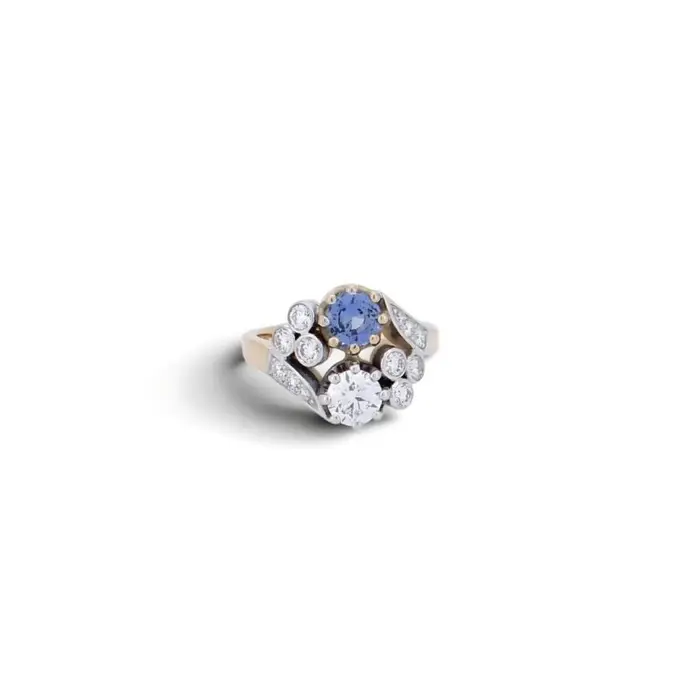
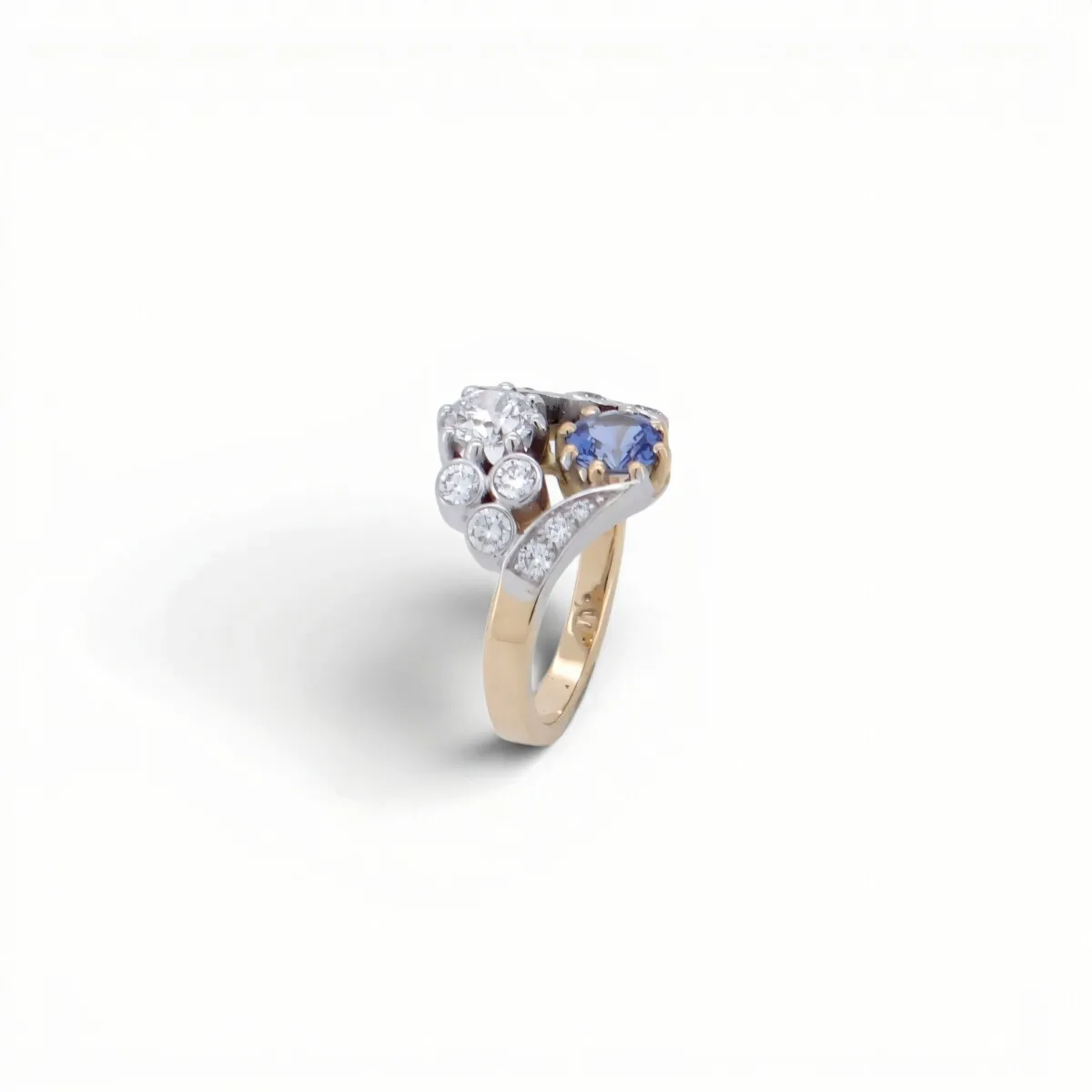
Some creations are born of loss. The one I am telling you about today came from the emptiness left by a vanished family heirloom, and from a stubborn wish to give it back its place. I made it entirely in my workshop in Saint-Sébastien-sur-Loire, near Nantes.
A cardboard folder and a lost diamond and sapphire Toi et Moi ring
One day, a client pushed open the door of the workshop with a cardboard folder under his arm. He opened it carefully in front of me. Inside were a few old black-and-white photographs, two more recent colour snapshots, and a handwritten sheet on which he had set down all his memories.
His request was as precise as it was moving. He wished to find again an antique ring that had been handed down in his family for several generations: a gold Toi et Moi, set with a diamond and a blue sapphire, surrounded by a foliate design. His grandmother had worn it all her life. His wife had then inherited it. Then the ring had been lost on a journey a few months earlier, and its disappearance had affected them both deeply.
I listened without interrupting. At such moments, we are not speaking only of gold and stones. We are speaking of memory.
Reproducing an antique jewel without the original
The challenge was considerable. Bringing a jewel back to life without having it before one's eyes calls for method and a great deal of patience. Together, we therefore studied each photograph under a loupe, one after another. From the close-ups, I took approximate measurements and noted the size of the stones, the arrangement of the settings, the proportions of the shank and the precise design of the foliage.
I then took out my sketchbook. Several drawings followed one another, each approved or corrected by my client, who would recognise one detail, hesitate over another, and suddenly recall a memory. The chosen design emerged little by little: a pear-cut diamond in a white gold claw setting, a blue sapphire beside it in a yellow gold claw setting, several small sapphires in closed settings beneath, and foliate motifs set with diamonds running along the shoulders.
When the drawing was approved, I felt we had found something true.
The Toi et Moi: a love story that goes back to Napoleon
Before touching the metal, I always like to place a jewel within its history. The Toi et Moi ring is one of the most romantic creations in jewellery, and it owes its fame to Napoleon Bonaparte. In 1796, the future emperor gave Joséphine de Beauharnais a ring set with a blue sapphire and a pear-cut diamond, mounted side by side in yellow gold. That gesture gave rise to one of the most emblematic styles of European romanticism.
Its symbolism remains very powerful. Two different stones, joined on a single band, speak of the union of two distinct and complementary people. The idea has charmed couples from the Belle Époque to the present day.
The foliage design and the sapphire
The foliate setting belongs to the Belle Époque (1890-1914) and to Art Nouveau. The jewellers of the day drew on nature: vine leaves, palmettes, plant scrolls, reeds. These motifs were often enhanced with small stones in pavé setting.
As for the sapphire, it belongs to the corundum family. Its hardness of 9 on the Mohs scale makes it a dependable stone for a jewel worn every day. Its deep blue, often associated with fidelity, converses beautifully with the light of the diamond.
For this creation, I carefully chose a pear-cut diamond and an oval-cut blue sapphire, in sizes close to those revealed by the photographs. The small sapphires were individually calibrated in order to recover the harmony of the original design.
Made entirely by hand in my workshop near Nantes
Then comes the technical phase, the one I love so much. Everything was made on site, at the bench.
I first melted the 18-carat yellow gold and the 18-carat white gold separately. Each metal was brought to around 1,064 °C, its melting point, then poured into separate ingots. These were rolled into sheets and drawn through the drawplate to obtain the wires required.
The yellow gold shank was then cut with a piercing saw and bent on the ring mandrel to the asymmetrical shape typical of antique Toi et Moi rings. The foliate scrolls of the shoulders I shaped with a needle file, curve after curve, constantly comparing them with the photographs.
The two main settings followed. The diamond's, in white gold, has an openwork basket, very typical of period jewels. The sapphire's, in yellow gold, recalls the warm tone of the lost ring. The four claws of each setting were cut one by one, slightly longer than on a contemporary piece: this is a hallmark of the Belle Époque. The closed settings for the small sapphires were formed from fine strips of white gold bent with pliers. Each diamond seat in the foliage was cut with a conical bur, then prepared for grain setting.
Soldering, setting and polishing
Assembly came next. Each element was soldered with precision, in an order devised to preserve the delicacy of the motifs.
Then I began the setting. The diamond and the blue sapphire were gently seated, their claws closed with a pusher. The small sapphires took their place in closed settings. The diamonds in the foliage were set grain by grain, with the graver and the beading tool.
Finally, the ring was sanded, then polished with felt and cotton mops. The white gold received its rhodium plating, while the yellow gold kept its natural warmth.
A bridge rediscovered between past and present
When my client saw the finished ring, his emotion confirmed what matters most. This jewel is not a mere copy: it is a bridge rediscovered between past and present, between the grandmother who wore it all her life and the wife who would be able to wear it once more.
If you too have lost an antique jewel, or if all you have of it is a few photographs, come and talk to me at the workshop. We shall look at your images together, unhurriedly, and see what can be brought back to life.