Published on by Olivier Maupas-Sehikyan · Rings
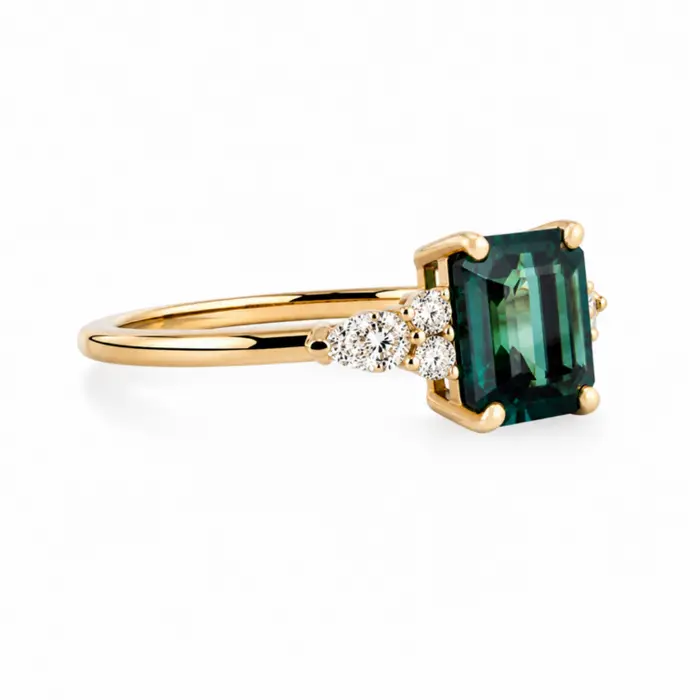
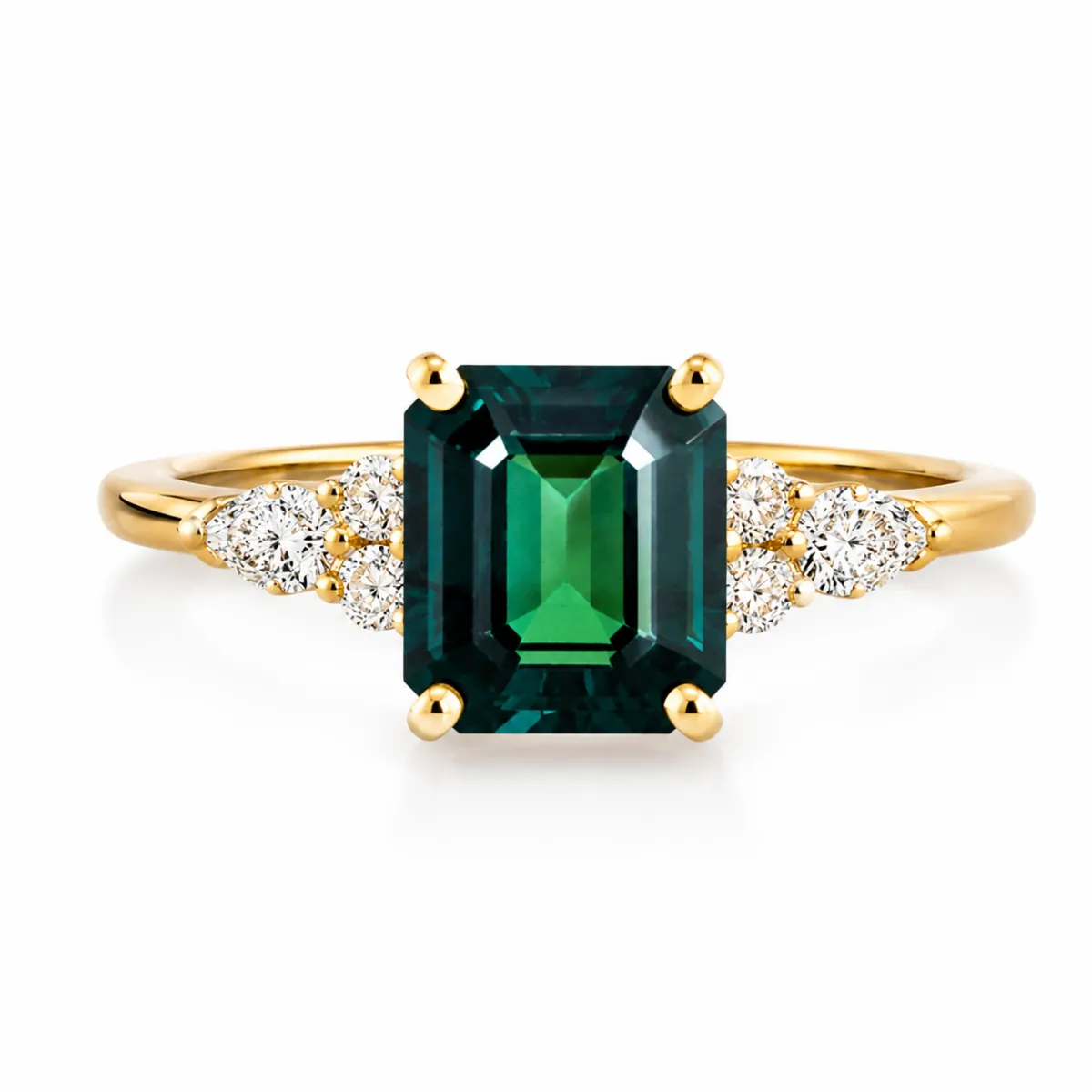
Some rings are born of love at first sight, others of conviction. The one I am telling you about today was born of both. In my workshop in Saint-Sébastien-sur-Loire, near Nantes, I handmade a lab-grown green diamond engagement ring for a man who was preparing his proposal and wanted the jewel to reflect his future wife.
A groom-to-be and the dream of an ethical engagement ring
It all began with a quiet visit. A man pushed open the door of the workshop with a very precise project in mind. His partner loves nature and the paths the couple walk together, and she is deeply sensitive to environmental issues. He was looking for an ethical engagement ring, one that could express their shared values without compromising them at the most important moment.
His request came down to two ideas. First, a green stone: for her, green evokes nature, life and renewal, and it recalls the landscapes they cross on foot. Second, a jewel whose making would not contradict what they stand for. I listened to him at length. Rarely has a project seemed so clear to me, or so moving.
Why choose a lab-grown green diamond
We reviewed the possibilities calmly, with my notebook open. Natural emerald is beautiful, but it carries a mining footprint and a high price. Green tourmaline is a delight to the eye, yet it is less durable than a diamond. As for tsavorite garnet, it is splendid, but it carries less weight in the imagination as a promise jewel.
I then introduced him to the lab-grown green diamond, sometimes called a cultivated green diamond. Chemically, physically and optically, it is identical to a natural diamond: pure carbon, a hardness of 10 on the Mohs scale, the same brilliance of light. Only its origin differs. It is not extracted from a mine but grown in a laboratory by crystal growth (CVD or HPHT processes), with no mining involved. From the information available to me, its production emits roughly 70% less carbon, and its price sits 30 to 50% below that of an equivalent natural diamond.
He knew at once. This green brought together the symbolism of nature and the ethical consistency he was seeking. The search was over.
A rare colour, even in nature
I also explained to him why coloured diamonds are so fascinating. The GIA classes them among the Fancy Color Diamonds, and only 0.4% of the natural diamonds analysed over the past twenty years show any colour. In nature, green comes from irradiation undergone by the stone during its long geological journey. The Dresden Green, a 41-carat diamond kept in Germany since the 18th century, remains the most famous example. The saturation scale runs from Fancy Light Green to Fancy Vivid Green, each grade having its own personality.
For this project, I chose an emerald-cut green diamond of Fancy Intense Green grade, certified by an independent laboratory. Its deep colour, somewhere between blue-green and forest green, was exactly what my client had imagined.
The design: 18-carat yellow gold and pear-shaped diamonds
I took out my sketchbook and drew several designs, until one stood out. At the centre, the emerald-cut green diamond, held in claws. On either side, two pear-shaped diamonds set horizontally, their points turned outwards, like two leaves unfurling. Finally, small round diamonds scattered in an asymmetrical cluster, giving the whole piece an almost organic movement. The band itself had to remain slender and feminine.
For the metal, I chose 18-carat yellow gold, an alloy of 75% pure gold enriched with copper and silver. Its warmth softens the depth of the green and offers it a luminous setting. The two pear-shaped diamonds and the small round diamonds were sorted one by one under a x10 loupe: clarity, colour, calibration. The design was approved by the client, and I was able to begin work.
From casting to setting, a handmade ring
Everything was made on site, in my workshop, by hand. I first melted the 18-carat yellow gold, heated to around 1,064 °C, then purified it with borax and cast it into an ingot. The ingot was then rolled into a sheet and drawn on the draw bench to obtain the sections required. The band was cut out with a piercing saw, shaped on the mandrel to fit the future fiancée's finger size, then soldered into a comfortable, slender ring.
Then came the central mount. The four claws intended for the green diamond were fashioned from gold wire, then fitted one by one with a needle file. It is patient work: each claw must cover the sharp corner of the emerald cut precisely, as the slightest misalignment would weaken the stone. Around it, I built the two settings for the pear-shaped diamonds, each with a V-claw to protect their more delicate points. The seats for the small round diamonds were cut with a conical burr, in the fluid, asymmetrical arrangement I had drawn.
Then the setting. The green diamond was carefully seated, its claws closed over with a pusher. The two pear-shaped diamonds followed, and the small round diamonds were grain-set, using a graver and a beading tool. Finally, the ring was smoothed, then polished with felt and cotton mops. It is always the moment I love most: the yellow gold comes alive, and the green gains depth.
A proposal accepted, a promise that reflects them
A few weeks later, my client came back to the workshop with a broad smile: his proposal had been accepted. This committed, responsible engagement ring now carried their shared values, on the finger of the woman who shares them. That day, I was reminded of how deeply this craft moves me: I am not simply making a jewel, I am taking part, very modestly, in a story that is just beginning.
If you dream of a bespoke creation, ethical or otherwise, whether you are in Nantes, Saint-Sébastien-sur-Loire or elsewhere, come and talk to me at the workshop. We will take the time to listen to you, look at stones and draw together. Your story deserves a jewel that reflects it.