
Published on by Olivier Maupas-Sehikyan · Signet rings
Love at First Sight in a Window in Saint-Sébastien-sur-Loire
Some clients arrive with a drawing folded at the bottom of a pocket. This one had nothing of the kind. He pushed open the door of my workshop and boutique, at 36 rue du Général De Gaulle in Saint-Sébastien-sur-Loire, just south of Nantes, simply to look around, talk, and understand how I work.
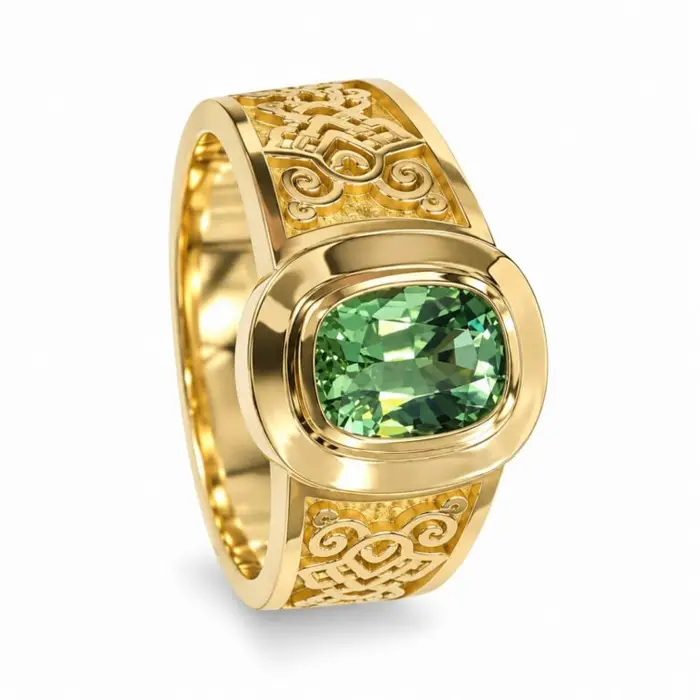
In the window, a green, oval-cut grossular garnet was waiting. I had chosen it at source during my latest buying trip, as I am also a gemstone dealer. What had struck me was its transparency: not the slightest visible inclusion, a soft green, almost crystalline. My client stopped in front of it, for a long while. Then he asked whether he might see it more closely.
I placed it in his palm, under the light. He had not planned to buy anything that day. Yet a few minutes were enough: this stone would not stay behind glass. He wanted to wear it every day, in a jewel that reflected him.
Imagining a Bespoke Men's Signet Ring Together
We talked at length, seated at the workbench. He likes sturdy men's jewellery, with character and meaning. Very quickly, the men's signet ring became the obvious choice: it is a signature one keeps on the finger, a quiet statement. He also appreciated chased decoration, those interlaced motifs that recall medieval and Celtic jewellery.
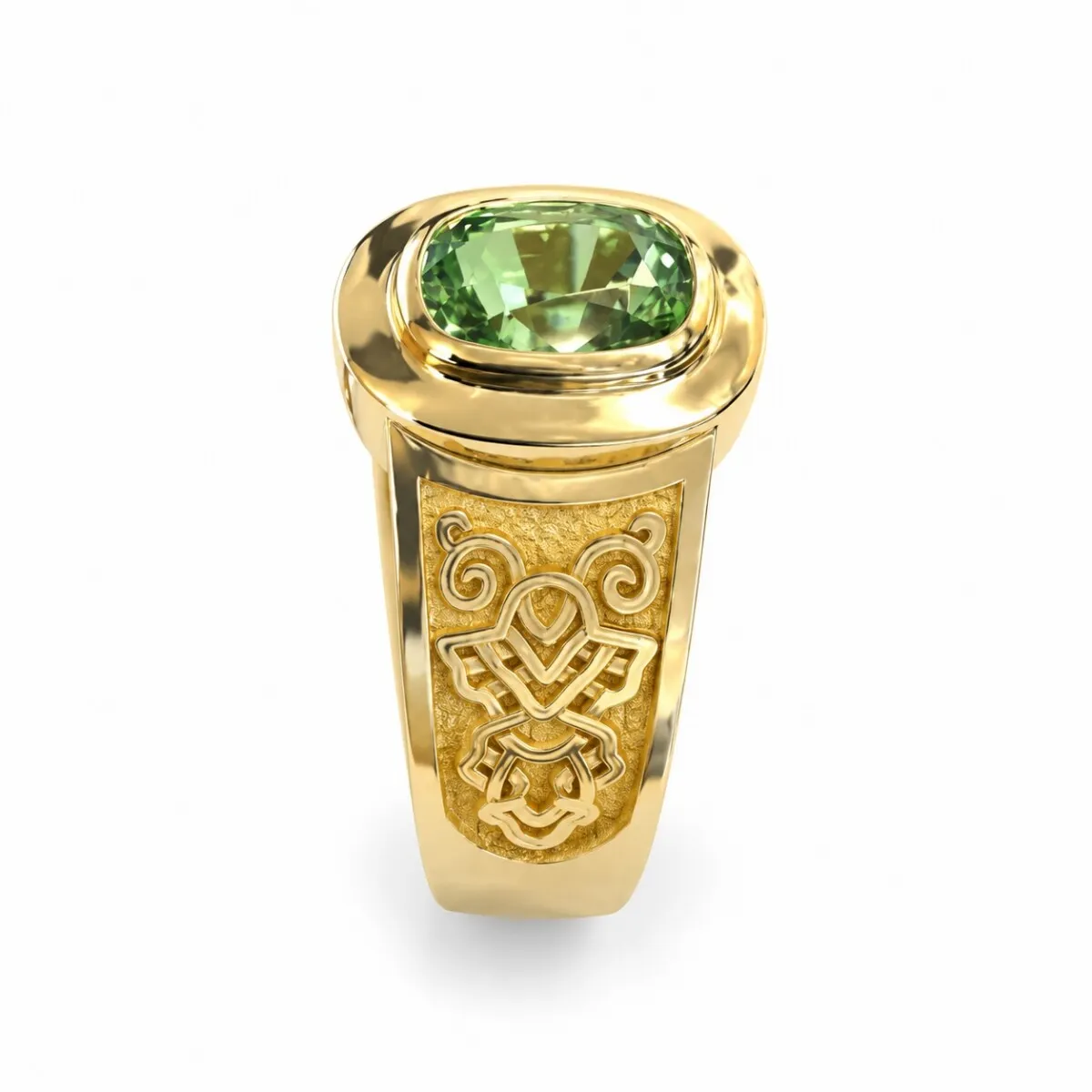
I took out my sketchbook and drew several designs. I then produced a 3D rendering, so that he could see the ring before it even existed. The chosen design sets the garnet in a closed setting on a domed oval plateau, framed by two shoulders with chased engraving. The body of the band remains thick and sculptural: it was essential to preserve the presence, the masculinity of the whole.
As for the metal, the choice was made almost without discussion: 18-carat yellow gold, an alloy of 75% pure gold, enriched with copper and silver. Its sunlit warmth plays against the green of the stone, and the pairing flatters a man's jewel without weighing it down. My client approved every detail on screen, then the wax model received his final approval. This is what I mean by a bespoke signet ring: a piece conceived around the stone and the person who will wear it.
The Grossular Garnet, a Little-Known Gemstone
Before going into the details of the making, I would like to say a word about this stone, as few people know it. The grossular garnet belongs to the great garnet family, one of the oldest and most varied groups of gemstones. Its name comes from the Latin grossularia, the gooseberry, whose colour some green varieties recall.
Unlike the far more common red garnet, it comes in green, yellow, orange-brown and sometimes colourless. Its hardness, between 6.5 and 7.5 on the Mohs scale, makes it perfectly suited to a jewel worn every day. Its most famous cousin, tsavorite, was discovered in 1967 in Kenya by the gemmologist Campbell Bridges. The garnet in this signet ring is not one, but it belongs to the same family and offers a luminous green that is wonderfully accessible.
It is found notably in Sri Lanka, Tanzania, Kenya, Mali, Canada and Russia. When I select a garnet, I look first for transparency, rare in this family, then for evenness of colour. These two criteria determine the final beauty of the jewel. As for symbolism, since Antiquity the garnet has been associated with inner strength and loyalty. Medieval warriors wore it as a talisman. In its green hue, one also reads growth and balance.
From Wax to Gold: Making the Ring in the Workshop
Now to the craft itself. Everything was made by hand, on site, in my jewellery workshop in Saint-Sébastien-sur-Loire.
Wax and Casting
From the approved 3D rendering, I sculpted a wax model. Each motif on the shoulders was patiently reworked: the depth of the hollows, the flow of the interlacing. This stage allows everything to be adjusted before the metal is poured. The wax was then replaced with yellow gold using the lost-wax casting process, a technique inherited from Antiquity, which faithfully reproduces complex decoration. The metal, poured under pressure into a refractory plaster mould, followed every detail.
Chasing, Closed Setting and Polishing
Once the rough piece had been released from its mould and cleaned, the work by hand began. I reworked the engraving with a needle file and a burr, to reveal every contour of the interlacing. The chasing gave the final contrast between hollows and raised areas, and it is this that makes the decoration come alive.
The bezel was built from a fine strip of gold, curved to the exact perimeter of the stone. This closed setting protects the gem and leaves its transparency intact. Then comes the setting itself: the garnet was placed with care, then the gold strip was folded over its girdle with a graver, using gentle, progressive pressure. A stone must never be rushed.
Finally, the signet ring was smoothed, refined edge by edge, then polished with felt and cotton. This mirror finish reveals all the warmth of the gold and the clarity of the green.
The Day the Signet Ring Found Its Finger
When my client returned to the workshop, I handed him the case without a word. He slipped the signet ring onto his finger, turned it a little under the light, and his smile said everything there was to say. The stone that had stopped him in front of the window a few weeks earlier now belonged to him, in a mount conceived for it alone.
These moments are the reason I do this work. A jewel is sometimes born of a project nurtured for years, sometimes of a simple glance in the right place. If a stone has ever held your attention, or if an idea for a man's ring is turning over in your mind, come and see me at the workshop in Saint-Sébastien-sur-Loire, near Nantes. We will talk it through unhurriedly, stone in hand, and see together what it might become.