
Published on by Olivier Maupas-Sehikyan · Signet rings
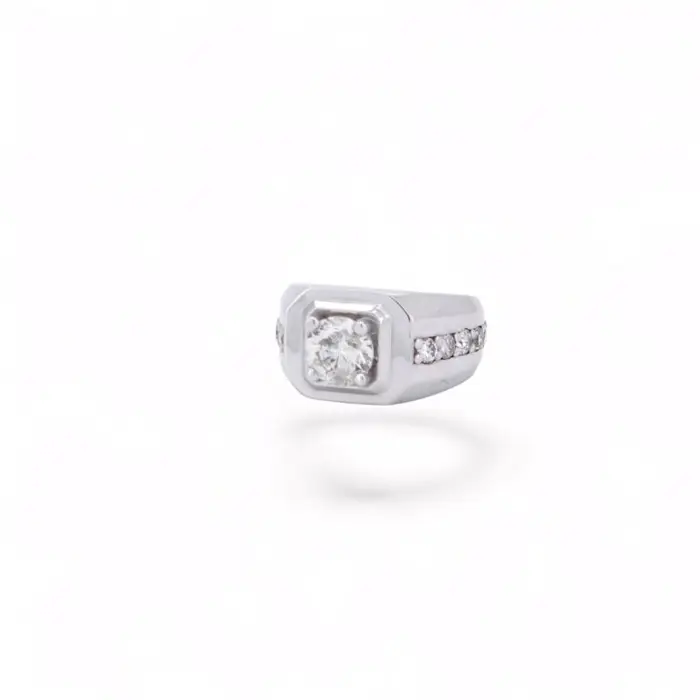
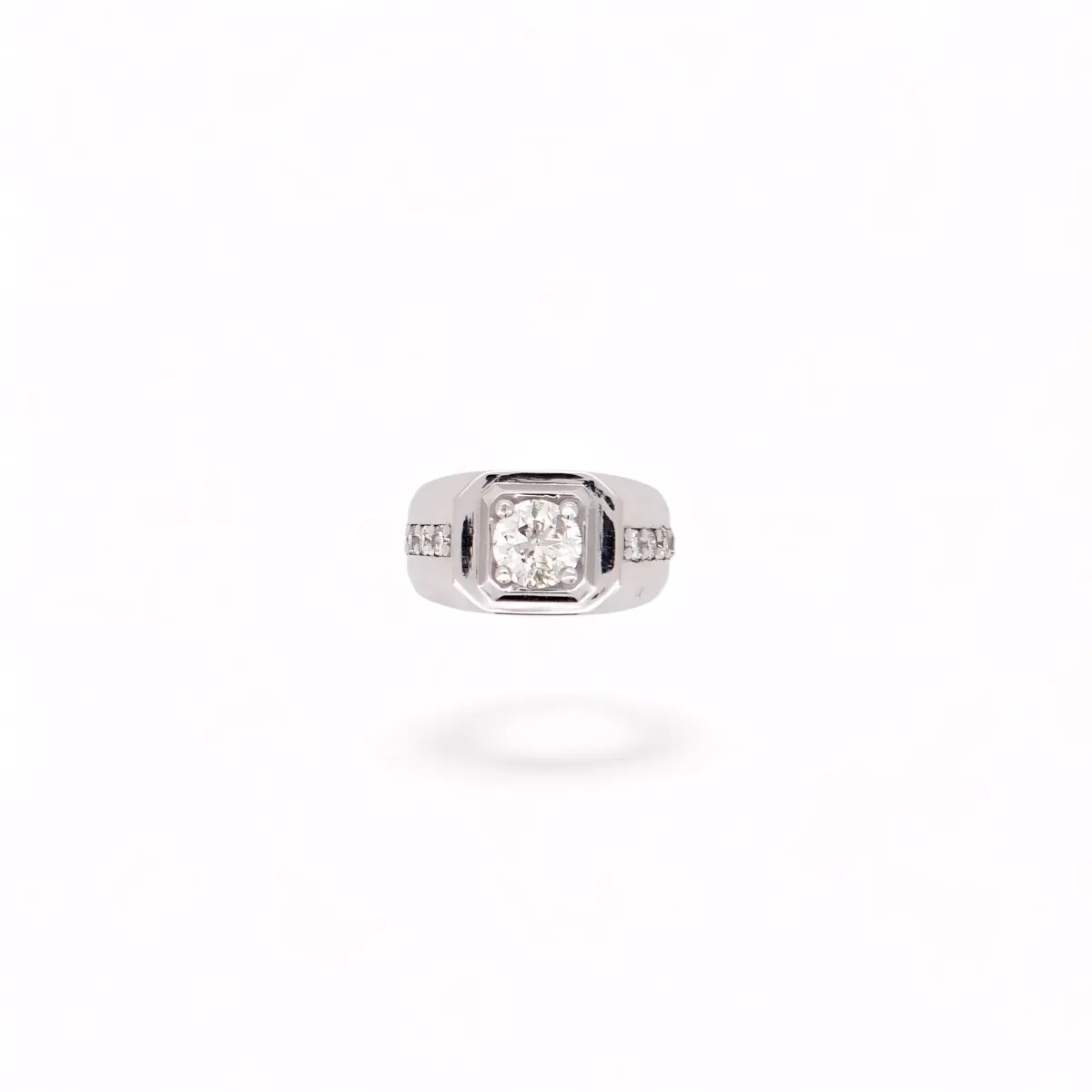
Some pieces of jewellery command attention at first glance, through sheer character. This men's white gold signet ring with diamonds is one of them. It was born in my workshop in Saint-Sébastien-sur-Loire, near Nantes, from an idea that was simple yet demanding: to give the gold and stones of old jewellery a second life, and turn them into a piece for today, masculine and luminous. Let me tell you how it came about.
A small pouch of forgotten jewellery
A client walked into the workshop with a small pouch in his hand. With a certain reserve, he emptied it onto my bench: a damaged ring, an old tarnished chain bracelet, a few diamonds gathered over the years. Everything was in 18-carat white gold, but none of it resembled him any more.
He no longer wanted that ring, which was too feminine, nor those outdated designs. What he dreamed of was a men's signet ring, broad and assertive, with just enough brilliance to remain elegant without becoming ostentatious. And he had a reason: he was celebrating his fiftieth birthday. He wanted to mark this milestone with a strong piece of jewellery that he would wear on his finger every day. The idea of transforming old jewellery rather than buying something new gave his request real depth.
We talked at length. About the way he dresses, his work, his habits. The classic signet ring, with a coat of arms or initials, held no appeal for him. He was looking for pure lines, a graphic look, stones that catch the light. A conversation like that is worth any brief: the ring was already beginning to take shape.
Designing a men's 18-carat white gold ring
I took out my sketchbook and drew several designs, watching his reactions. One of them stopped him. A raised rectangular top. A round diamond at the centre, held by claws. And on each shoulder, a row of pavé diamonds set in a channel. The body of the ring remained thick, almost sculptural, to keep all the masculinity of a true signet ring.
We agreed on the design together, without hesitation. When a drawing is right, you feel it immediately. That day, the bespoke signet ring already existed, on paper.
Rhodium-plated white gold and diamonds, a duo with character
Why 18-carat white gold
18-carat white gold contains 75% pure gold, alloyed with other white metals such as palladium or silver. Its natural tone remains slightly greyish. A rhodium bath transforms it: a fine layer of white precious metal is deposited, which brightens the lustre and protects the surface from wear. The resulting white is intense, almost platinum-like. For this men's 18-carat white gold ring, the choice was obvious: more modern than yellow gold, warmer than platinum, it brings out the whiteness of the diamonds.
Stones that already have a history
The central diamond, taken from an old piece of jewellery, was the main stone of the lot. Diamond is the hardest mineral known, rated 10 on the Mohs scale. Formed more than 150 kilometres below the surface, it took billions of years to come into being. Its brilliant cut, with 57 facets, returns light generously. I chose a claw setting, which lets the maximum amount of light pass beneath the stone.
The eight small diamonds of the pavé also came from old jewellery. I sorted them, re-calibrated them, checked them under a x10 loupe, then divided them into two series of four, in a channel setting. The stones are held between two fine lines of metal, with no visible claws. For a man's ring worn every day, it is ideal: the line of light remains unbroken and the stones are protected from knocks.
At the bench: melting, soldering and setting
Everything was made on site, in my workshop, without any intermediary. I began by melting down the 18-carat white gold of the old jewellery. The metal was brought to around 1,064 °C, its melting point, purified, then cast into a clean ingot. This ingot was then rolled into a sheet to obtain the volumes required.
The rectangular top was cut out with a piercing saw, then filed to the agreed dimensions. The shank, made from a thicker wire, was shaped on the mandrel and soldered into a comfortable band. Then I soldered the top onto the shank with a flame, using a compatible 18-carat white gold solder. At that moment, the signet ring took shape: massive, structured, already full of presence.
I then prepared the seat for the central diamond with a drill and a burr, to the exact diameter of the stone, before shaping the four claws one by one with a needle file. The channels were cut with a graver on both shoulders, to the precise width of the small stones. It is a moment of total concentration: one false move, and the diamond would not sit properly.
Then comes the setting. The central diamond is placed in its seat, then its claws are gently closed down with a pusher, and their tips rounded with a bell burr for a clean finish. The eight small diamonds slide into their channels, and the metal of the edges is closed over them to lock them in place for good. Finally comes the polishing: sanding, filing, then felt and cotton mops. Last of all, the rhodium bath gives the piece that mirror white so characteristic of the metal.
The day he slipped on his signet ring
When my client slid the signet ring onto his finger, he understood at once that he was wearing far more than a piece of jewellery: he was wearing his own history, transformed. The old objects forgotten at the bottom of a pouch had become a piece made for him, in his image and to his measure.
If you too have old jewellery sleeping in a drawer, or simply long for a signet ring that truly reflects you, come and talk to me at the workshop in Saint-Sébastien-sur-Loire. We will take the time to look at what you have, to talk, and to imagine together what it could become.