
Published on by Olivier Maupas-Sehikyan · Rings
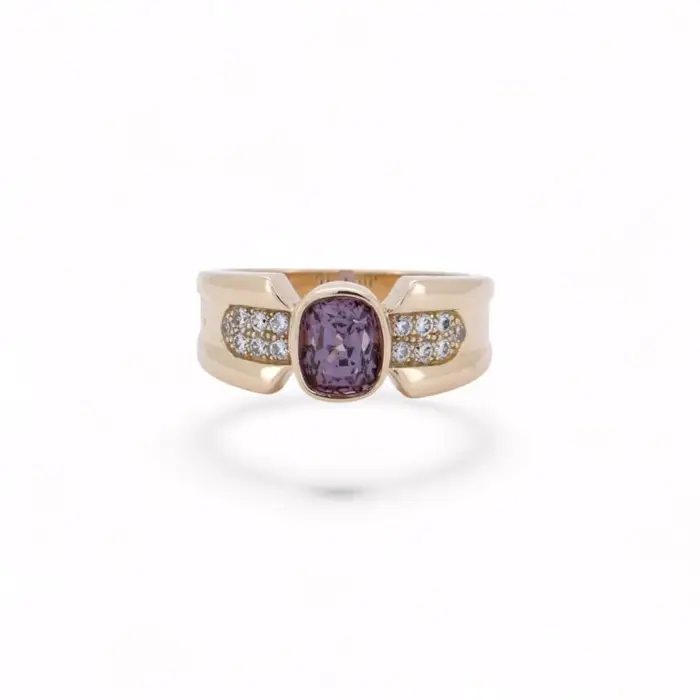
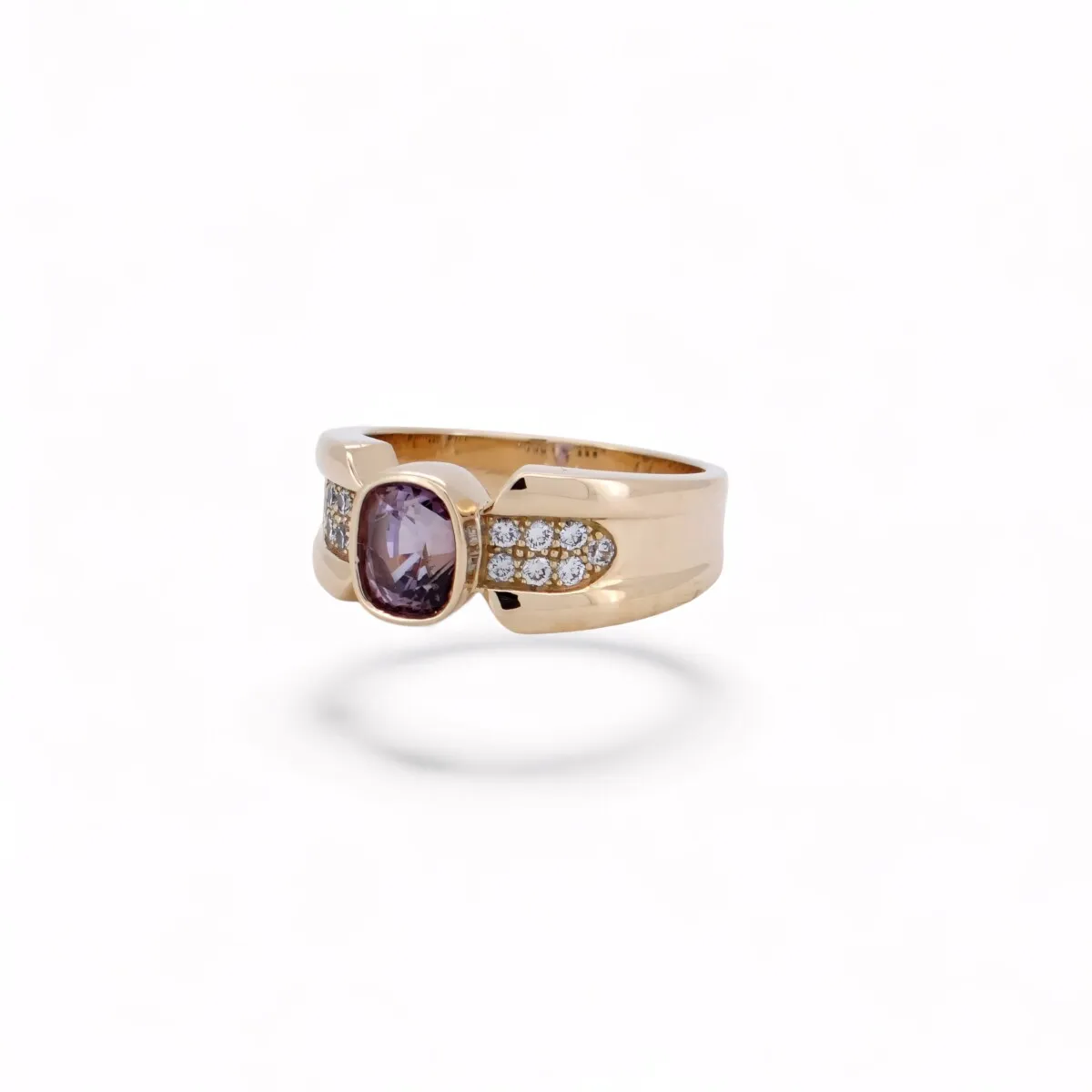
Some projects begin with a small pouch placed on the workbench. This one held old yellow gold jewellery and a handful of small diamonds. That day, a client walked into my workshop in Saint-Sébastien-sur-Loire with a clear wish: to give a second life to what she had received from her family. Let me tell you how this bespoke yellow gold spinel ring came to be.
A clear request: transforming family jewellery
These pieces came from her family. They carried obvious sentimental value, but no longer suited her style. She wished neither to sell them nor to leave them lying in a drawer. She wanted to transform her old jewellery into a single piece that truly reflected her: a modern ring, wider, with a confident silhouette and a central stone that would draw the eye.
I took the time to examine the gold and the diamonds. The 18-carat yellow gold could be melted down and reused. The small diamonds, once sorted and cleaned, would find their place in a pavé setting. This inherited material became the starting point of the creation, and I found that moving: the ring would carry something of those who had worn these pieces before her.
The stone was still to be chosen. My client browsed my display cases, hesitating between sapphire, ruby and amethyst. None of them truly won her over. I then brought out of my personal collection a gemstone that is little known to the general public: a cushion-cut grey-violet spinel. Under the light, it shifted from lavender to an ashen purple, with silvery reflections. It was love at first sight.
The cushion-cut grey-violet spinel, a gemstone worth discovering
The grey-violet spinel deserves a closer look. It is an oxide of aluminium and magnesium, with a cubic crystal structure, and it offers a very lively vitreous brilliance. Its hardness reaches 8 on the Mohs scale, so it withstands everyday wear very well, which mattered for a ring intended to be worn often.
For a long time, history confused this stone with ruby. The “Black Prince's Ruby” of the British crown and the “Timur Ruby” both turned out to be spinels. I like to tell this story to my clients, because it reminds us that a little-known stone is by no means a lesser one. The violet shades owe their colour to the iron present in the crystal, and the grey tones add a discreet sophistication that I particularly appreciate.
The cushion cut did the rest. This cut, between round and square, with softened corners and generous facets, gives the gemstone a gentle, almost enveloping presence. It returns the light without harshness, which suited my client's personality.
From sketch to wax: lost-wax casting
I then took up my pencils. Several sketches were drawn, and one design was chosen: a wide band with an architectural form, a central spinel in a closed setting, and on either side a shoulder paved with diamonds. The diamonds were not meant to dazzle. Their role was to accompany the stone and form a luminous halo around it.
To bring this design to life, I chose lost-wax casting, a very ancient technique that allows complex volumes to be reproduced faithfully. I first sculpted a wax model to the exact dimensions of the future ring. The volumes were shaped by hand, the stone seats prepared, the shoulders profiled. My client was able to hold this model in her fingers and feel its width, its visual weight, its balance. It is a stage I am very fond of: the piece ceases to be an image and becomes an object.
Once approved, the wax was attached to a sprue, then plunged into a cylinder filled with refractory plaster. When the plaster had set, I heated the cylinder: the wax melted and ran out, leaving a perfect cavity. The 18-carat yellow gold from the old jewellery was then heated to 1,064 °C and cast under pressure into the mould. The metal followed every detail. There is something faintly solemn about this moment: the gold of earlier generations taking the shape of a new ring.
Setting and polishing: bringing the ring to life
After cooling, the raw ring was removed, cleaned, filed and adjusted by hand. I prepared the diamond seats with a conical bur and hollowed out the setting for the spinel, taking care that the stone would sit perfectly.
Then comes the setting, which I consider the heart of the craft. The spinel was secured in a closed setting: a fine band of gold surrounds the gemstone and protects it durably, which suits a stone worn every day. The diamonds were grain set. Using my graver, I lifted tiny curls of gold, then pushed them over and rounded them with a beading tool to form those small beads of metal that hold each stone in place. It is patient work, loupe to the eye, where one overly firm movement comes at a high price.
Polishing completed the making. The ring was sanded, then polished with felt and cotton, to that mirror finish that reveals all the warmth of yellow gold. The grey-violet spinel seemed to have found its metal: the yellow warms the stone's silvery reflections and gives them depth.
Handing over the ring
On the day of delivery, my client slipped the ring on her finger and stayed silent for a moment. Then her emotion came, simple, without superfluous words. She found in this piece the gold and diamonds of her family, but in a form that was finally her own. It is this moment that reminds me why I do this work: a unique piece of jewellery is, above all, a shared story.
If you too have old jewellery sleeping in a drawer, or a wish for a less common stone, you are most welcome at my workshop in Saint-Sébastien-sur-Loire, near Nantes. We will take the time to talk it over, with a coffee and a few stones, without any obligation.