Published on by Olivier Maupas-Sehikyan · Bracelets
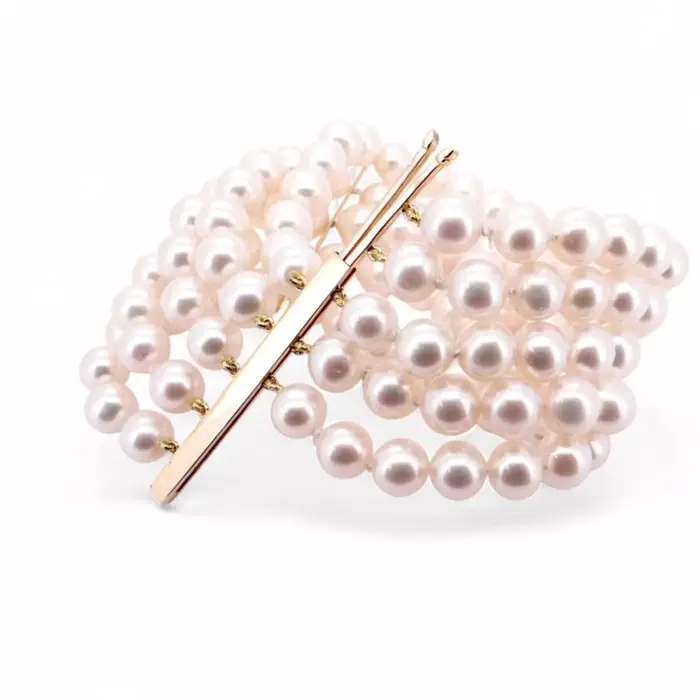
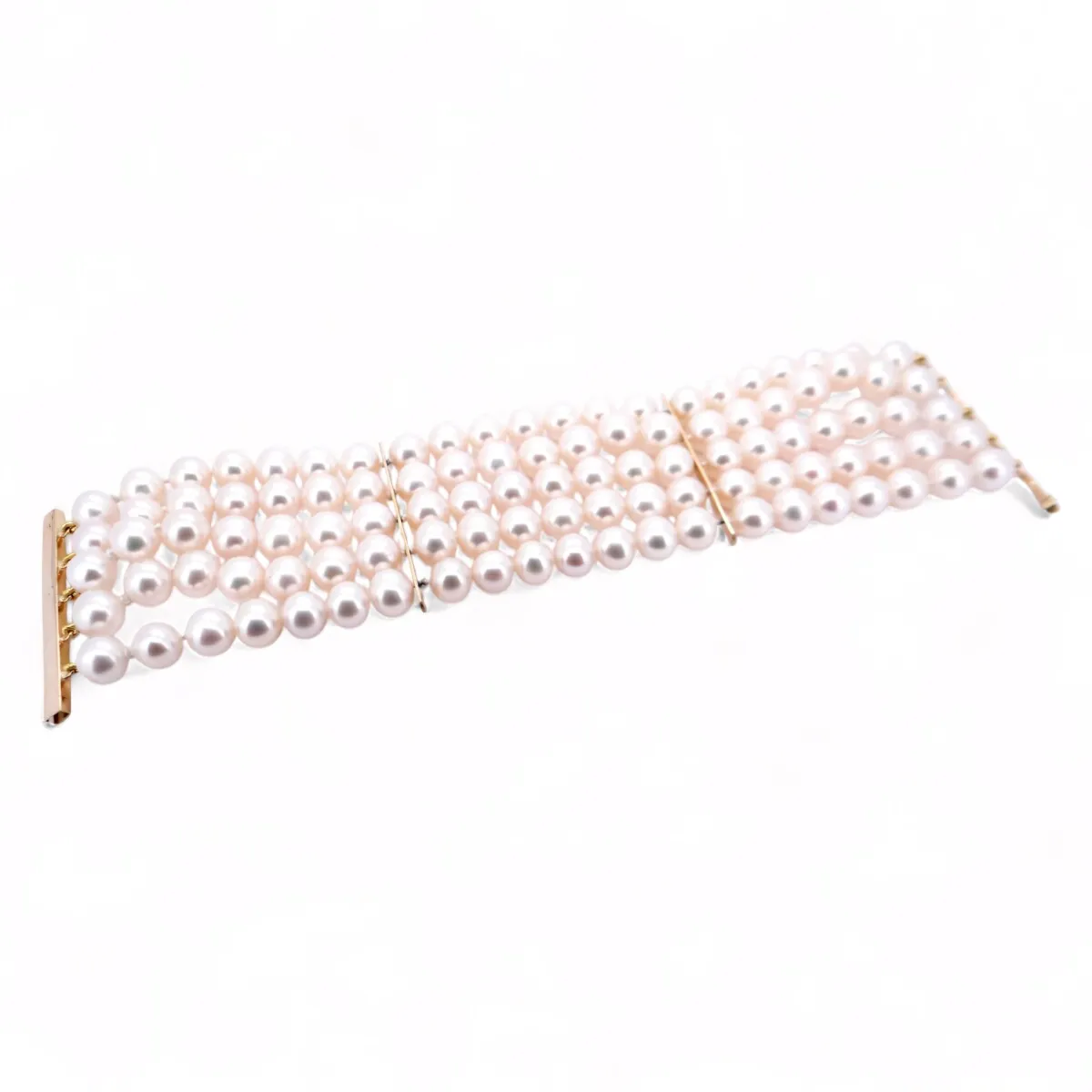
Some pieces of jewellery look simple at first glance, yet they demand hours of work that no one ever sees. This bracelet of five strands of round pearls, fastened with a gold tongue clasp designed especially for it, is one of them. I conceived, designed and made it in my workshop in Saint-Sébastien-sur-Loire, near Nantes, from the choice of each pearl to the final soldering. Let me tell you how it came to be.
A client, a milestone birthday and a bespoke cultured pearl bracelet
It all began with a visit to the workshop. A client walked in with a very clear idea: she wanted a bespoke cultured pearl bracelet, and above all not a simple single strand of the kind one sees everywhere. She imagined a generous, almost sculptural piece that would truly dress the wrist.
We took the time to talk. A milestone birthday was approaching, and she wished to mark it with a jewel she could one day entrust to her daughters. In her words, the pearl was the obvious choice: soft, luminous, feminine, with an elegance that never seeks to be loud. I listened, and I understood that we were speaking not merely of an accessory, but of a memory to be crafted.
I laid out several lots of freshwater pearls in different sizes on the bench. She rolled them in her palm and held them up to the light. The 8/9 mm diameter caught her attention: present enough to have character, measured enough never to appear ostentatious. As for the number of strands, we tried several options on her wrist. The five-strand format won her over, as it turns the bracelet into a true pearl cuff, rich and beautifully held.
8/9 mm freshwater pearls: the secret of their glow
Before turning to the metal, I must say a word about these pearls, because they are the heart of the jewel.
A cultured pearl forms inside a mollusc after a human hand has introduced a graft. Freshwater pearls, cultivated mainly in China, grow inside mussels. They have a quality I always enjoy explaining: unlike Akoya pearls or South Sea pearls, they contain no solid bead nucleus. They are made almost entirely of nacre. This is what gives them their strength and that deep, almost living lustre.
How I judge the quality of a pearl
Four criteria guide my eye: lustre, surface quality, shape and size. To these I add colour, overtone and the thickness of the nacre. So-called AAA pearls, the most sought after, offer a virtually flawless surface and remarkable roundness.
For this piece, I selected pearls of a delicate rosé white, with a mirror-like lustre, carefully matched for size. Each one was examined under the loupe: shape, colour, any blemishes, the alignment of the drill hole. This patient work is invisible in the finished jewel, and yet it determines the entire result. The 8/9 mm diameter then provides just the right volume on a multi-strand bracelet, without weighing down the wrist.
A bespoke tongue clasp in rose gold
That left the question of the clasp. I could have chosen an off-the-shelf model, but it would have betrayed the spirit of the commission. So I suggested designing and making a bespoke tongue clasp, perfectly integrated into the bracelet. She accepted without hesitation. I took out my pencils and filled page after page with sketches, until I settled on a refined, elongated, resolutely contemporary silhouette.
The principle of the tongue clasp is ingenious: a folded blade of metal slides into a box fitted with a notch. Once in place, it locks itself. It is released only by gently pressing its ends. It is one of the most secure and discreet clasps I know, and it is particularly well suited to jewellery with some weight.
I began by rolling out a sheet of 18-carat rose gold to the required thickness. The rectangular box was cut with a piercing saw, then folded and soldered to form a closed volume. The blade of the clasp was made separately, from a thinner sheet, folded in two and then fitted with a file. This is where all the subtlety lies: too supple, and the clasp would open by itself; too stiff, and it would become tiresome to handle. I returned to the file as many times as it took to find just the right tension.
On the body of the clasp, I then soldered five small rings, one for each strand. Gold spacer bars were added along the bracelet to keep the strands perfectly parallel and prevent them from tangling.
Hand-knotting a five-strand bracelet
Then comes the stringing, a stage I would entrust to no one. Each strand was threaded on braided silk, supple enough to follow the wrist, strong enough to carry the pearls. In keeping with the jeweller's tradition, a knot was tied by hand between each pearl, using a fine curved needle.
This slow gesture has two virtues. First, the pearls no longer rub against one another, which protects their nacre. Second, should the thread ever break, the bracelet will not scatter across the floor: only a single pearl would escape. For a jewel meant to last, this detail matters a great deal.
The ends of the threads were fixed to the rings of the clasp, then concealed within fine gold cups. The bracelet was checked, adjusted to the exact length of the wrist, then carefully polished so that the gold and the pearls answer one another. All of this was done on site, in my workshop, with no intermediary.
The day she put on her pearl bracelet
When my client returned, I placed the case on the bench and let her open it herself. She slipped the bracelet onto her wrist. The clasp engaged with a small, crisp click, almost imperceptible, and the five strands settled around her hand as if they had always been there. She raised her arm towards the light of the workshop. I had no need to comment: the result spoke for itself.
This bracelet is not merely beautiful. It carries an intention, that of a woman who wished to celebrate a milestone in her life and leave something to her daughters. I believe it will become a true heirloom, the kind that is handed down together with the story that goes with it. It is for moments like these that I do this work.
If you, too, dream of a jewel that reflects who you are, whether in pearls, in gold or in some other idea still taking shape, come and talk to me at my workshop in Saint-Sébastien-sur-Loire, near Nantes. We shall take the time to look, to touch, to draw. The rest will follow.