
Published on by Olivier Maupas-Sehikyan · Signet rings
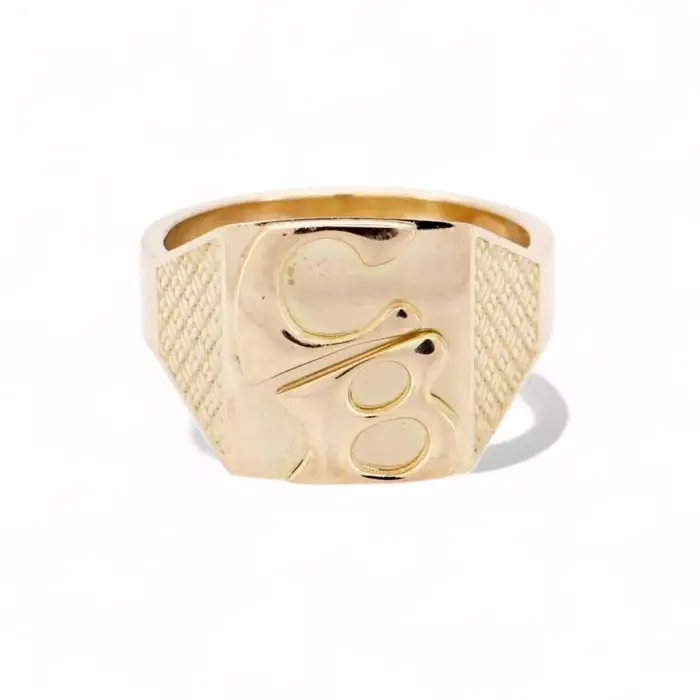
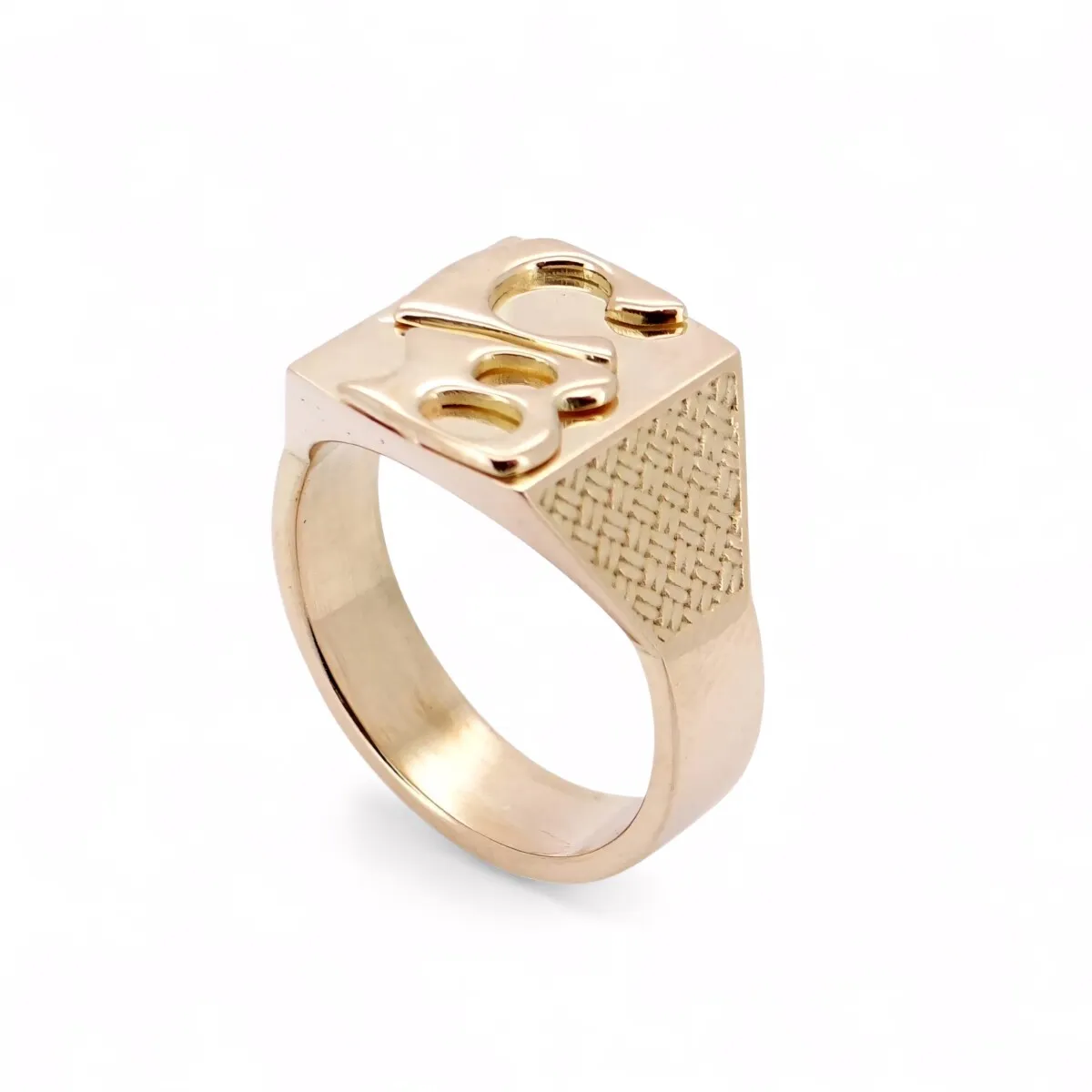
There are jewels we wear, and others that wear us. The signet ring belongs to the second family. I remember very clearly the day a young man pushed open the door of my workshop in Saint-Sébastien-sur-Loire, near Nantes. He had a very clear idea in mind: a bespoke yellow gold signet ring that would be a true reflection of him.
I want to tell this story in full. It says a great deal about what I love in my craft: listening, drawing, then working the metal until it becomes a signature.
A signet ring for his coming of age: my client's request
In the past, the signet ring served as a seal. In Antiquity, it was pressed into wax to authenticate a document, like a signature one could hold on one's finger. In the Middle Ages, it became the emblem of the nobility, engraved with the family coat of arms. Today it is worn far more widely, yet it remains the jewel of identity par excellence.
My client wished to mark his coming of age. A tradition born in the early 20th century has a young man receive his coming-of-age signet ring at 18 or 21, as a passing of the baton into adulthood. His request was precise: 18-carat yellow gold, a broad, masculine ring that he would wear for life and perhaps one day hand down to his own son.
We talked at length. About his style, his tastes, the image he wished to project. His family has no coat of arms and he had no wish to invent one. What mattered to him was his own signature. Engraving his initials seemed the obvious choice. I suggested something rarer, however: cut-out, soldered initials set onto the face, without carving into the metal.
A men's 18-carat gold signet ring: why this metal
Before touching a single sheet of gold, we talked about the metal. 18-carat yellow gold is an alloy of 75% pure gold, combined with copper and silver, which give it its warm, luminous hue. The "750" hallmark guarantees its legal fineness.
For a men's 18-carat gold signet ring, it is the traditional choice, and for good reason. Its warmth is natural, its resistance to wear is real, and it withstands decades of daily wear without flinching. My client wanted a ring that is never taken off, one that ages alongside its wearer. Yellow gold suited that perfectly.
Cut-out, soldered initials rather than engraved ones
The vast majority of signet rings on the market are engraved: a burin incises the design into the body of the metal. It is quick and effective, but visually more discreet. Cut-out, soldered initials follow an altogether different path. Each letter is made separately from a sheet of gold, then applied in relief onto the face. The method is longer and more demanding, but it brings volume and character, and the light catches on the letters.
Choosing the lettering took several trials: block letters, gothic, cursive, interlaced. We finally settled on a modern cursive, slightly stylised, which combines elegance with a contemporary feel.
In my notebook, I then drew several sketches. The chosen design features a flat, barrel-shaped face, the raised initials at the centre, and on the sides a woven guilloché pattern, reminiscent of the weave of a fabric.
Making the signet ring at the Saint-Sébastien-sur-Loire workshop
Everything was made on site, in my workshop, with no intermediary. That is how I understand the work of a jeweller: following a piece from the first line of the drawing to the last stroke of the polisher.
The face and the shank
I began by melting the 18-carat yellow gold into a clean ingot, then rolled it into a thick plate for the body of the ring. The face was cut out with a piercing saw, then filed to the dimensions agreed with my client. The shank was made separately: a round wire bent on a ring mandrel, flattened on its inner surfaces to sit comfortably on the finger. The face was then brazed onto the shank with a flame, using an 18-carat gold solder.
Next came the pattern on the sides. With a chasing tool and hammer, I traced the woven design by hand. Each line was incised at a regular rhythm, with total concentration, because the slightest error would show immediately.
The initials, the most delicate stage
I drew the letters at exact scale, then transferred the outline onto a thin sheet of 18-carat yellow gold. With the piercing saw, I patiently cut out each letter, following the curves of the drawing. The edges were filed, polished, then lightly bevelled to soften the finish.
Then came the soldering, and this is where one holds one's breath. The letters were positioned on the face with millimetre precision, held in place, then brazed with a flame. The heat had to be measured exactly so as to melt only the solder, without distorting either the letters or the face.
The polishing
The piece was then pickled, sanded, and polished with felt and cotton. The mirror finish revealed all the warmth of the yellow gold. It brought out the contrast between the gleaming face, the matt woven pattern and the luminous initials.
Presenting the signet ring
When my client slipped the ring onto his finger, he understood at once that he was wearing far more than a piece of jewellery: a signature in his own image. In those moments, I am happy to stay silent. The work is finished, and it is the signet ring that speaks.
This is why I continue to make jewellery by hand. A signet ring is not merely a gold band. It marks a stage in life, it is passed down, it tells the story of someone.
If you have a project for a signet ring, for a coming of age, for a family heirloom or simply for yourself, come and talk about it at the workshop in Saint-Sébastien-sur-Loire, near Nantes. We will take the time to imagine your next creation together.