
Published on by Olivier Maupas-Sehikyan · Bracelets
Some appointments begin with a small sound: that of a wooden box being set down on the workbench. That day, my client opened it in front of me, and I knew we were about to make something singular. In my workshop in Saint-Sébastien-sur-Loire, near Nantes, I created for her a bespoke gold and silver bracelet, born from her own jewellery. Let me tell you how.
A wooden box and the wish for a second life
Inside the box were several pieces of 18-carat gold jewellery: a worn chain, a damaged ring, a few odd earrings. Pieces gathered over the years, which she no longer wore. They had been sleeping in a drawer for far too long, and she could neither bring herself to forget them nor leave them as they were.
Her wish was clear. She wanted to transform her gold jewellery into a bracelet to wear every day, rather than a ring or a pendant. A sturdy piece, slightly sporty, that would go with all her outfits. Yet she had no wish for it to be made entirely of gold: she loves the freshness of silver and its clear light.
The idea of a two-tone bracelet came almost naturally. We talked about her tastes, the colours she wears, what she likes to see on her wrist. For a long time, mixing two metals was considered a lapse in taste. Today it is a true signature of contemporary jewellery, and the bracelet sits as comfortably alongside gold as it does alongside silver.
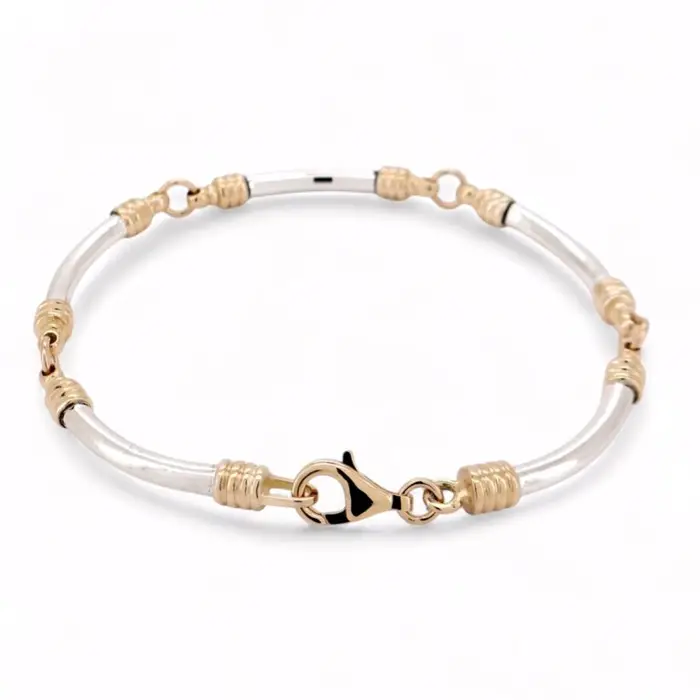
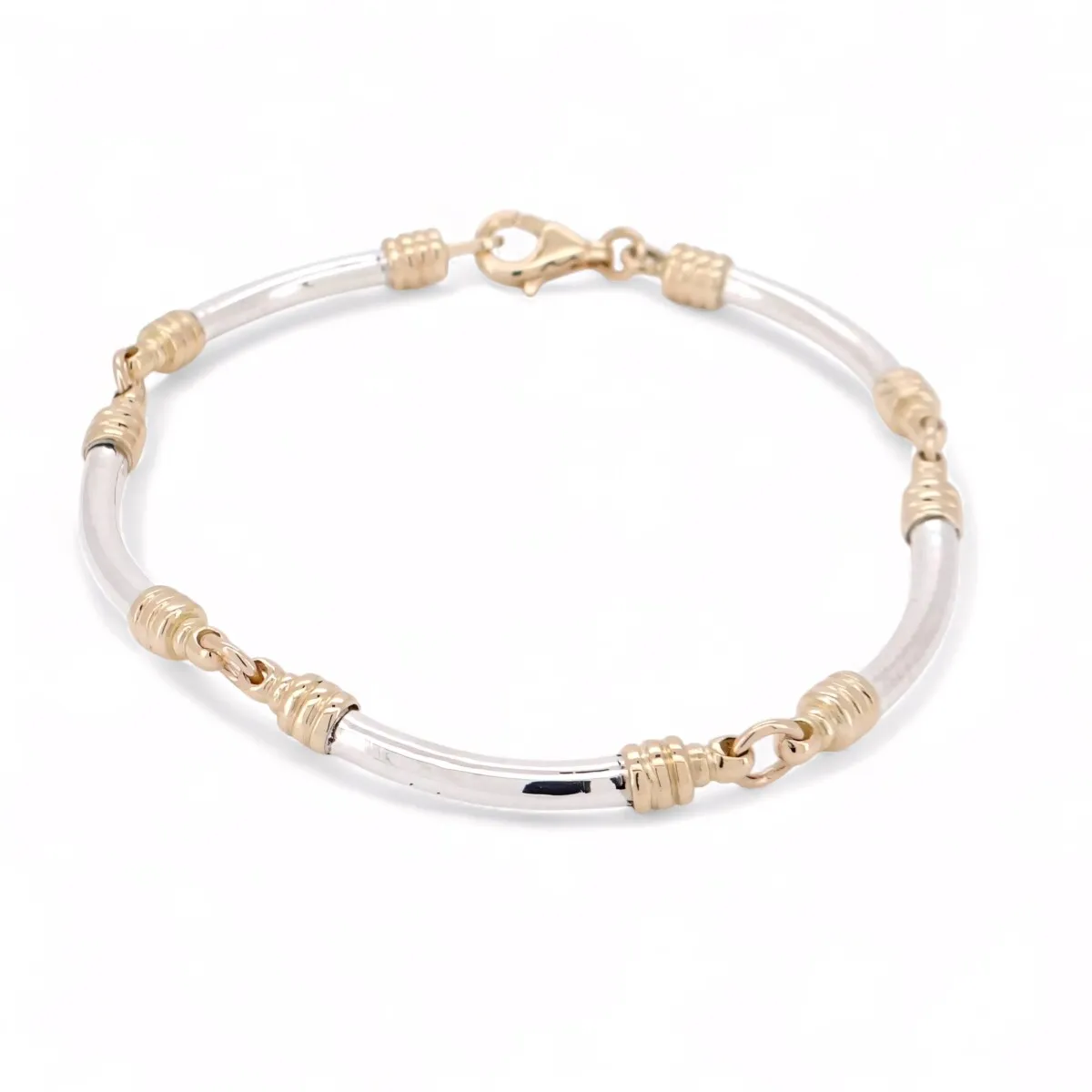
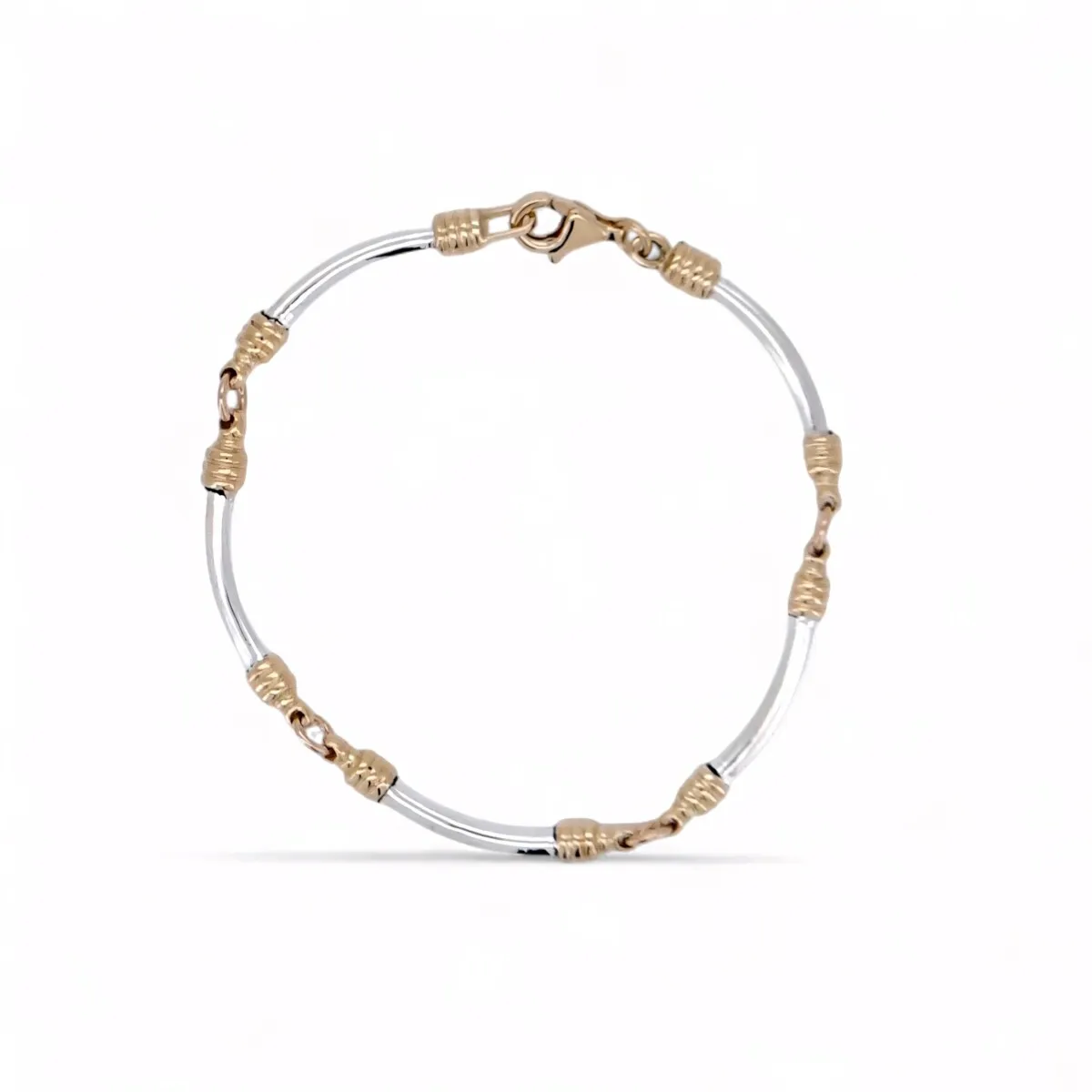
I opened my notebook and drew several sketches. The design we chose alternates 925 silver tubes with small fluted cylinders in 18-carat yellow gold, linked by fine round rings. The lobster clasp would also be in gold, to keep the whole piece in harmony. She approved the design.
18-carat gold and 925 silver: two metals in conversation
Before touching the metal, I always take the time to explain my choices. 18-carat gold is an alloy made of 75% pure gold, combined with other metals, such as copper and silver, which determine its shade. I chose a yellow gold, warm and classic. It melts at around 1,064 °C, and its resistance to wear is ideally suited to a piece worn every day.
925 silver, also known as sterling silver, contains 92.5% pure silver and 7.5% copper. It melts at around 960 °C. Its clear, almost bluish-white lustre answers the warmth of the yellow gold. As for the "925" hallmark, it guarantees the purity of the metal.
Why not choose a grey or white gold? For two reasons. First, silver allowed me to make the most of my client's precious gold. Second, it offers a genuine colour contrast: a rhodium-plated white gold, visually closer to yellow gold, would not have produced the same graphic effect.
From ingot to soldering: how it was made in the workshop
Giving the old gold a new form
The gold recovered from the old jewellery was first melted at 1,064 °C, refined, then cast into a clean ingot. I then rolled it and drew it on the draw bench to obtain the wire and tube needed for the gold elements. Watching these tired objects become fresh, luminous metal in the crucible is always a moment that moves me.
The small cylinders were turned one by one, then fine parallel grooves were cut with a needle file. This detail adds relief and catches the light. The silver tubes were cut with a piercing saw from a preformed tube, gently curved to follow the wrist, then carefully deburred.
Soldering, the most delicate stage
Joining gold and silver by soldering demands real mastery. Since silver melts at a lower temperature than gold, there is a genuine risk of melting it before the solder flows. I therefore used a low-temperature silver solder, at around 650 °C, and guided the flame with precision to heat evenly without ever exceeding the critical point.
Each silver tube was joined to a gold cylinder by a fine round ring, soldered at both ends. The chain took shape link by link, until the bracelet was complete. The 18-carat yellow gold lobster clasp was then soldered onto the end ring, and the whole piece was pickled in a diluted acid bath, which removes the oxides left by the heat.
Polishing
Finally came the polishing. The silver was polished with cotton impregnated with compound, to a mirror shine. The gold elements, meanwhile, kept their fluted texture, in order to preserve the contrast between matt and bright.
The moment of slipping the bracelet onto her wrist
When my client slipped the bracelet onto her wrist, she was won over at once. It was no longer a box of forgotten pieces, but a contemporary, elegant and hard-wearing piece of jewellery, which will now accompany her every day. Her gold had found a second existence, and I had the joy of having shaped it.
If you too keep jewellery in a drawer, or if you dream of a piece that exists nowhere else, come and talk about it at the workshop in Saint-Sébastien-sur-Loire, near Nantes. We will look at what you have together, and quietly imagine what it could become.