Published on by Olivier Maupas-Sehikyan · Rings
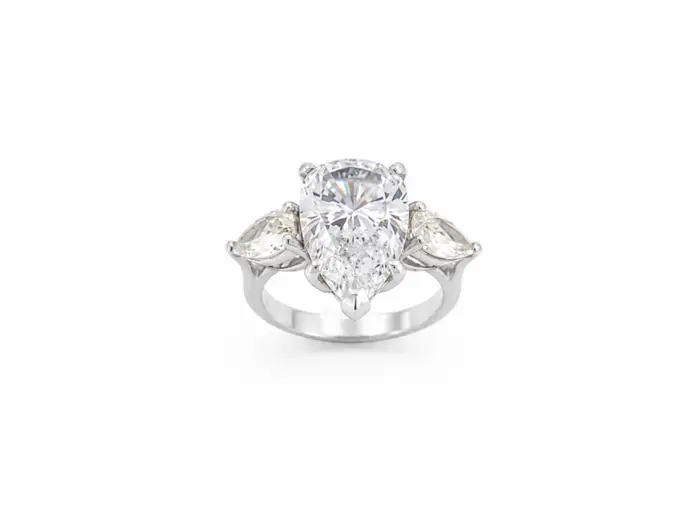
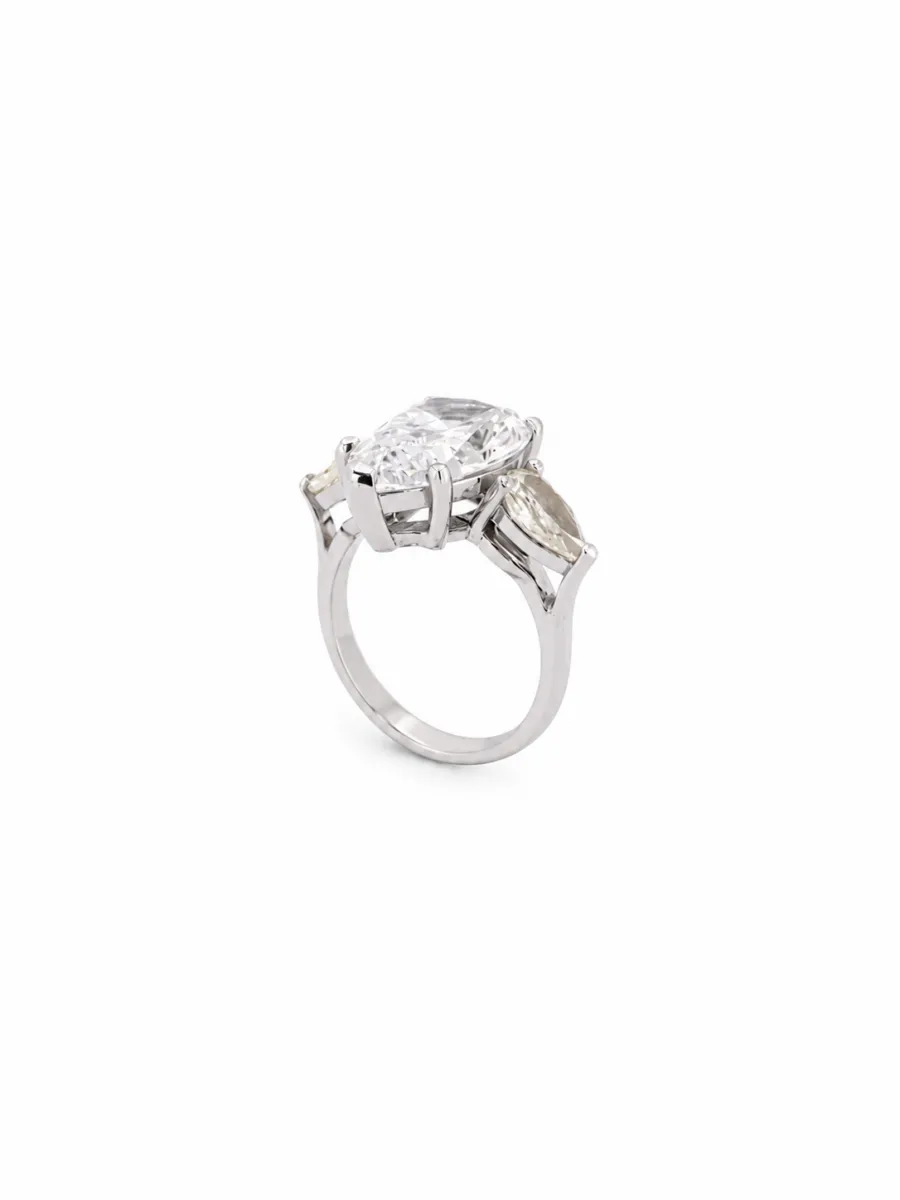
Some requests make you look up from the bench. This was one of them. One morning, a client pushed open the door of my workshop in Saint-Sébastien-sur-Loire, near Nantes, with a very clear idea: she wanted to wear a lab-grown diamond ring with a pear-cut stone of around 10 carats. Let me tell you how this piece came to life.
A client, an extraordinary stone and a moment to mark
She was not looking for just another piece of jewellery. She wanted to celebrate a major milestone in her professional life, and for that, a bespoke ring carrying a spectacular stone. It was a bold choice, and it appealed to me immediately.
We began by looking at the possibilities candidly. A natural diamond of this size represents a considerable investment, tens and sometimes hundreds of thousands of euros depending on quality. She understood the idea, but she remained open to other avenues. That is when I spoke to her about the lab-grown diamond, also known as a cultivated diamond.
I explained what it truly is: chemically, physically and optically, it is identical to a natural diamond. The same pure carbon, the same hardness of 10 on the Mohs scale, the same brilliance, the same fire. Only one thing differs: its origin. Instead of lying dormant for billions of years underground before being extracted from a mine, it is born in a laboratory in a matter of weeks.
Two arguments won her over. The price, first: a lab-grown diamond costs 20 to 40% less than a natural diamond of equivalent quality. Ethics, second: its production requires no mining. She saw it as a modern choice, in keeping with her values. I could tell from the way she smiled and nodded.
Designing a trilogy in 18-carat white gold
That left the mounting to imagine. She wanted something classic, which would showcase the central stone without ever stealing its thunder. The trilogy style, three stones in a row, almost chose itself. On either side of the central diamond, two pear-cut yellow diamonds would bring warmth and a touch of originality.
For the metal, I proposed 18-carat white gold, an alloy of 75% pure gold enriched with palladium. Understated and luminous, it acts as a setting that never distracts the eye. The shank would remain slender and pared back, with a final rhodium plating to achieve that crisp, mirror-like white.
I then produced a 3D model so that she could see the result before any fabrication began. She examined every detail on screen: the proportions, the spacing of the stones, the fineness of the band. Then she approved the project.
Stones chosen one by one
Before moving on to the bench, I must say a word about these gemstones. A lab-grown diamond is produced by one of two methods. The first, HPHT (high pressure, high temperature), reproduces the conditions of the Earth's mantle: a pressure of 5 to 6 GPa and around 2,000 °C. The second, CVD, deposits carbon atoms layer by layer in a plasma chamber over two to six weeks. The result is often purer than the average natural diamond, with fewer inclusions.
For this ring, I selected a 10-carat pear-cut lab-grown diamond, accompanied by a certificate issued by an independent laboratory. I checked every parameter: colour D, which means perfectly colourless, VVS clarity, with inclusions barely visible under a loupe, and an excellent cut. The stone was magnificent.
The two yellow diamonds, on the other hand, are natural. Their hue comes from the presence of nitrogen in the crystal structure. Their hardness and brilliance match those of a white diamond, but their sunlit reflections make the contrast with the purity of the central stone sing.
Work at the bench: a ring shaped by hand
The bezel, that is, the metal setting that holds the stones, and the shank were made entirely by hand, alongside the 3D model. I began by melting the white gold into an ingot, heated to around 1,064 °C. The metal was then rolled into a sheet, and drawn on the draw bench to obtain the sections required.
I cut the band with a piercing saw, then bent it around the ring mandrel so that it would fit my client's finger exactly. It was soldered into a ring, comfortable and slender, to leave all the space to the three stones.
The central setting, the real challenge
With a 10-carat stone, the structure had to be robust enough to hold it securely, while remaining open enough to let in as much light as possible. I shaped six claws from thick wire, fitted one by one with a needle file. Beneath the stone, a basket of crossed wires provides solid support without weighing down the silhouette. The two side settings follow the same principle on a smaller scale, with claws adapted to the exact geometry of the yellow pear cuts.
Soldering, setting and polishing
The assembly was soldered with a flame, in an order planned long in advance, and every joint was checked under a x10 loupe. Then comes the moment I like best: the setting. I placed the lab-grown diamond in its mounting, then closed its six claws over it with my pusher. The two yellow diamonds took their places in turn. Finally, the ring was sanded, polished and rhodium plated to perfect its lustre.
The day she slipped it onto her finger
When my client came back to the workshop, I presented the ring without a word. She took it, studied it at length, then slipped it onto her finger. Her emotion spoke for her. I added nothing: some silences are worth more than any words.
If you, too, dream of a lab-grown diamond ring, a unique piece designed for a milestone in your life, you are welcome to visit my workshop in Saint-Sébastien-sur-Loire, near Nantes. We will take the time to talk it through, simply, and to imagine together what your jewel could be.