
Published on by Olivier Maupas-Sehikyan · Rings
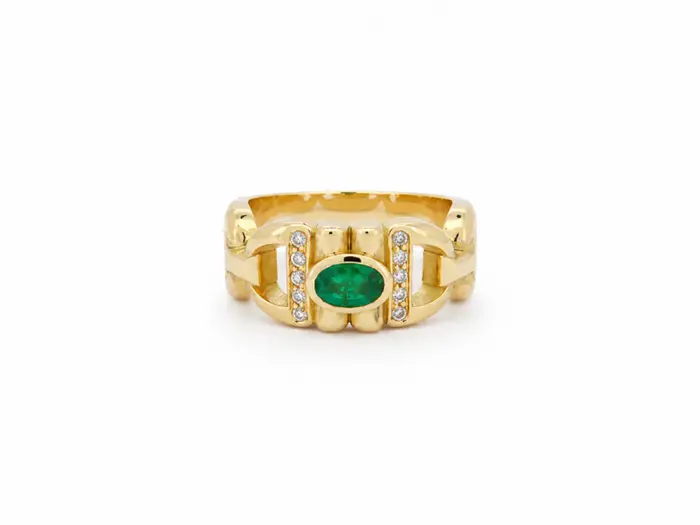
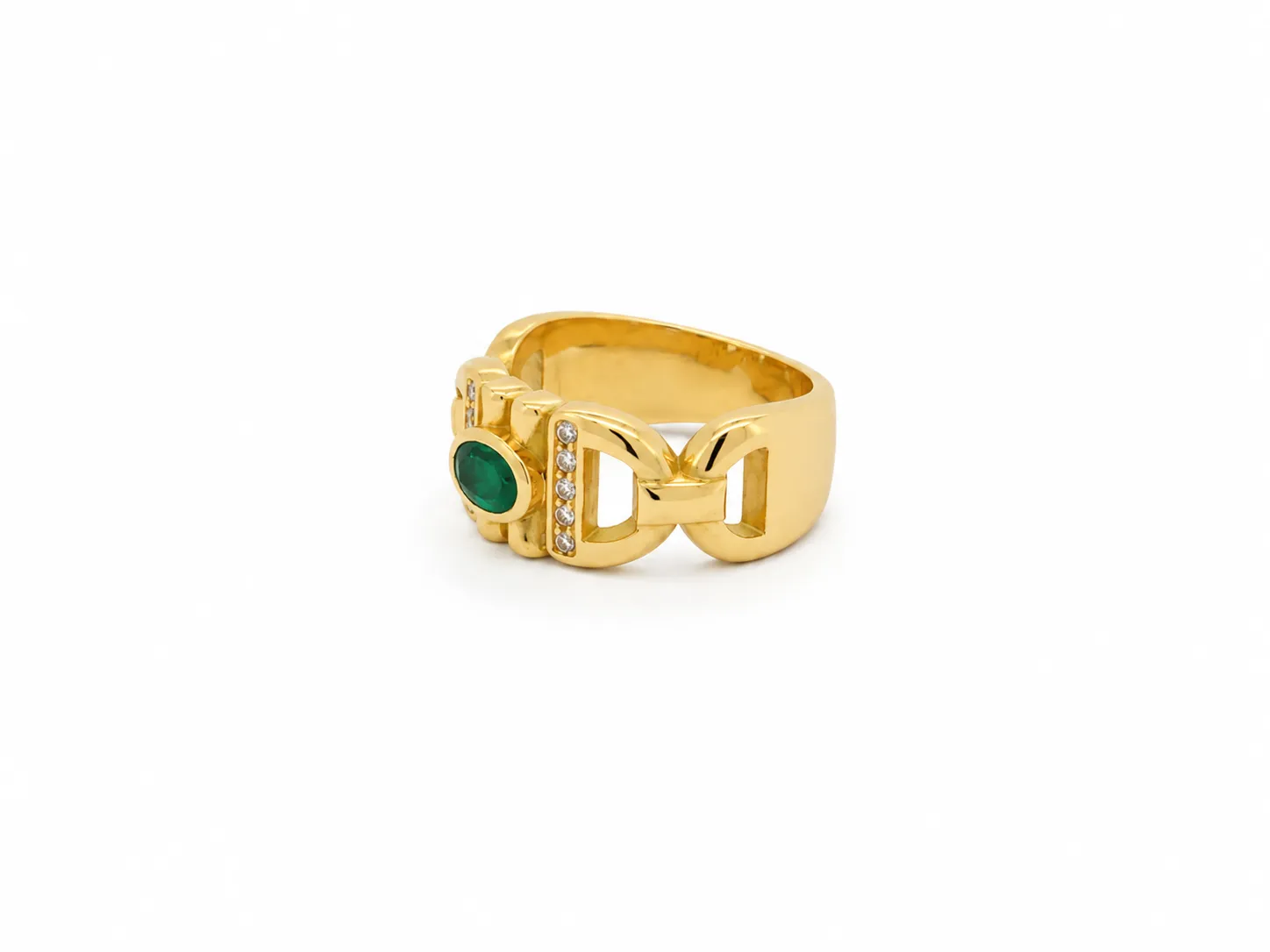
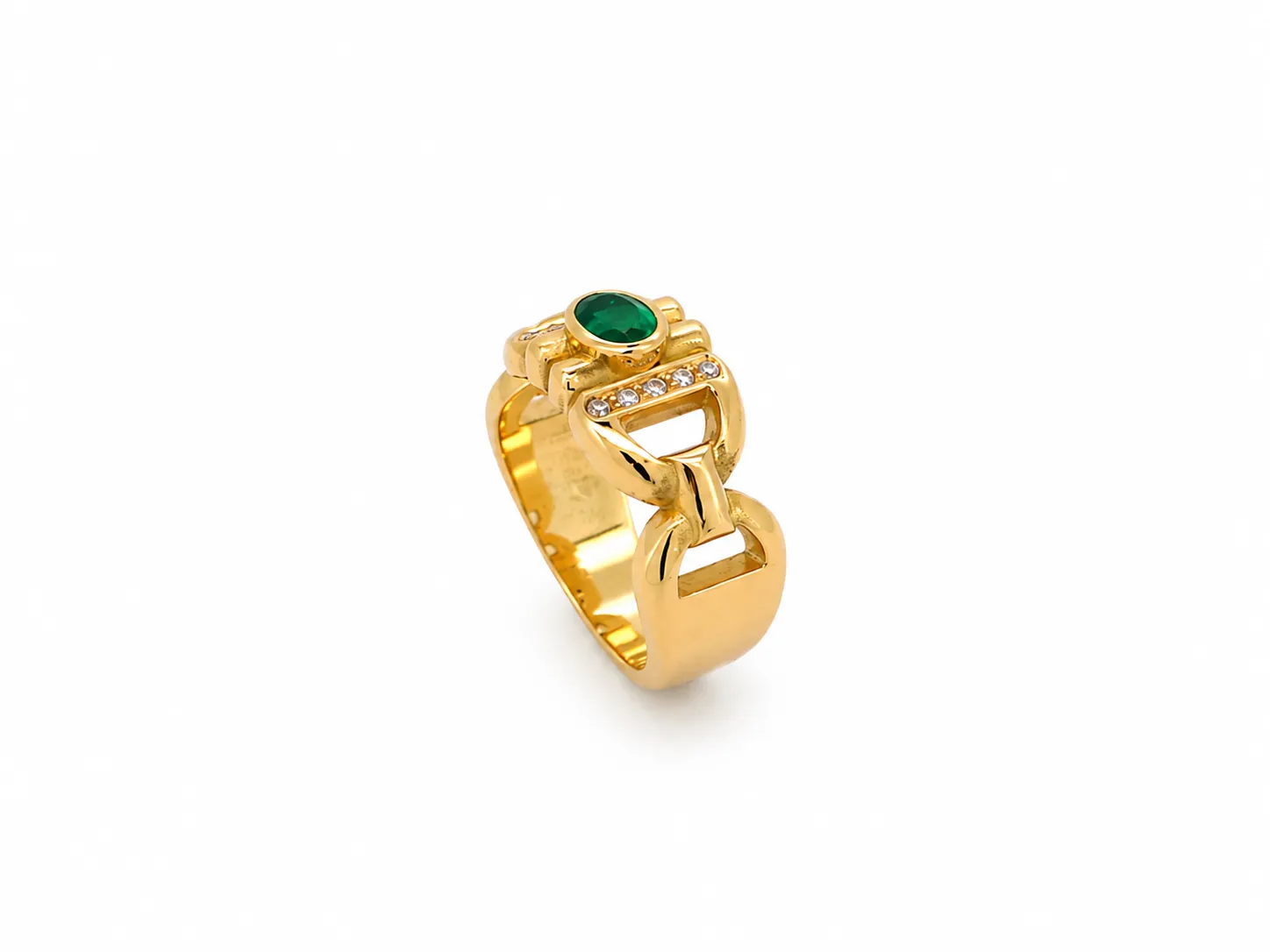
Some commissions begin with a silence. The silence of a man who places a small velvet box in front of me, without a word, the way one sets down something both precious and fragile. That day, I understood that I was not simply going to make a bespoke yellow gold emerald ring in Nantes. I was being asked to preserve a piece of history.
A velvet box and a ring worn since the wedding
My client came into my workshop in Saint-Sébastien-sur-Loire with great discretion. He opened the box. Inside lay an 18-carat yellow gold ring with an elegant geometric design, an emerald at the centre and small diamonds on either side. It had real presence, this ring. But the emerald was cracked, the gold bore the marks of time, and the whole piece told of decades of daily wear.
His wife has worn it since their wedding. She has never taken it off, neither for the great moments of their life together nor for the ordinary days. Today, the wear is too advanced: the stone can no longer be held securely. I explained to him that repairing the original would take weeks, with no lasting guarantee. So he shared his idea with me: to reproduce the ring exactly, with a new emerald. To give his wife a brand-new piece of jewellery, yet faithful to the one she loves so dearly. It would be a surprise, for an anniversary to come.
I took the ring between my fingers with a certain gravity. One does not simply copy a piece like this: one begins by understanding it.
Observing, measuring, choosing an oval emerald
We studied the ring together, detail by detail. The dimensions of the body, the geometric motifs on the sides, the position of the central mount, the arrangement of the small diamonds, the thickness of the shank: everything was recorded. Every proportion had to be respected to a tenth of a millimetre, because the slightest drift would have betrayed the original. In a jewellery reproduction, it is this patience that decides everything.
That left the central stone. I showed him several oval emeralds, calibrated to the exact dimensions of the old one. We chose one of a deep green, slightly bluish, worthy of the finest Colombian stones. He looked at it for a long time, in silence, then nodded.
I then made a wax model from the original ring. Every volume, every curve, every hollow was reproduced with millimetric precision. Once the wax was approved, the project could truly begin.
The emerald, a stone of kings and a fragile one
Before starting fabrication, I always take the time to talk about the stone. The emerald belongs to the very exclusive circle of the four precious stones, alongside the diamond, the sapphire and the ruby. This rare variety of beryl owes its green colour to the chromium and vanadium lodged in its crystal structure. Beryllium forms in the earth's crust, while chromium comes from the deep mantle: their meeting, made possible by intense tectonic movements, explains why the emerald is so rare.
Colombia supplies roughly 50% of world production, thanks to the mines of Muzo, Chivor and Coscuez. The Incas were already wearing emeralds in their ceremonies more than 500 years ago. They later adorned the crowns of Europe and have always symbolised hope, balance and serenity.
Its hardness, between 7.5 and 8 on the Mohs scale, is good, and yet the emerald remains fragile. Its internal inclusions, poetically called "gardens", make it sensitive to knocks. They also prove its authenticity: every stone has its own, as unique as a fingerprint. This fragility explained the crack in the old emerald after so many years of wear. For the new one, a closed setting, which wraps the stone in a band of metal, was essential to protect it better.
As for 18-carat yellow gold, an alloy of 75% pure gold, copper and silver, it makes a marvellous dialogue with this deep green. This classic pairing crosses centuries and fashions without showing a single wrinkle.
From wax to gold: lost-wax casting and setting
Everything was done on site, in my workshop, without intermediaries. For the lost-wax casting, I attached the model to a sprue, then placed the whole thing in a cylinder filled with refractory plaster. Once the plaster had hardened, I heated the cylinder: the wax ran out and left a perfect cavity. The 18-carat yellow gold, melted at 1,064 °C, was then cast under pressure. The metal followed every detail with a fidelity that still moves me.
Finishing the ring by hand
The raw ring was removed from its mould, cleaned with a brush, then filed by hand. I took particular care over the geometric motifs on the sides, those interplays of lines and voids that give the piece all its character. Every line was reworked to recover the finesse of the original.
The central mount was shaped as a closed setting: a fine band of gold, bent to the exact perimeter of the gem, then soldered. This type of mount is particularly well suited to the emerald, as it shows the stone to advantage while protecting it from side impacts. The positions of the small diamonds, cut with a conical burr, follow the original arrangement: two vertical lines on either side of the stone.
The moment of setting
Then comes the moment I always approach holding my breath. The oval emerald was delicately seated in its closed setting. I folded the gold band over the girdle with my bezel pusher, using very gentle pressure: any abruptness could have cracked the stone. The small diamonds were then grain-set, with the graver and the beading tool. This emerald and diamond ring was at last taking its final form.
All that remained was the polishing. Sanded, filed, then polished with felt and cotton, the ring revealed the full brilliance of the yellow gold and the deep green of its new emerald.
A gift of memory
When my client came back to collect the ring, he turned it for a long time under the light, comparing it in his mind with the one he knew by heart. Then he placed it back in the velvet box. He left with far more than a piece of jewellery: a gift of memory for his wife, who will find on her finger the ring of a lifetime, and a new stone for the decades to come.
I was not there for the surprise, and that is just as it should be. But I like to imagine that moment.
If you own a damaged family jewel that you would like to repair or reproduce, come and talk to me at the workshop in Saint-Sébastien-sur-Loire, near Nantes. We will look at it together, without haste, and see what is possible.