
Published on by Olivier Maupas-Sehikyan · Rings
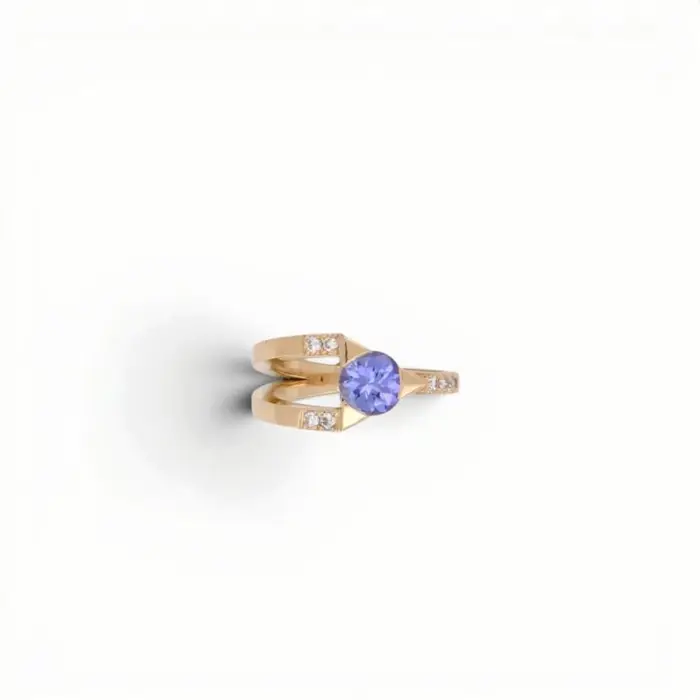
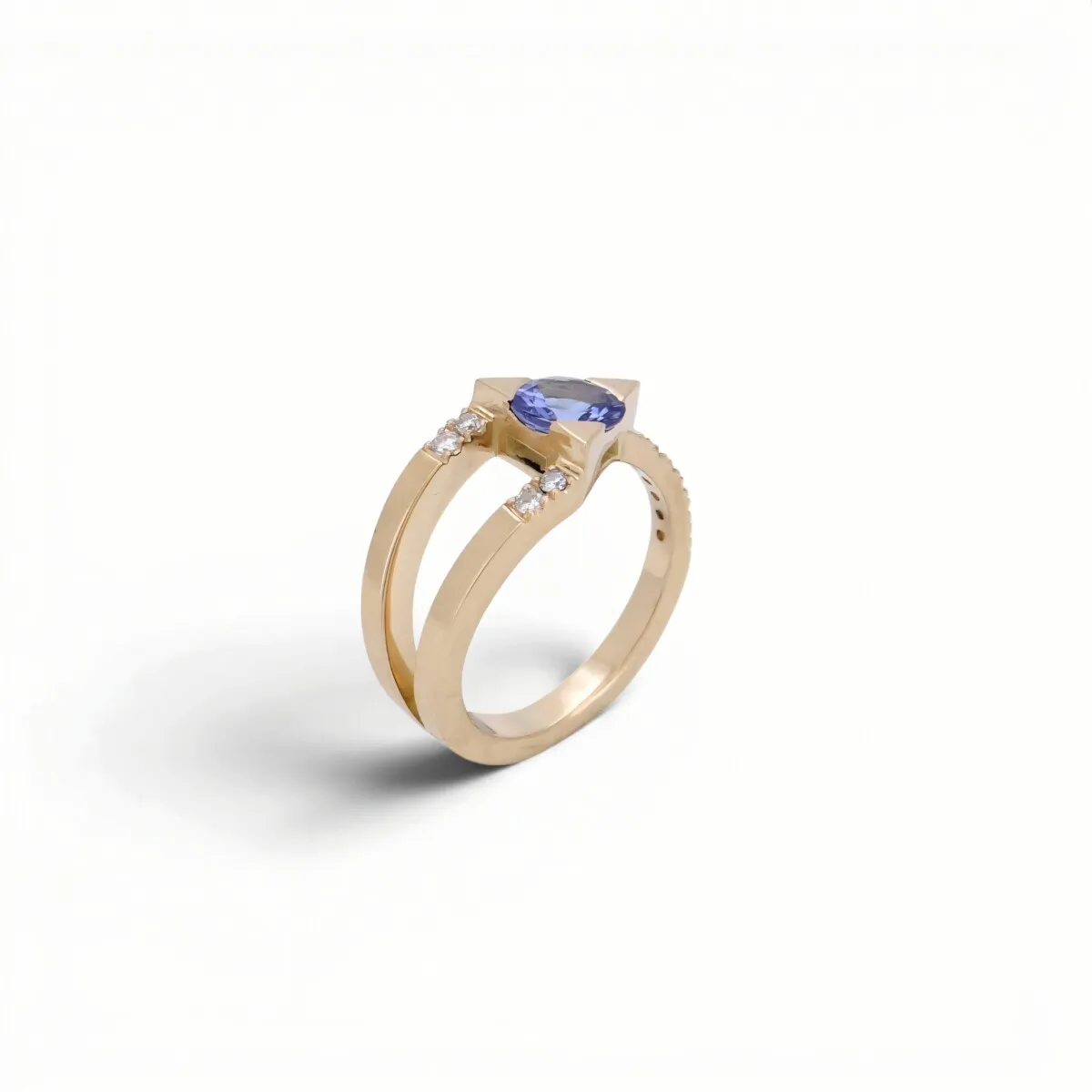
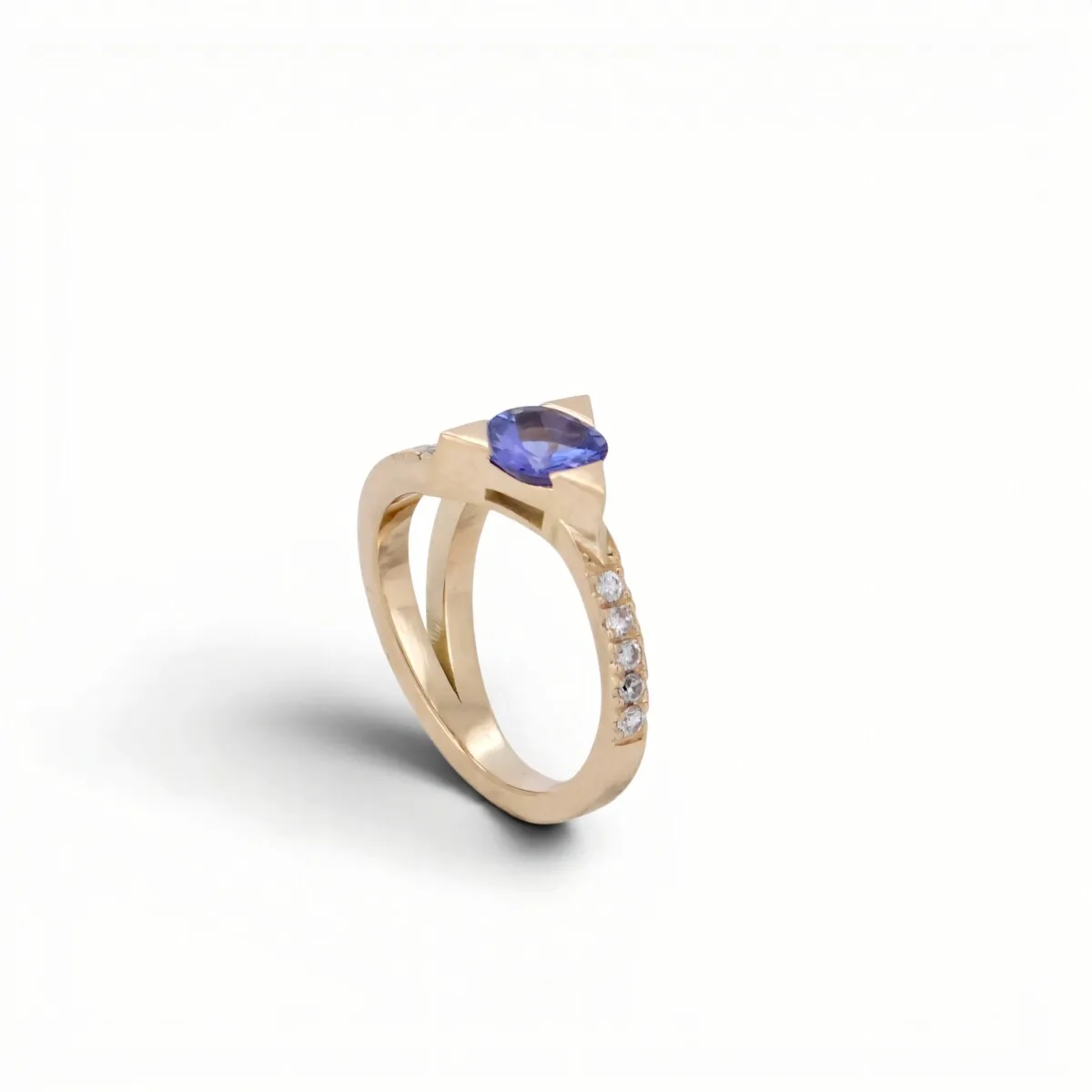
Some projects make me smile from the very first conversation, because I can sense they will be out of the ordinary. This was one of them. In my workshop in Saint-Sébastien-sur-Loire, near Nantes, I created a bespoke yellow gold tanzanite ring from a client's old jewellery, with a stone I offered her from my own stock. Let me tell you how it all came about.
A leather box and the wish for a sculptural ring
It all began one afternoon, when my client pushed open the workshop door, a leather box held tightly against her. She opened it in front of me with a certain reserve. Inside: two outdated yellow gold rings, a broken chain and a few small diamonds kept over the years. No one wore these pieces any more, yet she could not bring herself to part with them.
Then she explained why she had come. She had just completed a career change, a new life was beginning, and she wanted to mark this turning point. Not with a discreet piece of jewellery, not with anything demure. She was looking for a sculptural ring, one that could declare, at a single glance, the woman she had become.
We talked at length about her tastes. She is passionate about contemporary architecture, clean lines and graphic volumes. What she wanted from a ring was structure, boldness and character. That suited me perfectly: contemporary jewellery in 2026 is moving precisely towards these statement pieces, which become the centre of gravity of an outfit.
Choosing tanzanite: an unexpected contrast
The centre stone remained to be chosen. My client was hesitant. She wanted a gemstone that would surprise her, not an obvious choice. I went to fetch a round tanzanite from my personal collection, in deep blue-violet shades. She was won over immediately. Placed beside the yellow gold, the stone created a striking contrast, far from the usual pairings, and the project was approved on the spot.
This gemstone has a story I love to tell. A Maasai herdsman discovered it in 1967 at the foot of Mount Kilimanjaro, and the house of Tiffany & Co. gave it its trade name in 1968, in homage to Tanzania. It is found only in a tiny area of about 20 km², in the north of the country. Some experts even believe the deposit could be exhausted within a generation. To celebrate a defining moment in a life, that rarity takes on real meaning.
Tanzanite also displays trichroism: depending on the angle and the light, it reveals blue, violet and sometimes indigo. It quite literally shifts before your eyes. On the other hand, with a hardness of 6.5 on the Mohs scale, it is vulnerable to knocks. I therefore knew its setting would have to protect it above all, and a bezel setting was the obvious choice: a fine band of metal encloses the stone all the way round.
As for the 18-carat yellow gold, an alloy of 75% pure gold with copper and silver, it brings the warmth that answers the blue-violet of the gemstone. Yellow against violet: two complementary colours that strengthen one another.
From sketch to workbench: transforming old jewellery
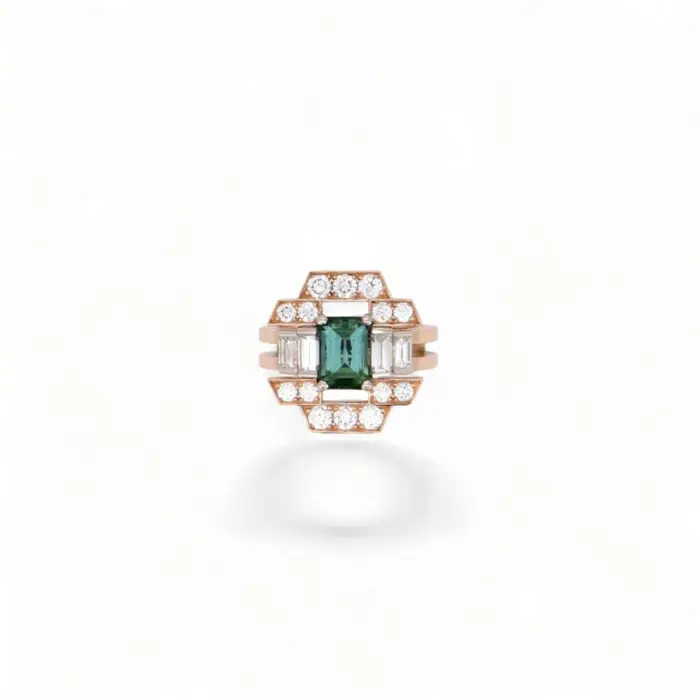
I took out my notebook and drew several sketches. The design we chose places the tanzanite at the centre, bezel-set, between two parallel bands slightly offset from one another, forming an open ring body. At each end, a geometric pavé of diamonds punctuates the whole.
This transformation of old jewellery began with melting. I melted down the 18-carat yellow gold of the two old rings and the chain, then refined it and cast it into an ingot. The ingot was then rolled into a sheet and drawn down on the draw bench to give the sections I needed. Seeing this family gold reborn in a new form is always a special moment at the bench.
Two bands, one balance
The open ring body demanded great attention. Unlike a solid band, it is made of two bands shaped separately from the same sheet, to the thickness required. Each was cut out with a piercing saw, then curved to follow the shape of the finger. I then joined them asymmetrically, one slightly set back from the other, and soldered them with precision. It is this offset that gives the ring its architectural character.
Setting the tanzanite and the diamonds
At the centre, I built the mount from a fine strip of gold, shaped with pliers to the exact diameter of the stone. At the ends, the seats for the diamonds were cut with a conical burr, with no margin for error, because in such crisp geometry every stone must sit in its exact place. The small diamonds recovered from the old jewellery had been sorted under a x10 loupe, by clarity, colour and size.
Then came the most delicate moment. The tanzanite was placed in its bezel, and the gold band was folded over the stone with a pusher, using gentle, progressive pressure. A sudden movement could have cracked it, so I rushed nothing. The diamonds were then fixed in grain setting, using a graver and a beading tool. Finally, the ring was sanded, filed, then polished with felt and cotton, until the yellow gold regained all its light against the blue-violet of the stone.
Handing over the ring: a smile that says it all
When my client returned, I presented the ring without a word. She took it, studied it in the light, turning her hand, then slipped it on her finger. Her smile told me everything. It was no longer a mere accessory: it was the visual signature of her new life, shaped from the gold and diamonds of her past.
This is what I love about my work as a jeweller in Saint-Sébastien-sur-Loire: transforming what lay sleeping in a box into a piece that tells something new. If you too are keeping jewellery that no longer suits you, or if a particular stone makes you dream, come and talk it over at the workshop. We will take the time to discuss it, simply, over a notebook and a few sketches.